
Caltrans outlines TIRCP Cycle 8 changes, adds CSIS metrics and estimates $900 million baseline
Get AI-powered insights, summaries, and transcripts
Subscribe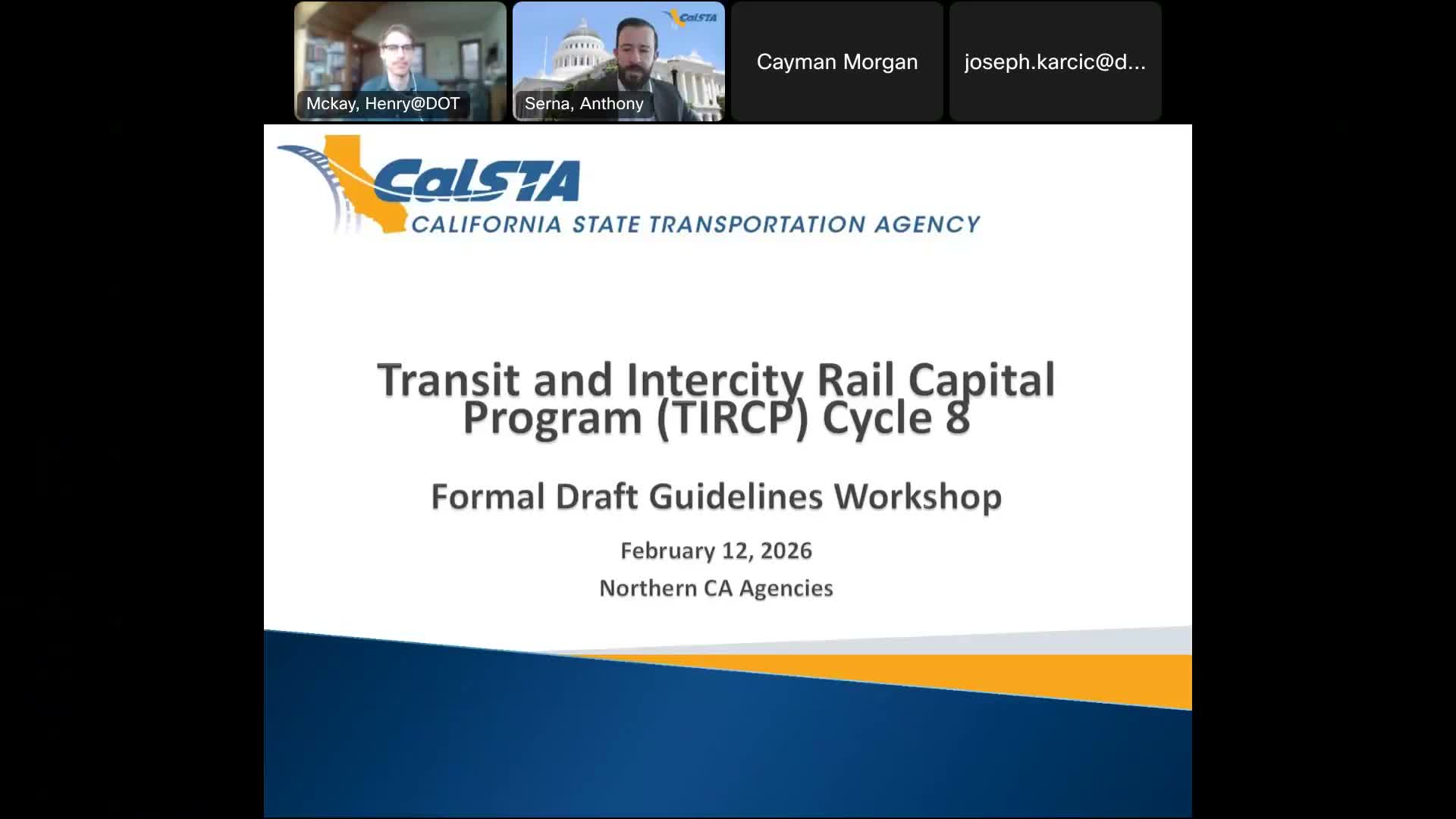
Summary
Caltrans staff detailed Cycle 8 updates to the Transit and Intercity Rail Capital Program, including the addition of Caltrans’ CSIS/CAPTI alignment metrics, revised CARB guidance and an estimated $900 million funding baseline; staff also clarified reimbursement rules and eligibility in extended Q&A.
Caltrans staff on the agency's TIRCP team presented key changes to the Transit and Intercity Rail Capital Program (TIRCP) Cycle 8, including the formal integration of the Caltrans System Investment Strategy (CSIS) as a secondary evaluation criterion, an expected funding baseline of about $900 million, and updated guidance from the California Air Resources Board (CARB).
Anthony (Caltrans staff) said the state’s cap-and-invest framework (formerly cap-and-trade) has been reauthorized and extended beyond 2045 and that the program’s continuous appropriation is now capped at "up to $400,000,000 per year" in statute, assuming about $4.2 billion in auction proceeds statewide. He added, "we are assuming an estimate of at least 900,000,000 for the cycle 8 of the program," but cautioned the number could change before the final call for projects.
Why it matters: CSIS adds a standardized, data-driven layer to project prioritization. Henry (Caltrans staff) described CSIS as a three-part framework—program fit (eligibility), quantitative CAPTI alignment metrics and other considerations such as delivery risk and leveraged funds—that will be used to assess how proposed rail and transit projects align with the Climate Action Plan for Transportation Infrastructure (CAPTI). Caltrans staff will score quantitative metrics on applicants’ behalf using data submitted in a structured intake form.
Major changes and guidance
- CSIS and CAPTI metrics: Henry said CSIS includes 11 CAPTI alignment metrics (nine quantitative, two qualitative). Quantitative metrics listed by staff include safety (including vehicle miles traveled reductions and grade separations), access to destinations, DAC access and traffic impacts, passenger mode shift, land-use measures tied to high-quality transit areas, freight sustainability, and ZEV infrastructure and purchases. Qualitative metrics include public engagement and climate adaptation/resiliency. Caltrans will standardize scoring and provide a detailed memo with the call for projects.
- Funding assumptions: Staff repeatedly cited an expected funding baseline of roughly $900 million for Cycle 8, while noting statutory language establishes a ceiling of up to $400 million per year from cap-and-invest continuous appropriations (given the stated auction revenue assumptions).
- CARB tools and methodology: Anthony described a new CARB resource portal housing quantification methodologies and calculator tools; Caltrans plans to link the CARB calculator and resource pages in the guidelines and call for projects. Final updates to carbon intensity and passenger auto GHG factors were described as posted in early 2026.
- Workforce and reporting: The CARB guidance now emphasizes recommended job-quality standards (consistent with state expectations about public-fund-supported jobs). CARB will calculate job co-benefits at the program level; applicants no longer must submit a separate jobs-modeling tool. Reporting timing was shifted earlier in the year to avoid holiday impacts.
Eligibility, reimbursements and common applicant questions
During an extended Q&A, staff clarified several practical points raised by prospective applicants:
- Previously funded projects: Anthony said TIRCP generally does not provide additional funds for the same scope on projects that already received awards. Applicants can request more funding only if they expand the project scope and document new, additional benefits; the 2023 infusion of general fund dollars was described as a one-time exception.
- Reimbursement process and timing: Anthony stressed TIRCP is a reimbursement-based grant program. Caltrans works with the California Transportation Commission (CTC) to secure allocations; projects can submit reimbursement requests only after the CTC approves an allocation. As a result, work or contracts awarded before a CTC allocation are not eligible for reimbursement.
- Use of funds and phases: Staff said the program can fund all phases tied to construction (including design and environmental work) when construction is part of the scope. A project’s schedule should be aligned with CTC processes to determine when allocations and reimbursements occur.
- TOD, housing and parking-conversion projects: Anthony said the program has funded transit-oriented development (TOD) in the past but will fund housing only when there is a clear, documented nexus to transit and demonstrable ridership benefits. There is no fixed maximum proportion of awards for TOD; eligibility is project-specific.
- Vehicle electrification, hydrogen and other technologies: Staff confirmed electrification and hydrogen projects are eligible and that ZEV infrastructure and ZEV vehicle purchases are metrics in CSIS. However, TIRCP typically requires that equipment purchases be tied to service expansions or other actions that produce measurable ridership or integration benefits rather than one-for-one replacements.
- Admin and construction management costs: Applicants may request admin costs (labor, supplies, training) and construction management costs if clearly documented, though high administrative overhead requests could affect competitiveness.
Key deadlines and next steps
Staff gave these target milestones: release of final guidelines and the call for projects (target Feb. 20), optional virtual consultations March 2–13, application due date May 14, and award announcements expected by Sept. 18 (dates subject to change). Caltrans will publish the presentation and recording on its website and encouraged applicants to sign up for one-on-one consultation meetings and to submit comments to tircpcomments@dot.ca.gov before the public comment period closes.
Speakers and sources
Quoted and attributed material in this article comes from Caltrans presenters Anthony, Henry, Cayman and Joseph (Caltrans staff) and from named attendees who raised questions during the Q&A (for example, Justin, Joe, Christina, Steven, Mary Lou). CARB, CAPTI and the California Transportation Commission were referenced repeatedly as authorities or sources of methodology and approval processes.
What’s next: Caltrans will publish a detailed CSIS memo and the final call for projects; applicants should watch Caltrans and CARB web resources for the intake form and metric documentation and should schedule optional consultations to discuss their proposals.