Get Full Government Meeting Transcripts, Videos, & Alerts Forever!
Get email alerts on the Dataseam Funding topic
No spam. Unsubscribe anytime.
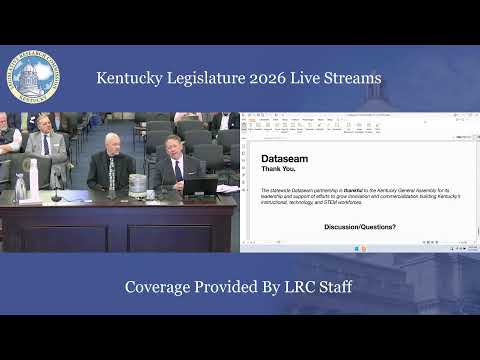
Kentucky budget subcommittee hears audit concerns, funding defense for DataSeam program
Summary
Advocates urged the General Assembly to suspend DataSeam funding and order a special audit, citing an OPA examination that flagged high administrative overhead and sole‑source contracting; DataSeam leaders told lawmakers the program expanded workstations, apprenticeships and leveraged federal research dollars, and asked for continued support.
At the House Budget Review Subcommittee’s fifth meeting, outside advocates urged lawmakers to suspend state funding for DataSeam and direct a special examination by the Auditor of Public Accounts, arguing the program relied on noncompetitive contracts and spent a substantial share of its state dollars on overhead.
Andrew McNeil, president of the Kentucky Forum for Rights, Economics, and Education (Kentucky Free), said an Office of Policy and Audit (OPA) examination found that from 2007 through 2020 the state provided roughly $27 million to DataSeam and that about $8 million — roughly 30 percent — went to personnel and administrative overhead. McNeil said the program’s recurring line‑item appropriations and memoranda of agreement have been treated as de facto earmarks, undercutting competitive bidding. "DataSeam funding should be suspended this biennium," he told the subcommittee, and he recommended that the legislature require DataSeam to reimburse the auditor’s office for the cost of a new special examination.
DataSeam’s chief executive, Brian Gupton, responded with program metrics and examples of district partnerships. Gupton said the program began in the early 2000s as part of a research infrastructure and that the current $3.5 million appropriation was expected to yield just over 2,300 K‑12 workstations by the end of the fiscal year, producing about $364,000 in additional value through purchasing efficiencies. He told lawmakers DataSeam has supported a Department of Labor–approved registered apprenticeship in information technology for high school students, helped secure competitive Appalachian Regional Commission grants for partner universities, and facilitated what he described as $80 million in federal research funding and a $200 million economic impact tied to the program.
Gupton acknowledged that participating districts commit local funds for professional development and technology staffing; he described the district investment as "about 18¢ on the dollar" relative to the value produced by the workstations and training. He said the workstations are earned by districts through local investment in staff training and apprenticeship participation.
Lawmakers pressed each side on specifics. A presenter cited OPA language stating some former participating districts reported negative experiences and perceived threats that machines would be removed if officials pushed back. DataSeam representatives said many districts value the program and that participating schools have used the workstations for classroom curriculum and for research partnerships with institutions including the University of Louisville and Morehead State University.
Because the subcommittee did not have a quorum at the start of the meeting, members did not take formal votes on funding or motions. The meeting record shows presenters on both sides urged additional oversight and clearer procurement language; no formal budget action was recorded at this session.
The subcommittee opened the floor to questions and requested documentation: one lawmaker asked for breakdowns showing how appropriated dollars are spent. The meeting proceeded to additional agenda items and concluded with a motion for adjournment; no roll‑call votes were recorded earlier in the session.
What happens next: presenters asked the legislature to consider directing a special audit and clarifying competitive‑bidding requirements in budget language; DataSeam asked lawmakers to weigh program outcomes, apprenticeships and research leverage when evaluating appropriations.