Get Full Government Meeting Transcripts, Videos, & Alerts Forever!
Get email alerts on the Privacy ALPR topic
No spam. Unsubscribe anytime.
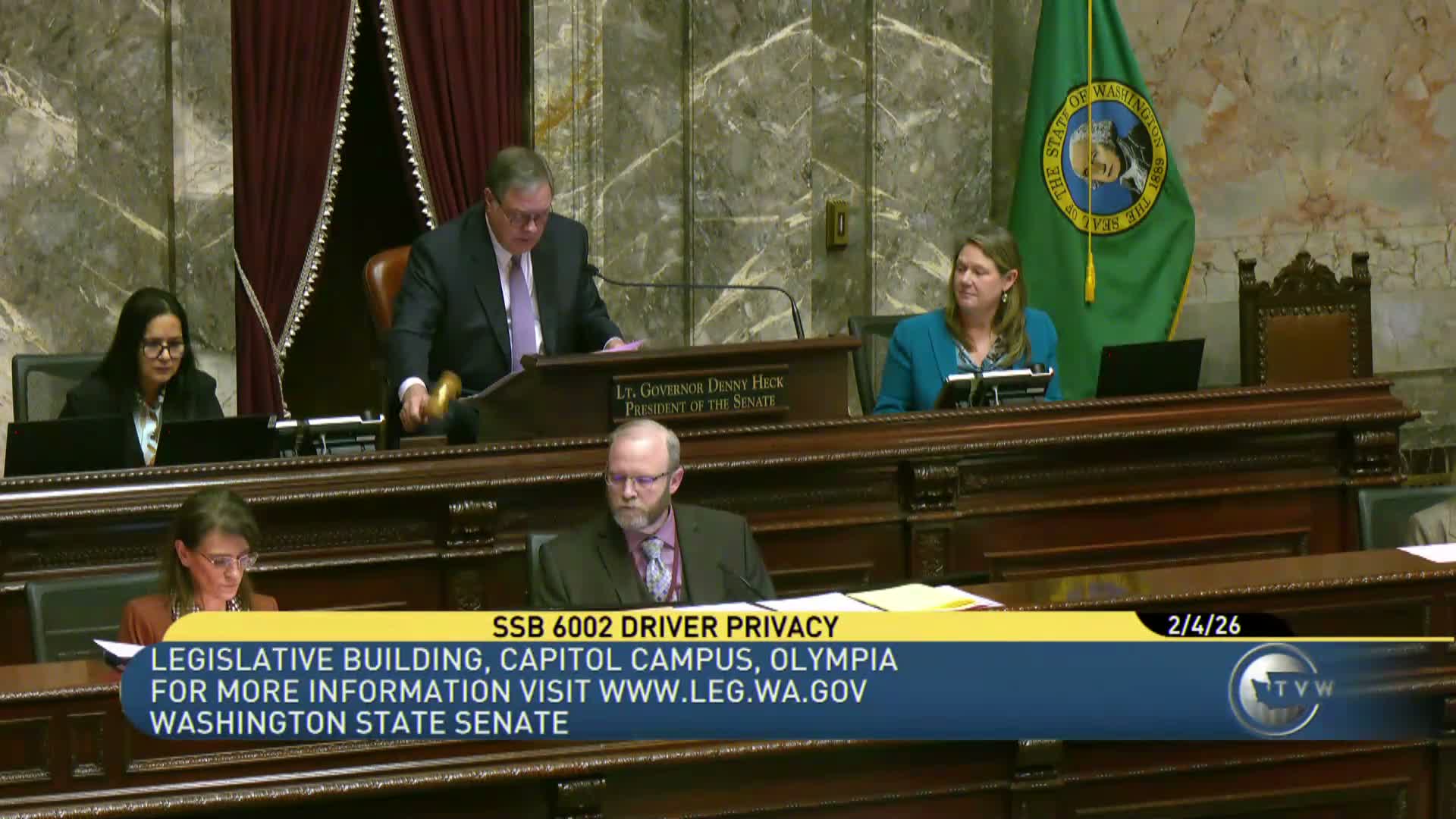
Senate passes bill to regulate automated license-plate readers, citing privacy and law-enforcement balance
Summary
The Washington State Senate passed substitute Senate Bill 6,002 to regulate automated license-plate reader (ALPR) systems and driver‑privacy protections after extended debate over retention, authorized uses and vendor access. Sponsors said the bill balances privacy and public-safety needs; the transcript records a roll-call result of 48–9.
The Washington State Senate on its floor session advanced and passed substitute Senate Bill 6,002, a measure to regulate automated license-plate reader (ALPR) systems, after extended debate on privacy safeguards, authorized law-enforcement uses and vendor access.
Senator Steve Trudeau, the bill's prime sponsor, urged support and framed the measure as grounded in state constitutional privacy protections, saying on the floor: “We have the strongest bill in the country that is completely workable by every jurisdiction that I have spoken to.” Trudeau and backers said the bill seeks to preserve ALPR utility for investigations while limiting misuse by private vendors and unauthorized government access.
Senator Mike Holy, who spoke in support, said the substitute incorporates many law-enforcement amendments and described the bill as preserving utility for stolen-vehicle investigations, missing-person searches and felony warrants while adding safeguards against intrusive uses. “This bill allows for the proper use of license-plate reader technology,” Holy said, adding it includes limits intended to prevent a broader surveillance state.
Opponents and cautious supporters pressed for narrower retention periods and clearer restrictions on secondary uses. Senator Trudeau and others pointed to recent news reporting and examples — including vendor-enabled nationwide searches — to argue stronger state rules were needed.
The transcript records multiple amendment votes. Sponsors described the striking and technical amendments as efforts to align privacy protections, limit data-sharing, and set implementation guardrails. After amendment votes and final remarks, the secretary called the roll and the transcript records the bill as having received a constitutional majority; the roll-call readback in the transcript was recorded as 48 yeas and 9 nays and the substitute SB 6,002 was declared passed. The bill text in the reading included an immediate-effect clause.
What happens next: with final passage on the floor, the bill proceeds according to the Legislature's process (engrossing, enrollment, and transmittal to the governor). The transcript does not record the governor's action on the measure.
Reporting note: quotes and attributions in this report are taken directly from floor remarks recorded in the transcript. The transcript includes references to related court cases and news reporting cited by senators during debate; those external materials are summarized only as referenced in floor remarks and are not independently verified here.