Get Full Government Meeting Transcripts, Videos, & Alerts Forever!
Get email alerts on the Legislation Roundup topic
No spam. Unsubscribe anytime.
Washington Senate advances package of bills on public safety, consumer protections and veterans' benefits
Summary
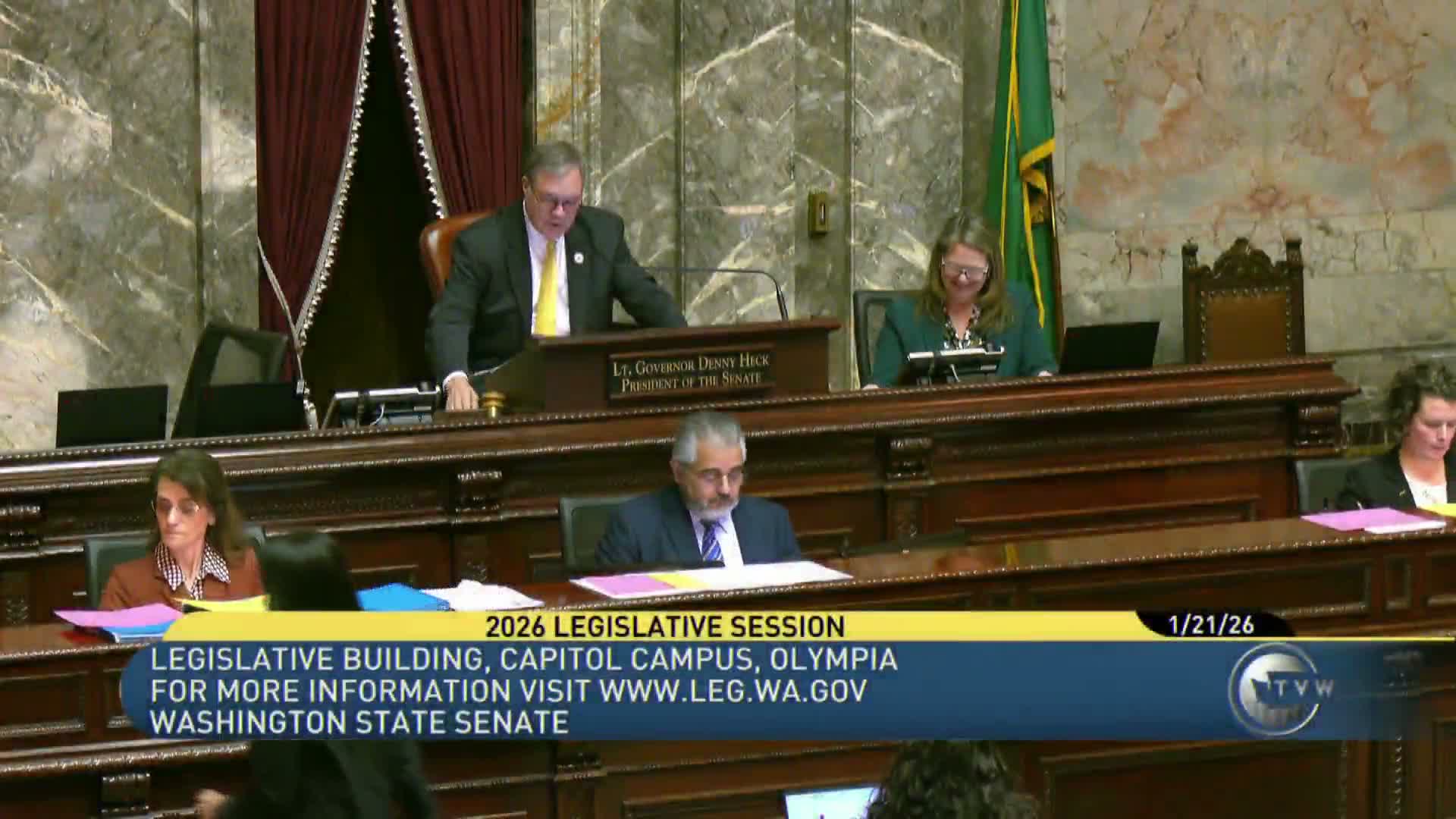
On Jan. 21, 2026, the Washington State Senate passed a number of bills spanning public-safety provisions, consumer rules for virtual-currency kiosks and veterans’ access to benefits. Several bills drew spirited debate; others passed unanimously. Vote counts and amendment actions are listed below.
The Washington State Senate on Jan. 21, 2026, approved a broad slate of measures addressing public safety, consumer protections and infrastructure while also confirming multiple gubernatorial appointees.
Lawmakers debated and passed Senate Bill 5,068, a measure aimed at addressing staffing shortages in public-service roles such as law enforcement, corrections and prosecuting attorneys. Sponsor Senator Lubbock said the bill “addresses the shortfall we are experiencing in public service roles” and will help recruit and place personnel in communities (Sen. Lubbock). Opponents pressed concerns about amendments related to who may exercise enforcement authority; after several amendment votes the bill passed final passage, 30 ayes to 19 nays.
Consumer protections for cryptocurrency transactions also moved forward. Senator Kaufman explained changes to Senate Bill 5,280 that raise the maximum per-transaction amount at virtual-currency kiosks from $1,000 to $2,000 and increase allowable fees from 5% to 15%, telling colleagues the amendment “makes the bill very palatable” (Sen. Kaufman). The amendment was adopted and the bill passed on final vote, 37 ayes to 12 nays.
The chamber unanimously approved substitute Senate Bill 5,436, a bill criminalizing interference with access to places of worship. As prime sponsor Senator Solomon noted, recent incidents around the state prompted lawmakers to seek clearer legal tools; the bill passed 49–0.
Lawmakers also updated criminal statutes to address the fentanyl crisis. Substitute Senate Bill 5,071 was amended to add sentencing alternatives aimed at connecting parents to treatment when children are endangered by controlled substances; with that amendment the bill passed final passage, 40 ayes to 9 nays. Supporters framed the measure as a public-safety intervention that pairs accountability with access to services (Sen. Braun; Sen. Dhingra).
Other measures approved included bills on hospital discharge and patient-placement processes (Substitute SB 5,124, passed 49–0), traffic-safety enhancements for school zones (SB 5,705, passed 49–0), expansion of certain property-tax exemptions for nonprofit assembly halls (Substitute SB 5,252, passed 48–1) and several bills aimed at broadband and supply-chain resilience.
Votes at a glance: - Senate Bill 5,068 (public-service staffing) — final passage: 30 ayes, 19 nays. - Substitute SB 5,252 (nonprofit assembly-hall tax exemption) — final passage: 48 ayes, 1 nay. - SB 5,280 (virtual-currency kiosks; fee/limit changes) — final passage: 37 ayes, 12 nays. - Substitute SB 5,436 (interfering with access to places of worship) — final passage: 49 ayes, 0 nays. - Substitute SB 5,071 (endangerment with controlled substance; includes fentanyl) — final passage: 40 ayes, 9 nays. - Substitute SB 5,124 (patient access/discharge provisions) — final passage: 49 ayes, 0 nays.
Several confirmations and appointments were approved by voice or roll call: Rosa Peralta (Seattle College District Board of Trustees), Steven A. Zimmerman (Wenatchee Valley College Board of Trustees) and Tara Leer (Walla Walla Community College Board of Trustees) were confirmed by roll-call majorities of 49–0.
What the debates revealed: Sponsors emphasized workforce and public-safety gaps, consumer protections and clearer tools for protecting religious institutions. Dissenters in several debates warned amendments could create unintended consequences or fail to change criminal behavior, arguing some measures would not address root causes.
The Senate stood at ease for caucus and adjourned, with lawmakers scheduled to return at 12:30 p.m. on Thursday, Jan. 22.