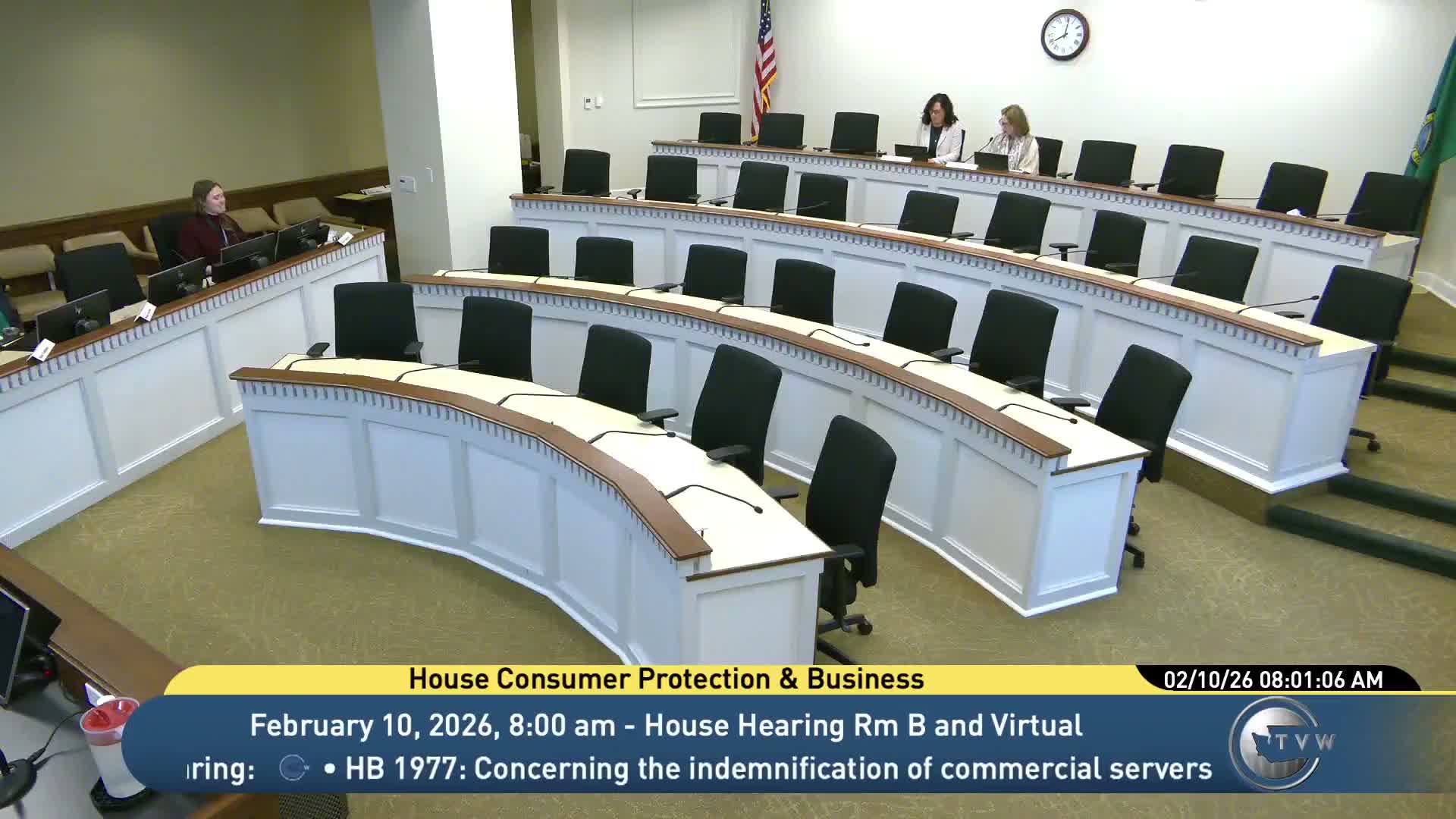
Committee hears bill to shift civil-defense costs for servers to retailers; questions remain about scope and insurance impact
Loading...
Summary
A Feb. 10 Business Committee hearing on House Bill 1977 explored a proposal to require retailers to cover legal defense costs and judgments for servers accused of overserving. Sponsor Representative Donaghy and industry witnesses discussed intent, insurance-market strain and unresolved drafting details; no vote was held.
Representative Donaghy, the bill—o-sponsor, told the Business Committee on Feb. 10, 2026, that House Bill 19 77 would require a retailer to pay "all necessary expenses of defending the action against the server and any monetary judgment entered against the server" when a civil suit is brought over alleged sale of liquor to a person apparently under the influence.
The measure, presented in a staff briefing by Peter Klotfelter, staff to the committee, would allow a judgment creditor to seek satisfaction only from the retailer and would bar a judgment against a server from becoming a lien on the server's property. Klotfelter emphasized that the bill does not change administrative enforcement under Washington liquor and cannabis rules, including fines or permit suspensions carried out by the Liquor and Cannabis Board.
Donaghy framed the bill as a narrowly targeted protection for servers who follow training and the law but are nonetheless named in costly civil litigation. "This legislation is not about servers who willfully over serve," she said, adding that the goal is to prevent workers who comply with rules from "losing everything" because of expensive lawsuits while maintaining mechanisms for accountability.
Industry testimony came from Logan Dozier of the Washington Hospitality Association, who warned the committee that "liquor liability insurance in Washington is broken." Dozier told members his organization administers property and casualty programs for some 6,000 members and said the market has thinned: insurers are raising premiums, moving accounts to surplus lines with higher costs and stricter coverage, and in some cases refusing to write liquor liability at all. He said the association believes HB 19 77 largely restates current practice that licensees defend employees in civil cases but will not stop servers from being named as defendants.
Committee members pressed multiple drafting and policy questions. Representatives asked whether the bill would protect servers when they are the sole employee on a shift and whether retailers or servers would ultimately bear civil judgments in multi-establishment incidents where a patron moved among several bars. Staff and the sponsor said the bill did not explicitly resolve those scenarios and that existing agency and tort rules could still impute liability to businesses.
Several legislators also questioned whether "indemnification" as written would only require retailers to cover legal defense costs or also obligate them to satisfy civil judgments. Donaghy said she expects the final drafting to clarify whether insurers would be responsible for payment from existing policies and welcomed stakeholder input; she acknowledged "indemnification" was used as shorthand and that the bill might need follow-up legislation or redrafting.
The Chair connected the bill to broader concerns about insurance affordability, noting that higher claim payments can raise rates for schools, adult family homes, child-care centers and small businesses. Lawmakers also asked whether the bill would apply to cannabis service; Donaghy said current law does not permit cannabis service in establishments and so the bill would not apply now, though she suggested the policy could be revisited if cannabis service were later authorized.
The hearing did not result in a committee vote. The Chair closed the public hearing after testimony and questions; the bill remained under discussion and the sponsor and witnesses offered to continue stakeholder conversations and supply additional data to the committee.