Secretary of State outlines fiscal-note process, litigation assumptions and ranked-choice voting costs
Loading...
Summary
Secretary of State Steve Hobbs and staff explained a three-day fiscal-note process, workload-to-FTE methods, a $28,000 per-FTE standard 'backpack' cost and how litigation and ranked-choice voting introduce uncertainty; the office urged early consultation and said some litigation risk assessments may be marked 'indeterminate.'
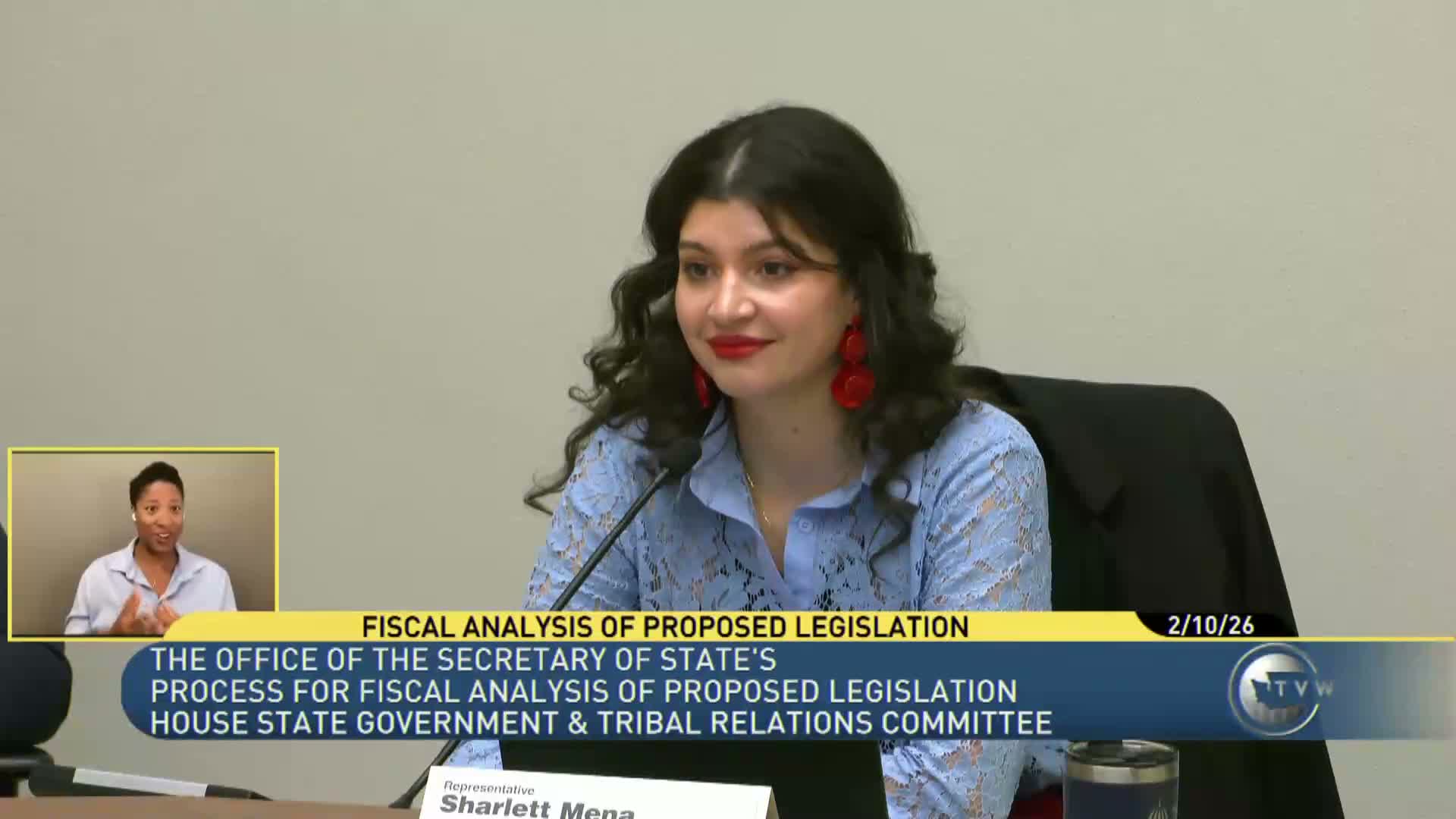
Washington Secretary of State Steve Hobbs and his budget team told the legislative committee on Feb. 17 that the office's fiscal-note process is designed to be neutral and that certain policy areas can create large, uncertain costs.
Tim Gallivan, budget and procurement manager in the Secretary of State's office, described a structured three-day fiscal-note workflow after assignment from the Office of Financial Management (OFM): day 1 assignment and subject-matter allocation, day 2 division coordination and outreach to outside agencies (including the attorney general's office when needed), and day 3 internal review and submission to OFM. "A key guardrail in this process is neutrality," Gallivan said. "If the language says x, we typically estimate on x."
Gallivan described how the office estimates FTEs and full costs: staff identify tasks and workloads, convert annual hours to FTEs using standard hours, and apply two additional components beyond salary and benefits. The first is a standard goods-and-services 'backpack' to cover operating supports (he estimated about $28,000 per FTE). The second is an admin allocation to cover internal operations (about 15% of salaries and benefits).
On litigation, Gallivan said the office uses three approaches: mirror AGO-provided costs when assigned concurrently, update fiscal notes after AGO costs arrive, or label costs as "indeterminate" when risk is too uncertain. Secretary Hobbs and staff said the office prefers to be transparent and will provide supporting worksheets upon request.
Committee members used several bills as examples. The committee discussed House Bill 1750 (relating to voting-rights litigation). Members questioned a fiscal-note assumption of two litigation cases per year despite historical evidence of zero; Stuart Holmes, director of elections, said evolving litigation strategies in other states (including challenges about signature verification and initiative-processing rules) increase the risk that new theories could be brought under Washington's voting-rights framework. Holmes said the office has adjusted its approach and sometimes marks litigation risks as indeterminate and would return to the legislature for funding if suits materialize.
The committee also discussed House Bill 2210 (proportional ranked-choice voting). Holmes said costs depend on how many and which ranked-choice methods jurisdictions adopt, noted the state has invested in an upgraded election-night reporting system and said the primary cost drivers are system updates and public education; he recommended a subject-matter specialist to support counties that adopt ranked-choice voting. In response to a procurement question, Holmes said each county auditor may procure certified voting systems independently; the state certifies systems but does not recommend specific vendors.
The Secretary of State's office urged early engagement from bill sponsors to reduce uncertainty in fiscal notes and to allow the office to produce more precise estimates.
Sources in the committee hearing: Steve Hobbs, Secretary of State; Tim Gallivan, budget and procurement manager; Stuart Holmes, director of elections.