Committee hears bill to expand pharmacist substitution of biosimilars; proponents tout savings, patient groups raise cost-sharing concerns
Loading...
Summary
The House Health Care and Wellness Committee heard testimony on SB 5594 to add biosimilars to existing pharmacist substitution rules and allow carriers to require a biosimilar trial beginning Jan. 1, 2027. Supporters said it will lower drug costs; patient advocates warned substitution could raise out-of-pocket costs without formulary fixes.
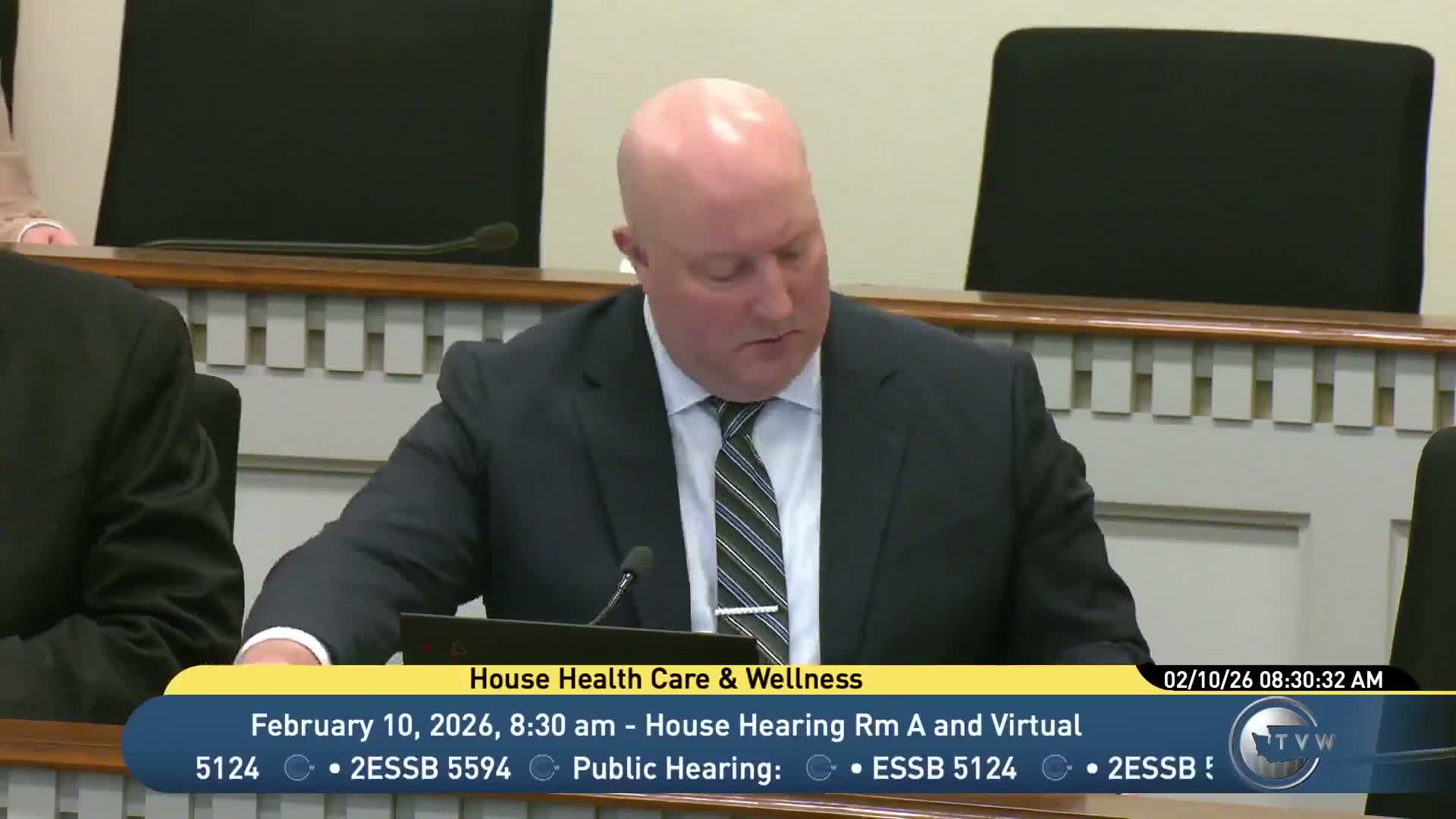
The House Health Care and Wellness Committee heard testimony Feb. 10 on Senate Bill 5594, which would add biosimilars to state rules that let pharmacists substitute therapeutically equivalent products and allow health carriers to require patients to try a biosimilar before covering an equivalent branded biologic starting Jan. 1, 2027.
Kim Weidner, staff to the committee, summarized the bill and said it would fold biosimilars into provisions that today apply to interchangeable biological products or generics. Under the bill, a pharmacist could substitute a therapeutically equivalent drug or interchangeable biological product unless the prescriber indicates the prescription ‘may not be substituted,’ and substitution would be permitted only when the patient’s out-of-pocket cost for the interchangeable product is less than for the prescribed product.
Supporters framed the measure as a cost-saving alignment with other states. “This has been introduced or is now in play in 47 other states,” said Senator Harris, the bill’s sponsor, who described biosimilars as lower-cost alternatives that could help patients with conditions such as arthritis. Marissa Ingalls of the Association of Washington Healthcare Plans told the committee biosimilars typically launch at about half the price of the reference product and that adopting substitution rules would not require new state funds. Chris Bandley of America’s Health Insurance Plans said the state has a history of encouraging lower-cost prescriptions and urged the committee to work through remaining concerns.
Manufacturers’ representatives echoed the savings case. Brett Michelin of the Association for Accessible Medicines said biosimilars have delivered large savings nationally, citing figures of approximately $56.2 billion in cumulative savings and $21 billion in 2024 as examples presented to the committee, and recommended adding biosimilars into existing generic interchangeability provisions rather than creating a separate subsection.
Patient advocates and some committee members pressed for implementation safeguards. Erin Jajic of the Patient Coalition of Washington said the bill’s intent is sound but warned that at the pharmacy counter pharmacists often cannot run both products to confirm whether substitution would lower a patient’s cost. “We are giving that pharmacist the discretion to maybe sub out, but they are not able to process the two meds and see what my cost sharing will be,” she said, arguing carriers and PBMs control formulary placement and cost-sharing and recommending that biosimilars be required on preferred formulary tiers to protect patients from higher out-of-pocket costs.
Committee members asked whether the bill could treat biosimilars like generics for substitution mechanics. Witnesses agreed some protections (for example, a prescriber marking ‘dispense as written’) already exist in the draft language, but said formulary and PBM contracting often determine whether substitution actually lowers the patient’s share.
No vote occurred; the hearing was suspended and later adjourned after public testimony. The committee did not adopt final language at this session and signaled it will continue working with stakeholders on implementation details and formulary/PBM issues.