Get Full Government Meeting Transcripts, Videos, & Alerts Forever!
Get email alerts on the Reproductive Health topic
No spam. Unsubscribe anytime.
Washington Senate passes bill allowing DOC to maintain stockpile of medication used for miscarriage and abortion amid heated amendments debate
Summary
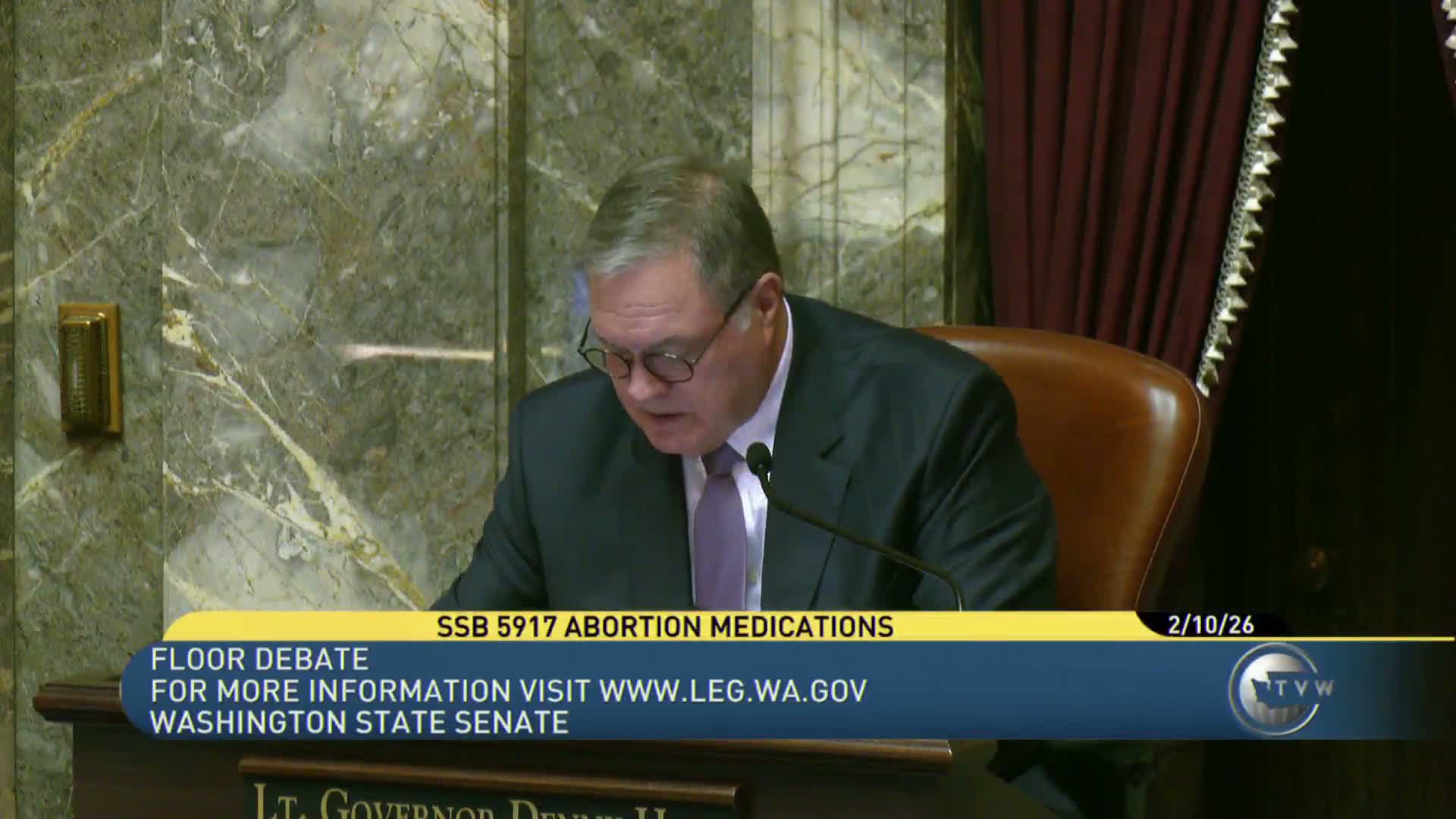
The Senate passed substitute SB 5917 to allow the Department of Corrections pharmacy to obtain and distribute mifepristone and misoprostol and to modify fee and distribution rules after extensive floor debate and several failed amendments. Final recorded vote was 32 yea, 17 nay.
The Washington State Senate on Feb. 10 passed substitute Senate Bill 5917, a measure that authorizes the Department of Corrections (DOC) pharmacy to obtain and distribute certain medication—specifically mifepristone and misoprostol—used both in medication abortion and in managing miscarriages. The session included extended debate and multiple amendment attempts before the bill passed by a recorded vote of 32 yeas to 17 nays.
Supporters said the bill preserves access to time-sensitive medication in a shifting federal and judicial landscape. Senator Bateman, the bill’s floor sponsor, said the measure updates a 2023 law to allow DOC to obtain the drugs and to modify prior fee requirements so the stockpile’s medications do not expire unused. “Without this stockpile, we cannot ensure that people in Washington can actually get access to this medication, which is safe,” Bateman said.
Opponents raised concerns about costs and out-of-state distribution. Senator Christian argued the bill "could be forcing Washington state to become the free supplier of all abortion drugs for the entire country," and pressed for more restrictive amendments to confine distribution to Washington residents and require reimbursement to the state. Several amendments sought to require DOC to charge at-cost, limit distribution to in-state residents, or add stronger warning labels; those amendments were offered and rejected on the floor.
Floor debate also included personal testimony about clinical experience. Senator Frame described how the mifepristone–misoprostol combination is used to manage miscarriages and said she could not access mifepristone when she needed it, explaining how that affected her care. Other senators argued the DOC pharmacy is the largest state-operated pharmacy with the infrastructure to store and manage the medications safely.
Key failed amendments included attempts to: require DOC to charge for medication at the purchase price; limit distribution to Washington state residents; add an enhanced warning label; and remove the bill’s emergency clause. Supporters warned some restrictions would prevent rapid deployment in emergencies or create operational barriers. Floor vote counts and recorded yeas and nays were taken after the roll call.
The Senate’s action amends prior statutory arrangements for DOC’s pharmacy role and clarifies the definition of "abortion medications" to explicitly include misoprostol. The bill’s proponents said the change preserves access for both miscarriage management and reproductive health care when federal availability is uncertain.
Next steps: the bill was declared passed after the Senate roll call; it proceeds to the governor for consideration and any potential signature or veto.