
Washington Senate advances and passes package of bills on elections, child-safety reviews, health and technology
Get AI-powered insights, summaries, and transcripts
Subscribe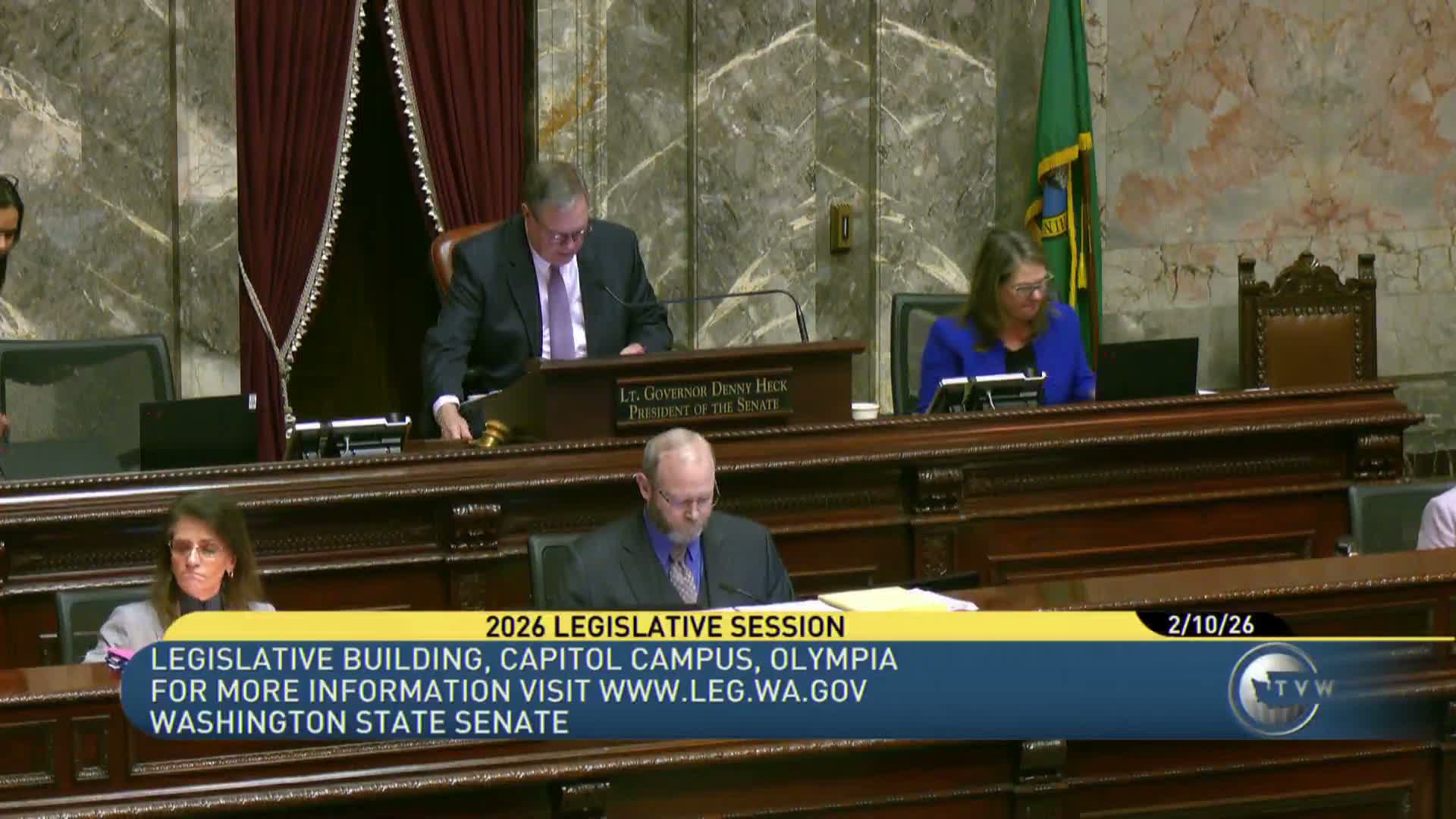
Summary
On Feb. 8 the Washington State Senate advanced multiple bills to third reading and declared final passage on a series of measures including SB 6,084 (clarifying single-state voting prohibition), SB 5,977 (publication of child near-fatality reviews), SB 5,985 (endometriosis awareness), SB 6,046 (Civil Air Patrol codification) and SB 5,956 (limits on AI in schools). Vote tallies and sponsor remarks accompanied each action.
The Washington State Senate on Feb. 8 advanced and declared final passage on a wide-ranging package of bills addressing election law, child welfare transparency, public-health initiatives and technology policy.
Election voting clarification (Senate Bill 6,084). Sponsor Senator Cortez urged support for SB 6,084, calling it a “common-sense bill” to address a Division II Court of Appeals ruling that she said had created ambiguity around the term “election.” Cortez told the chamber the bill clarifies that a person may not vote in an election in Washington and another state if the election date is the same for both states. The secretary reported the result as 47 yeas, 1 nay, 1 excused; the President declared SB 6,084 passed.
Child near-fatality reviews (Senate Bill 5,977). Senator Torres described SB 5,977 as a transparency measure “about learning from serious incidents” and protecting children by publishing near-fatality reviews so the public can see what went wrong and how to prevent future harms. The roll call recorded 47 yeas, 0 nays and 2 excused; the bill was declared passed.
Health and research bills. Substitute SB 5,985 (endometriosis) was sponsored by Senator Orwell, who said the measure will fund awareness and research partnerships and noted the bill includes a section that expires on June 30, 2029. Substitute SB 6,183 (coverage for HIV antiviral drugs) was described by Senator Elias as continuing bipartisan policy to ensure quick access to medication for newly diagnosed people; sponsors said earlier Medicaid policy extensions showed success without major program cost increases. Both bills were advanced and declared passed by constitutional majorities.
Public safety and state operations. SB 6,046, an agency-request bill to integrate Civil Air Patrol into the Washington Military Department, was described by Senator Wagner as a practical way to codify chain of command and speed the state's use of Civil Air Patrol assets in search-and-rescue and disaster response. The Secretary reported 47 yeas, 0 nays and 2 excused; the bill was declared passed.
Education and technology (Substitute SB 5,956). Sponsor Senator Nobles said artificial intelligence is already in schools and that the bill aims to prevent harmful uses — for example, automated systems predicting behavior or replacing educators in discipline decisions — while protecting student data. The bill drew more extended debate, with some senators expressing concern the measure might be overly broad. The final tally reported 35 yeas, 13 nays, 1 excused and substitute SB 5,956 was declared passed.
Other votes. The Senate also advanced and passed measures on wastewater inspection training periods (SB 6,291), motor-fuel definition changes to allow hydrogen sales (SB 6,269), protections for human-trafficking survivors (SB 5,936), audiologist clinical autonomy (SB 6,226), updates to fetal-death definitions (SB 6,025), wage-enforcement process adjustments (SB 6,058), and a transparency requirement for proposed workers’ compensation rates (SB 6,136). Sponsors’ remarks accompanying each measure addressed the bills’ goals — from environmental protection and public health to regulatory clarity and worker protections — and roll-call tallies were reported on the floor for each final-passage vote.
Where debate occurred, senators repeatedly distinguished discussion from formal action: several bills were advanced on motions to suspend rules and place them directly on final passage; other items included adopted amendments (for example, an amendment to SB 6,058 requiring the Department of Labor & Industries to publish written protocols on prioritizing wage complaints). After concluding the day’s business the Senate stood at ease to allow Democratic caucus activity.
A detailed list of bills, sponsors and vote tallies is included below (as announced in the Senate): SB 6,084 (Cortez)—47 Y, 1 N, 1 Excused; SB 5,977 (Torres)—47 Y, 0 N, 2 Excused; SB 5,985 (Orwell)—47 Y, 0 N, 2 Excused; SB 6,046 (Wagner)—47 Y, 0 N, 2 Excused; SB 6,291 (Lovellette/Lovelock)—48 Y, 0 N, 1 Excused; SB 6,007 (Warnock)—48 Y, 0 N, 1 Excused; SB 6,183 (Elias)—48 Y, 0 N, 1 Excused; SB 5,956 (Nobles)—35 Y, 13 N, 1 Excused; SB 5,820 (Cortez)—passed; SB 5,936 (Orwell)—49 Y, 0 N; SB 6,269 (Shoemake)—48 Y, 0 N, 1 Excused; SB 6,226 (Harris)—48 Y, 0 N, 1 Excused; SB 6,025 (Cleveland)—48 Y, 0 N, 1 Excused; SB 6,058 (Saldana)—passed after amendment; SB 6,136 (King)—48 Y, 0 N, 1 Excused. (Vote tallies and excused counts reported on the floor as shown in the official roll-call.)