
Committee advances 'Buy Right Housing Development Act' with amendments to protect local zoning
Get AI-powered insights, summaries, and transcripts
Subscribe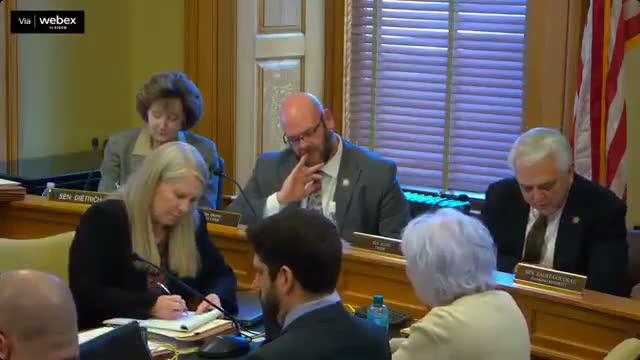
Summary
The committee amended and favorably reported SB 418, which would streamline permitting and allow certain single-family homes under 3,000 sq ft to be built under the 2018 residential code on separately platted lots; amendments narrow the zoning application and require separate legal descriptions for lots.
A Kansas Senate Commerce committee voted Feb. 17 to advance Senate Bill 418, the Buy Right Housing Development Act, after adopting committee amendments intended to limit unintended consequences for local zoning and homeowners associations.
Amelia Kovar Donahue summarized SB 418 for the committee, saying the bill would create a streamlined permit approval process for Buy Right Housing Developments, allow third‑party review and inspection at the election of a political subdivision, and require political subdivisions to allow certain building provisions for single‑family residences under 3,000 square feet. The introduced text initially would have treated all land within a city’s corporate limits as zoned for single‑family residential use; the committee considered amendments to narrow that provision.
Senator Rose, who led the discussion, explained two key amendments the committee adopted. The first (page 5 of the amendment packet) requires that single‑family residences covered by the under‑3,000‑square‑foot provision be constructed on their own separate lots or parcels with individual legal descriptions — language intended to prevent a subdivision using one legal description to create a “horizontal apartment.” The second amendment (page 9) narrows the zoning clause so the single‑family provision applies only to land already zoned for residential use rather than to every parcel within a city’s corporate limits.
On the choice of building code, Senator Rose said the bill would require cities to allow construction using the 2018 edition of the International Residential Code for qualifying homes but would not force a city to adopt that code as its only standard. He told the committee that builders estimate bringing some jurisdictions to a newer code could add approximately $30,000 to the cost of a new home, a consideration the sponsor said motivated the bill’s approach to cost control.
After debate, the committee adopted the amendment (the chair called the vote, recording an affirmative vote and one abstention) and then voted to advance SB 418 as amended. The transcript records the motions, seconds and the chair’s announcements that the amendment passed and that the bill was carried forward favorably; it does not include a roll-call tally of votes by name.
What’s next: The committee reported SB 418 favorably as amended; subsequent steps will follow the Senate’s regular calendar and any further committee or floor action.