
House Agriculture panel hears how December floods devastated farms, urges funding for ag relief
Get AI-powered insights, summaries, and transcripts
Subscribe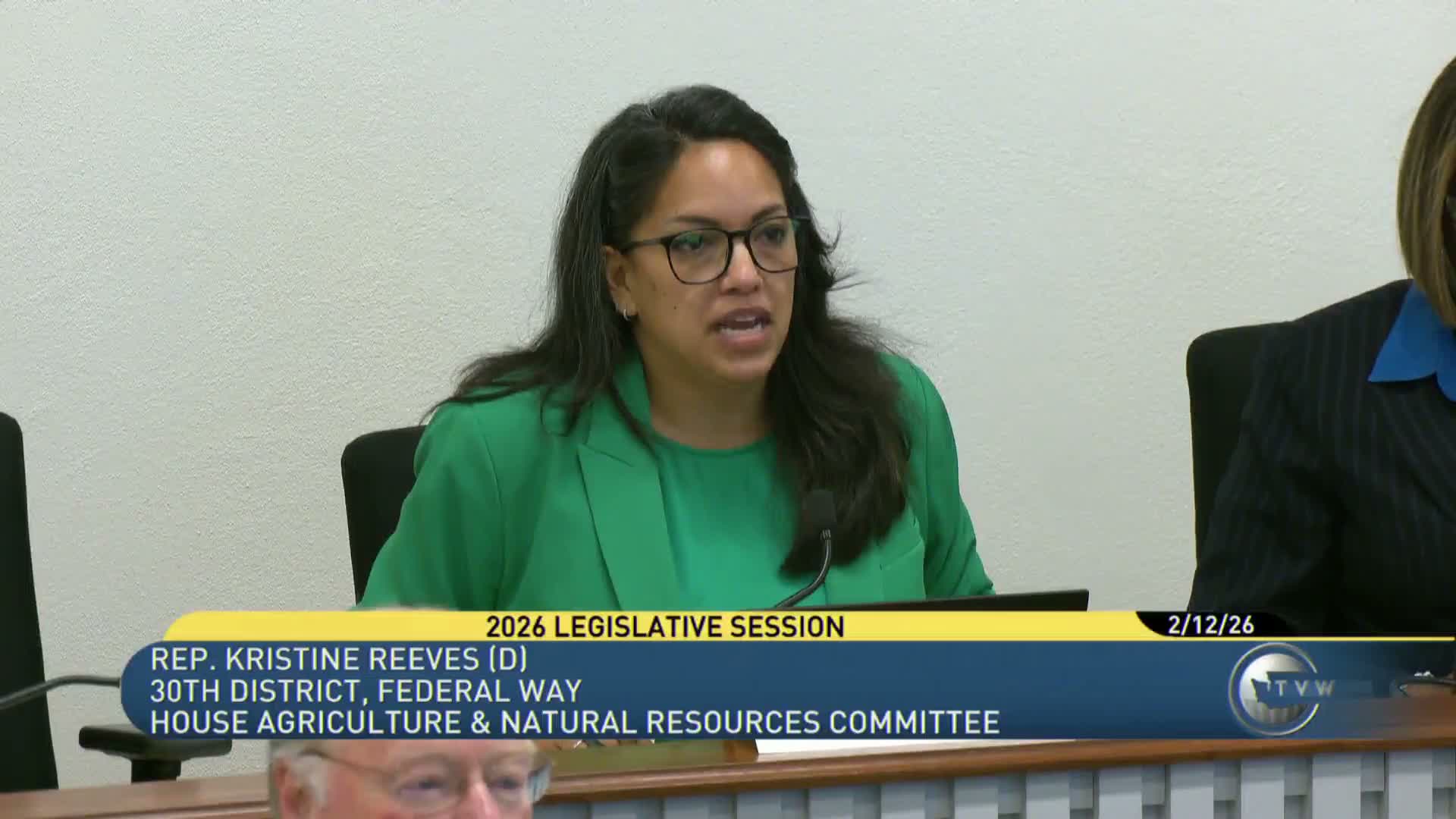
Summary
State and local emergency managers, the Washington State Department of Agriculture and dairy industry representatives told the House Agriculture and Natural Resources Committee that December 2025 atmospheric rivers flooded rivers and low-lying farmland across Western Washington, causing infrastructure and crop losses, constraining feed supplies and highlighting gaps in federal aid for small farms.
On Feb. 12 the Washington House Agriculture and Natural Resources Committee held a work session to examine how the December 2025 atmospheric‑river events affected farms and food production across the state.
The session opened with a statewide overview from Robert Ezell, director of the Emergency Management Division at the Washington Military Department, who said the storms "dropped between 20 and 40 inches of rain, which was between 3 and 6 times the normal rainfall" for the period and led to 33 flooded rivers, including record stages on the Skagit, Snohomish and Cedar. Ezell reported about 4,000 homes were affected (440 with major damage or destroyed), one fatality, roughly 380 successful rescues and about 1,000 assisted evacuations. He said preliminary damage assessments identify approximately $180,000,000 in qualifying damages that could be eligible for FEMA public‑assistance reimbursement.
Why it matters: witnesses told the committee that farms often sit in floodplains and absorbed much of the floodwater, producing losses that may not be fully known until spring or later. Lucia Schmidt, director of Snohomish County Department of Emergency Management, said at peak flood levels 36,000 acres in her county were underwater (about 56 square miles), and described submerged equipment, ruined hay and lost nursery stock. "These losses are particularly devastating," Schmidt said, noting blueberry bushes can take years to return to full yield.
Details and response: Kelly MacLean, assistant director and policy advisor in the Agricultural Environmental Services Division at the Washington State Department of Agriculture, described WSDA’s role as lead for Emergency Support Function 11: coordinating hunger relief, food and feed safety, animal and plant health and connecting producers to available programs. She said a feed mill in the region was offline for a week, that WSDA worked to bring feed from Oregon and Canada and coordinate with Customs and Border Protection, and that the agency contacted livestock veterinarians to assess animal care needs. "We are the lead and we coordinate Emergency Support Function 11 for the state," MacLean said.
Witnesses and committee members emphasized limits in federal programs for diversified and small‑scale farms. MacLean said USDA disaster supports were designed for large commodity operations and often do not cover losses such as destroyed hoop houses; she also noted that USDA requires on‑site verification before repair or replacement assistance is provided and that few applicants have been able to secure inspections so far.
Industry perspective and long‑term planning: Jay Gordon, policy director for the Washington State Dairy Federation and a multi‑generation farmer, described repeated flood events in basin systems such as the Chehalis and stressed the value of local mitigation and advanced river gauges that give operators time to prepare. Gordon highlighted that employee impacts and losses of winter root crops can compound recovery needs: he recounted a grower who now faces employees seeking food‑bank assistance as a result of lost harvests.
Requests to lawmakers: Schmidt urged reinstating and funding the Washington State Conservation Commission’s disaster assistance program, which she said was cut in the recent budget. Ezell and panelists described the state’s statutory individual‑assistance programs as options if federal assistance is delayed or inadequate, and noted the state is preparing a major disaster declaration request for public assistance to submit through the governor’s office to FEMA Region 10.
Next steps: WSDA said it is working on a stakeholder‑vetted report with recommendations for small and mid‑sized farms that will be delivered in July. Committee members requested follow‑up data on insurance coverage among affected farms and a prioritized list of mitigation projects and planning efforts (panelists pointed to existing basin collaboratives such as ongoing Nooksack planning, with an identified fiscal note of roughly $15 million for that effort).
The committee adjourned without votes or formal action; members said they would use the report and follow‑up information to consider budget and policy options in coming months.