
House Appropriations and Finance Committee advances SB241 to codify child-care assistance, lowers trust-fund drawdown
Get AI-powered insights, summaries, and transcripts
Subscribe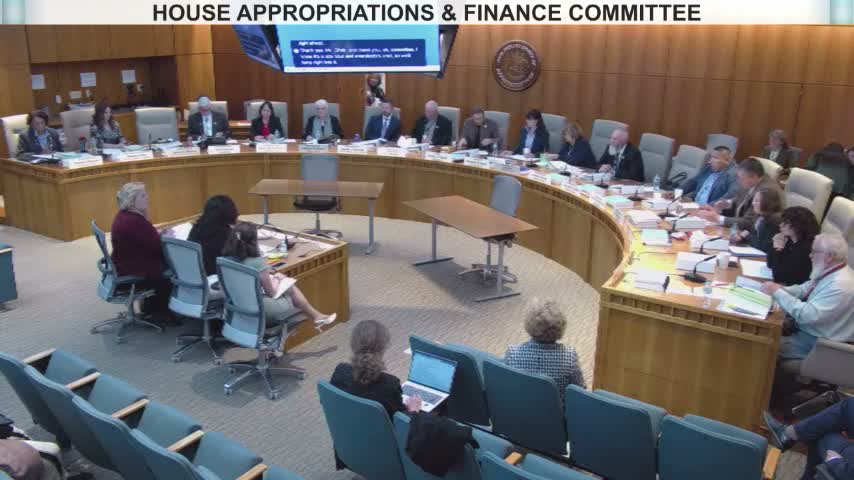
Summary
The committee voted 10–7 to give a do-pass recommendation to the Senate Finance Committee substitute for Senate Bill 241, which codifies New Mexico's child care assistance program, adds reporting and wage-lattice provisions, and reduces the authorized transfer from the early childhood trust fund from $1 billion to $700 million.
The House Appropriations and Finance Committee voted 10–7 late Monday to advance the Senate Finance Committee substitute for Senate Bill 241, a measure that would codify New Mexico’s child care assistance program in statute and set requirements aimed at stabilizing the early childhood system.
Sponsor Chair Marlene Gallegos told the committee the substitute “codifies New Mexico’s child care assistance program in statute, transforming what has largely operated through administrative regulations into a program with well defined criteria, safeguards, and mechanisms for accountability.” She said the bill is intended to “create stability in child care services for eligible New Mexican families.”
Committee members adopted a HAFC amendment, introduced by Vice Chair Dixon, that made several substantive changes. Dixon summarized the amendment as lowering the authorized transfers from the Early Childhood Education and Trust Fund from $1,000,000,000 to $700,000,000 and adding reporting and participation requirements for rate-setting and provider data. “The amendment instructs ECECD to report to the legislative health and human services committee and the legislative finance committee biannually regarding the wait list, specifically including the number of children added to the wait list by month, and the number of children moved off the wait list by month,” Dixon said during his explanation of the amendment.
The secretary for the sponsoring department, Amanda, described program design details and protections for families and providers. She said the bill establishes a co-payment structure and conditional wait list and that “the co payments are waived, again, unless there’s a number of conditions and triggers in the law in the bill.” She also said copays are calculated so parents “won't pay more than 7% of their income” in situations where they apply.
The secretary said the bill codifies the use of a cost-estimation model to set rates and that the law will allow the department to set the portion of rates that must go toward wages and to implement a wage scale and career lattice. “This will truly provide a more stable and predictable child care supply and address workforce compensation,” the secretary said.
Public testimony reflected broad support for the policy’s goals but divided views on compensation and implementation. Carolyn Wynne, deputy chief over training and recruiting for the New Mexico State Police, told the committee that “access to reliable child care directly affects recruitment, recruit school completion, and the retention of our current officers,” and said the measure would help staffing in public safety. Several early childhood organizations and advocates—represented in-person and online—said they supported SB241 but urged stronger, enforceable language tying reimbursement and reporting to wages and credentials so that wage increases reach classroom staff rather than just owners.
Teresa Madrid of the Partnership for Community Action said her organization “cannot support SB241 in its current condition” and urged an amendment “tying reimbursement to wages and fringe benefits, according to competencies, credentials, and job classification.” Multiple providers and advocates pressed the committee to ensure reporting is robust enough to track whether increased funding results in higher pay for educators.
Committee members asked detailed questions about contracts, full-time versus part-time eligibility, nontraditional hours and rate add-ons. The secretary said contracts are delinked from fixed hours and will reflect parent preference; full-time contracts are generally available at 29 or more hours per week and nontraditional-hour providers can receive a 10–15% rate add-on depending on setting and child age.
Representative Duncan proposed an amendment to require first-come, first-served enrollment language; sponsors and the secretary said that would conflict with federal priorities and reduce flexibility to prioritize very low-income families, children with disabilities and children experiencing homelessness. The committee moved to table that amendment; the clerk recorded 9 votes to table and 7 votes against tabling.
After debate and brief explanations of intent and concerns, Vice Chair Dixon moved that the committee adopt the committee substitute for SB241 as twice amended. On the roll call the committee recorded 10 votes in favor and 7 against, producing a do-pass recommendation to the next stage.
Budget staff told the committee that fiscal projections provided earlier by the State Investment Council assumed the larger drawdown and that reducing the authorized transfer amount was intended to preserve trust-fund stability. Committee members reiterated that this bill launches a major new entitlement and will require ongoing legislative oversight.
By a committee vote of 10–7, the HAFC approved the Senate Finance Committee substitute for SB241 as amended and recommended a do-pass. The committee adjourned and said it would reconvene at 8:00 a.m. the next day to begin with a briefing on Senate actions on House Bill 2.