Get Full Government Meeting Transcripts, Videos, & Alerts Forever!
Get email alerts on the Transportation topic
No spam. Unsubscribe anytime.
Forward Pinellas presents case for Tampa Bay regional MPO; council hears timeline and concerns
Summary
Forward Pinellas presented a multi-county plan to merge three MPOs into a single Tampa Bay regional MPO. The executive described benefits for regional funding and transit-housing coordination, proposed a 25-member governing board and outlined a phased timeline; councilmembers asked about land-use authority and representation for St. Petersburg and smaller cities.
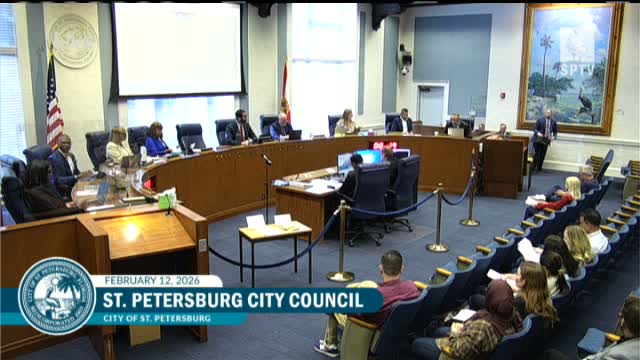
Forward Pinellas officials told the St. Petersburg City Council on Feb. 12 that a proposed merger of the Pinellas, Hillsborough and Pasco metropolitan planning organizations (MPOs) could improve the region's competitiveness for discretionary transportation funding and better align housing and transit policy.
"I've come around to believe that a merger is in the Tampa Bay region's best interest," the Forward Pinellas representative said, calling the change a way to "scale up so that we can realize the full possibility of a region that's adding close to 2,000,000 people over the next 20 to 25 years." He described a planning process that must satisfy federal and Florida statutory requirements and said the work includes a feasibility study, stakeholder workshops and a consultant-led scope of work.
Key points from the presentation included: a likely 25-member board (with 23 elected officials and two regional-agency representatives), seats apportioned by population (Hillsborough 10–11, Pinellas 7–8, Pasco about 4), and possible small-city advisory mechanisms to ensure representation. Forward Pinellas also noted statutory constraints, including the need to address special acts related to the Pinellas Planning Council if a merger proceeds.
The presenter outlined a tentative timeline: additional TMA leadership discussions, a staff recommendation and presentation to joint county boards in March, MPO and principal-organization resolutions of support potentially as early as April and a draft transition plan by year-end if the principals agree to proceed.
Councilmembers asked detailed questions about representation and safeguards. Councilmember Driscoll said the merged MPO would be the largest in the state if adopted and highlighted the potential for increased funding and interjurisdictional collaboration. Councilmember Gabbard pressed for clarity on how the city’s voice would be represented — noting the statute’s requirement that the governor and the four principal jurisdictions (three counties and the largest city) must agree to designation — and forward- Pinellas staff explained that the Pinellas MPO would vote first and that the city has four seats on the current Pinellas MPO.
Speakers also raised land-use concerns: if the Pinellas Planning Council’s special act remains unchanged, a merger could alter who decides countywide land‑use cases, and that change could require legislative action. Forward Pinellas staff said these are among the legal and structural issues being studied.
The briefing closed with a call for continued engagement: Forward Pinellas encouraged council feedback as it prepares materials for upcoming leadership workshops and the joint‑board discussion. No formal council action was taken at this meeting beyond questions and direction to stay involved.