
House public‑safety committee advances package of sheriffs‑related measures, funding and posse clarifications
Get AI-powered insights, summaries, and transcripts
Subscribe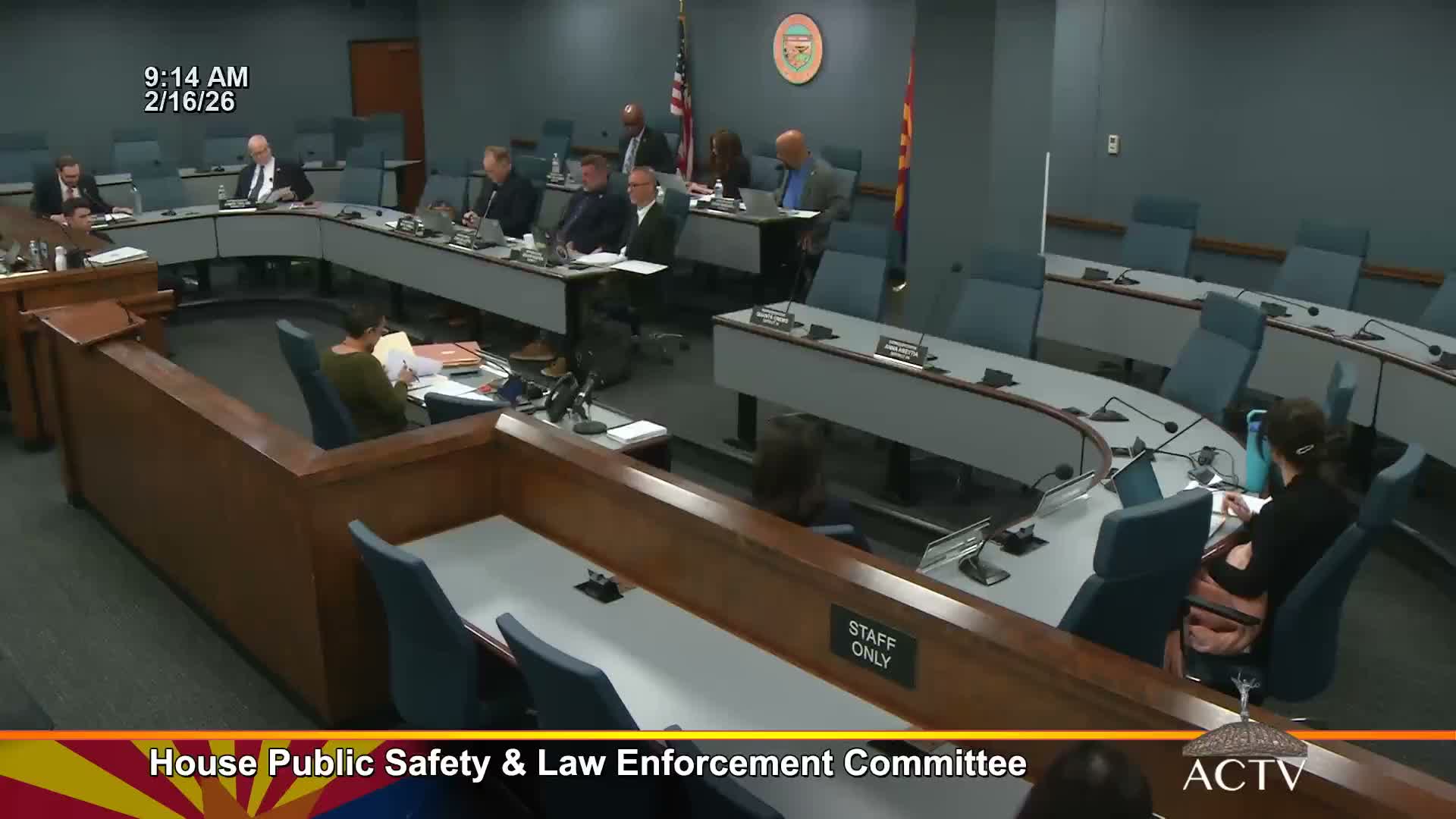
Summary
Arizona’s House Committee on Public Safety on Feb. 16 advanced a set of bills and a nonbinding resolution supporting county sheriffs, including measures to clarify posse authority and county branding, to expand interference‑with‑arrest penalties, and to approve appropriations for border support and law‑enforcement wellness programs (one bill was withdrawn). The committee recorded several close votes and asked staff for drafting fixes.
The Arizona House Committee on Public Safety and Law Enforcement on Feb. 16 heard testimony and advanced a package of bills and a concurrent resolution concerning sheriffs’ authority, volunteer posses, county seals and several appropriations.
Chairman Marshall convened the panel, and members completed roll call before taking up House Concurrent Resolution 2059, a nonbinding resolution expressing legislative support for county sheriffs. Sponsor Chairwoman Griffin said the measure was intended as a “recognition” of the 15 county sheriffs and the role sheriffs play, especially in rural communities. Representative Volk said one line — describing the “supreme constitutional authority” of sheriffs — risked endorsing a fringe theory about sheriffs’ powers and explained her no vote. The committee approved the resolution by voice and roll call (8 ayes, 3 nays, 3 absent).
The panel then considered several bills of substance.
Representative Gillette led debate on HB 28‑11, which would expand Arizona’s obstructing‑governmental‑operations statute to include interference with the making of a lawful arrest when a person knowingly uses or threatens physical force; the sponsor said the change would make violent interference with an arrest a classified felony in appropriate circumstances. Criminal‑defense attorney Pamela Hicks opposed the bill, telling the committee that resisting‑arrest statutes (cited in testimony as ARS 13‑2508) and hindering statutes already criminalize much of the behavior Gillette described and that the measure could be duplicative. The sponsor and others argued the bill clarifies coverage for federal officers and closes a drafting gap; the committee gave HB 28‑11 a do‑pass recommendation (8 ayes, 4 nays, 3 absent).
The committee considered HB 4,129, a proposal to establish a Department of Public Safety law‑enforcement mental‑health and wellness program funded by $15 million in FY2027, with $5 million targeted for smaller agencies. Sponsor Representative Blackman outlined confidential counseling, peer support, suicide prevention and telehealth for rural officers. Members raised concerns about duplication with existing programs (including the Officer Craig Tiger Act referenced in committee discussion) and whether there are sufficient providers who could deliver the full array of services listed in the bill. Representative Blackman withdrew the bill to work with committee members on revisions.
The panel voted 12–1 (with two absent) to advance HB 22‑70, which would expand statutory protection of county seals to cover county office logos, insignia and other identifying branding, require approval for use and give sheriffs exclusive authority to name or dissolve posses that operate under their jurisdiction. Navajo County Sheriff David Klaus and the County Supervisors Association’s legislative liaison, Kaitlyn King, testified the measure would codify recent court rulings and avoid future litigation after private groups continued to use names and insignia tied to sheriff’s offices. Some members pressed staff to tighten the bill’s definitions and to include explicit First Amendment and professional‑use carveouts to avoid overbroad restrictions on speech and branding; the staff signaled willingness to work on clarifying amendments going forward.
Appropriations and public‑safety funding were also on the agenda. HB 24‑16 would appropriate $20 million in FY2027 to DPS for local border support grants — funding new officer positions, prosecution and detention costs, and equipment for border‑nexus criminal investigations (trafficking, smuggling and related crimes). Sheriff Klaus testified in support and cited seizures and enforcement activity on interstate corridors. Community members and some representatives opposed the appropriation, saying the funds should be used for housing, health care and other social services; supporters said prior appropriations have been fully spent on interdiction work. The committee returned HB 24‑16 with a do‑pass recommendation (7 ayes, 5 nays, 4 absent).
Members also advanced HB 40‑18 (as amended), a strike‑everything rewrite that explicitly confirms a sheriff’s authority to request aid from, regulate and dissolve volunteer posse and reserve organizations operating under the sheriff’s direction. Maricopa County witnesses described posses as trained volunteers who assist with search‑and‑rescue and event support; opponents and several public commenters urged caution, saying the language could allow armed volunteers to be deployed for immigration enforcement or expand duties beyond current practice. Committee members signaled they would work on clarifying language; HB 40‑18 as amended received a do‑pass recommendation.
Other measures the committee advanced included HB 22‑53 (protections for employees testifying in disciplinary appeal proceedings) and HB 40‑44 (creation of a Public Safety Parity Fund to help address pay parity for DPS and Department of Corrections staff by redirecting certain non‑general‑fund revenue). Sponsors and police associations said those bills would improve due process and retention; several members asked for amendments to preserve budget corpus or inflation protections. HB 2,675 (a strike‑everything amendment regarding constable ethics review) was advanced after sponsor Representative Hernandez said she was working with AZ POST and the constables’ association to add impartial members and recusal language.
What happens next: most bills advanced from committee will proceed to additional committee referral or the floor, where sponsors and staff are expected to address drafting concerns flagged in committee — particularly definitions that members described as vague or potentially overbroad. Representative Blackman withdrew HB 4,129 for revision.
Quotes that capture the hearing: "We support all law enforcement, but this is a special recognition for the sheriff's…we depend on them, those of us that live in rural Arizona." — Chairwoman Griffin "I think the bill is poorly constructed…this language goes in an infinite loop." — Representative Volk (on HB 28‑11 drafting) "We spent a lot of money in civil litigation to get that back." — Sheriff David Klaus (describing a posse naming dispute in Navajo County)
Votes at a glance (committee recommendations): - HCR 2059 (resolution supporting county sheriffs): do pass recommendation (8 ayes, 3 nays, 3 absent) - HB 28‑11 (expand obstructing statute to cover interference with lawful arrest): do pass recommendation (8 ayes, 4 nays, 3 absent) - HB 4,129 (law‑enforcement mental‑health program): withdrawn by sponsor for redrafting - HB 22‑70 (protections for county seals/logos; posse naming rights): do pass recommendation (12 ayes, 1 nay, 2 absent) - HB 24‑16 ($20M local border support appropriation): do pass recommendation (7 ayes, 5 nays, 4 absent) - HB 40‑18 (posse/reserve authority; strike everything adopted): do pass recommendation (10 ayes, 5 absent) - HB 22‑53 (protections for employee testimony in disciplinary appeals): do pass recommendation (10 ayes, 5 absent) - HB 40‑44 (Public Safety Parity Fund): do pass recommendation (8 ayes, 3 nays, 4 absent) - HB 2,675 (constable ethics; strike everything adopted): do pass recommendation (11 ayes, 4 absent)
The committee asked staff to provide clarifying language on several items before floor consideration: (1) precise definitions for "logo, insignia, or other textual/visual identifier" and what qualifies as 'professional use' under HB 22‑70; (2) drafting fixes to eliminate circular/confusing language in HB 28‑11; and (3) inflation or corpus protections for funds proposed in HB 40‑44. Sponsors indicated willingness to work with members and stakeholders on amendments.
Ending: The committee adjourned and will reconvene for additional hearings and floor referrals as scheduled.