
Senate Committee Advances Bill Tightening Limits on Foreign Interests in Arizona Property
Get AI-powered insights, summaries, and transcripts
Subscribe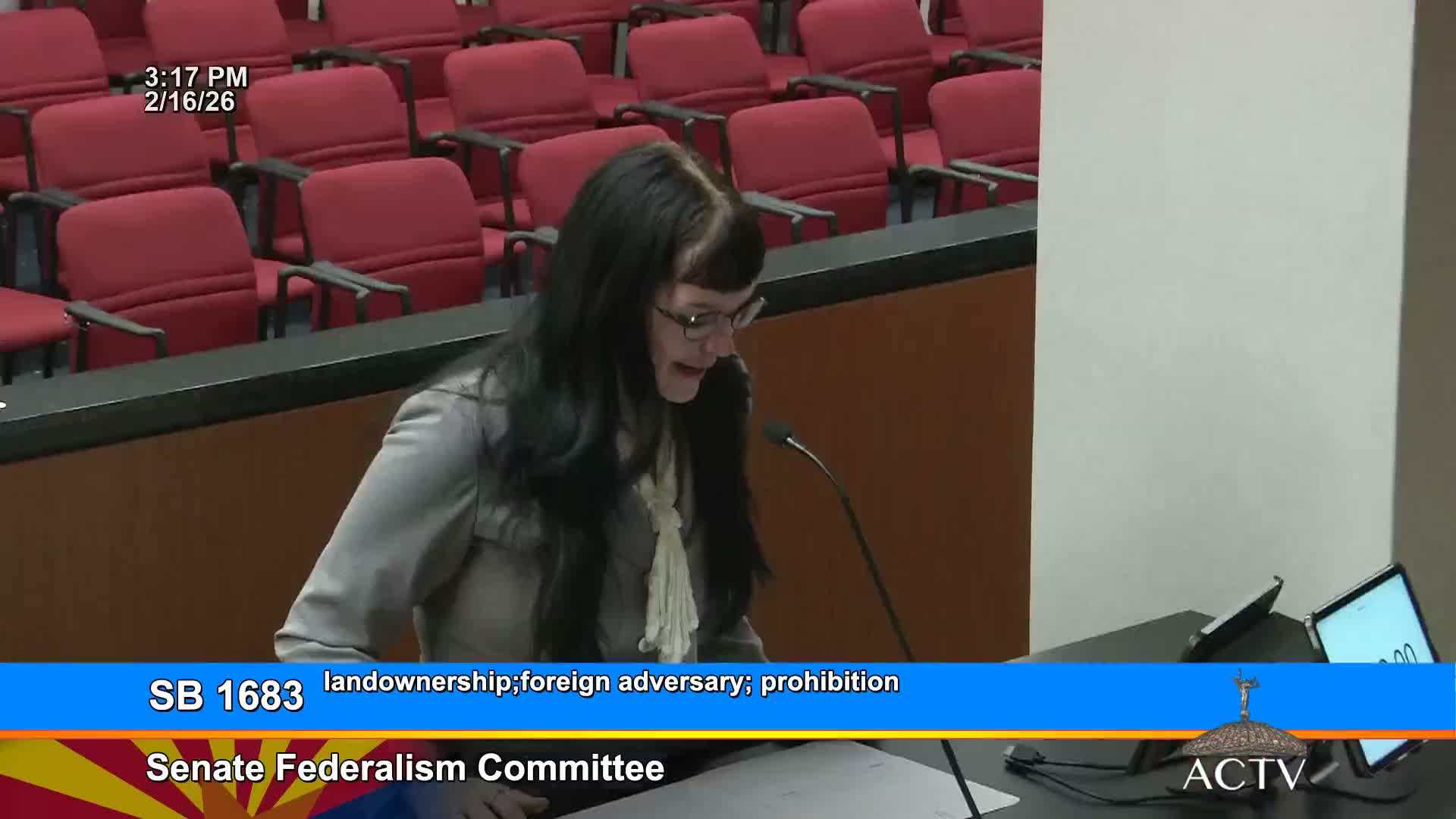
Summary
The Federalism Committee gave SB 1683 a due-pass recommendation (5–2), approving an emergency measure that expands prohibitions on foreign adversaries acquiring or leasing interests in Arizona real property, lowers the "substantial interest" threshold to 5%, and authorizes notification and enforcement by state agencies.
The Arizona Senate Federalism Committee voted 5–2 to give Senate Bill 1683 a due-pass recommendation after hearing testimony and questions about the measure’s scope and definitions.
An unidentified presenter read the bill to the committee, describing SB 1683 as an emergency measure that would expand the state’s prohibition on foreign adversaries ‘‘purchasing, owning, acquiring, or otherwise obtaining a substantial interest in real property’’ to explicitly cover leasing, concessions and ‘‘installing, maintaining, or having access to the data of or operating any equipment’’ on Arizona property. The presenter said a violation would be a class 5 felony and that the change would lower the definition of a ‘‘substantial interest’’ to 5 percent of contingent interests (the presenter contrasted that figure with a previously higher threshold referenced in the bill text). The bill would require certain public service corporations, telecommunications providers, critical infrastructure owners, and government agencies to notify the attorney general and the Arizona Corporation Commission if they believe a foreign adversary has obtained or may obtain access to property or infrastructure; the presenter said the attorney general would enforce the prohibition.
Retired Lt. Col. James Rusty Mitchell, who identified himself as having served 22 years in the Air Force and working on compatible land uses at Luke Air Force Base, testified in support. Mitchell said the legislation would protect military training and capabilities in Arizona and cited economic figures, saying Luke Air Force Base contributes about $3.8 billion to the state and that military activity contributes roughly $15.8 billion statewide. ‘‘They were going just under whatever that threshold was to be able to get that property under control,’’ Mitchell said, arguing that a 5 percent threshold would make it less feasible for adversaries to gain control.
Members pressed witnesses on how the bill defines an individual ‘‘acting in support’’ of a designated foreign terrorist organization and on the bill’s potential to affect non-adversarial transactions. Committee members and witnesses referenced federal authorities — including CFIUS and federal statutes enforced or defined by agencies such as the Department of the Treasury and Department of Homeland Security — as the sources for relevant definitions and investigative authority. Travis Schulte, legislative liaison for the Department of Emergency Military Affairs, told the committee that the definitional references point back to federal statute and federal agencies.
Several senators explained their votes during the roll call. Senator Carroll voted yes. Senator Diaz said his cities are supportive and he would vote yes today but reserved the right to reconsider on the floor if new concerns surfaced. Senator Ortiz voted no. Senator Payne voted yes. One member who had pressed for clarity during questioning said he remained concerned that the bill’s broad 5 percent threshold and the undefined scope of ‘‘acting in support’’ could sweep in non-adversarial activity and compared some restrictions in the bill to historical alien land laws; he explained that concern as part of a no vote. The motion passed by a 5–2 margin, and the committee adjourned.
SB 1683 will proceed with a due-pass recommendation for further consideration by the full Senate. The transcript record shows committee discussion focused mainly on the bill’s definitional scope, the shift to a 5 percent ownership threshold, reporting requirements for infrastructure owners and service providers, and how federal definitions or investigations (CFIUS, Treasury, DHS) would interact with the state measure.
What’s next: the bill moves forward with the committee’s recommendation and may be debated on the Senate floor, where some members flagged they may change their votes if additional information or objections arise.