
Committee advances bill directing ADEQ to seek EPA 'exceptional event' findings for federal-land wildfires
Get AI-powered insights, summaries, and transcripts
Subscribe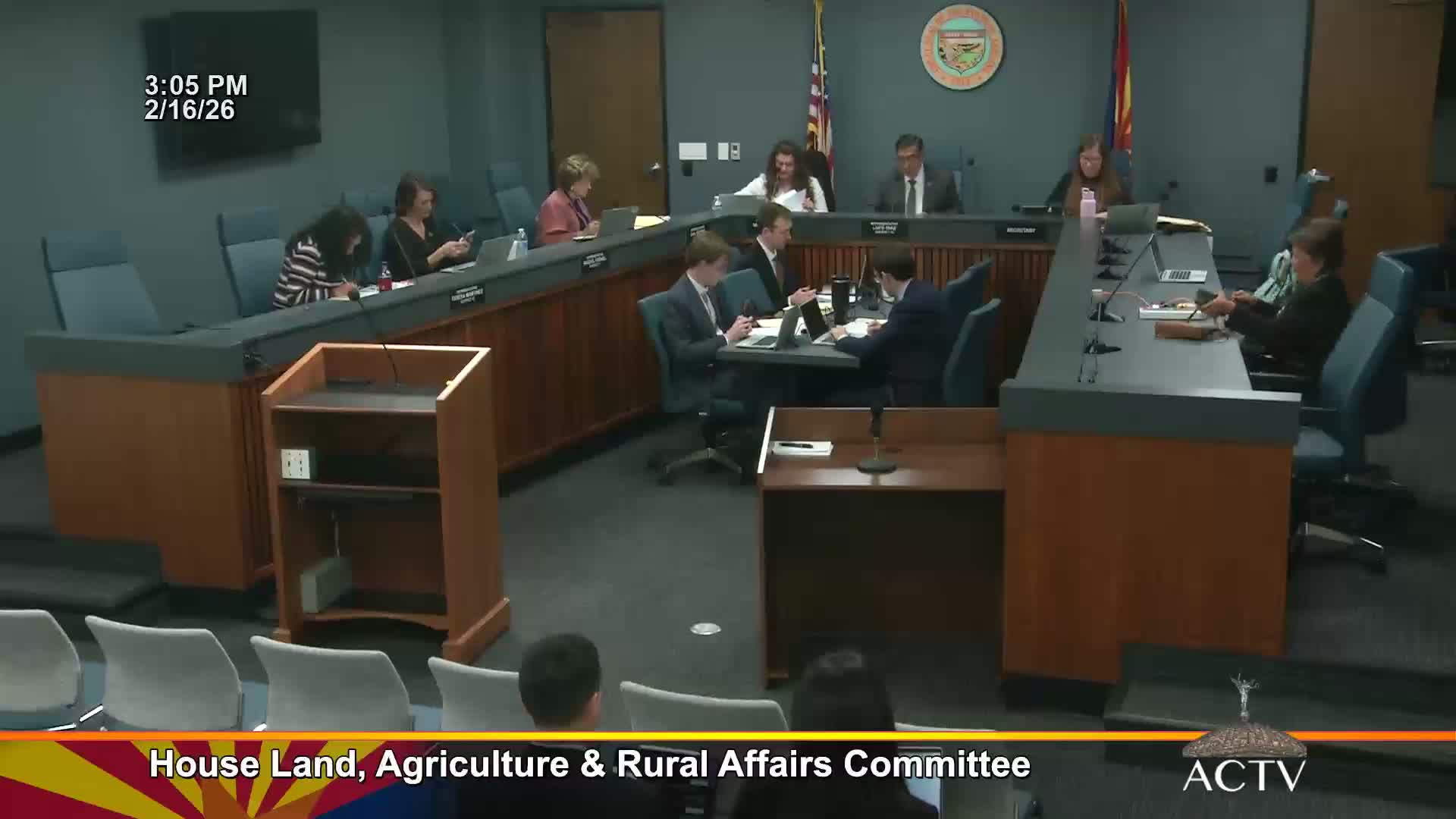
Summary
The House Committee on Land, Agriculture and Rural Affairs returned House Bill 2013 with a due-pass recommendation after sponsor Rep. Lisa Fink said the measure would require ADEQ to submit exceptional-event demonstrations to EPA when wildfires on federally managed land affect Arizona air quality. Sierra Club opposed the bill, citing existing processes and funding concerns.
The Arizona House Committee on Land, Agriculture and Rural Affairs on Feb. 13 returned House Bill 2013 with a due-pass recommendation, advancing a measure that would require the Arizona Department of Environmental Quality to submit an "exceptional event" demonstration to the U.S. Environmental Protection Agency when a wildfire on federally managed land affects the state.
Sponsor Representative Lisa Fink (District 27) told the committee the bill narrowly targets wildfires on federal land and is intended to prevent states from being penalized for air-quality violations outside their control. "It is a natural human caused event that affects air quality, is not reasonably controlled or preventable," she said, and added the policy could prevent Arizona from being forced into "stricter regulatory plans, permits, [and] other unnecessary compliance burdens." Fink said that, among other outcomes, the change could help preserve options for fuel supply in Maricopa County.
Sierra Club Grand Canyon Chapter director Sandy Barr opposed the bill, arguing ADEQ already follows an exceptional-event demonstration process that includes modeling and analysis. "Filing for one every time there's a fire on federal public lands doesn't really make sense," Barr said, noting mixed-ownership fires and the absence of a specified appropriation to cover additional agency work. Barr warned that frequent filings could be dismissed by EPA and urged caution.
Matt Rippin of the Department of Environmental Quality signed in as neutral and said the agency had met with the sponsor and is available to answer questions.
The committee voted to return HB 2013 with a due-pass recommendation. The chair announced the result as five ayes, one nay and absences noted; the committee recorded the bill as having a due-pass recommendation and sent it on for further consideration.