Get Full Government Meeting Transcripts, Videos, & Alerts Forever!
Get email alerts on the Infrastructure Standards topic
No spam. Unsubscribe anytime.
Arapahoe County to send IDCS revisions to public hearing, including condition-based pavement moratorium and higher restoration standards
Summary
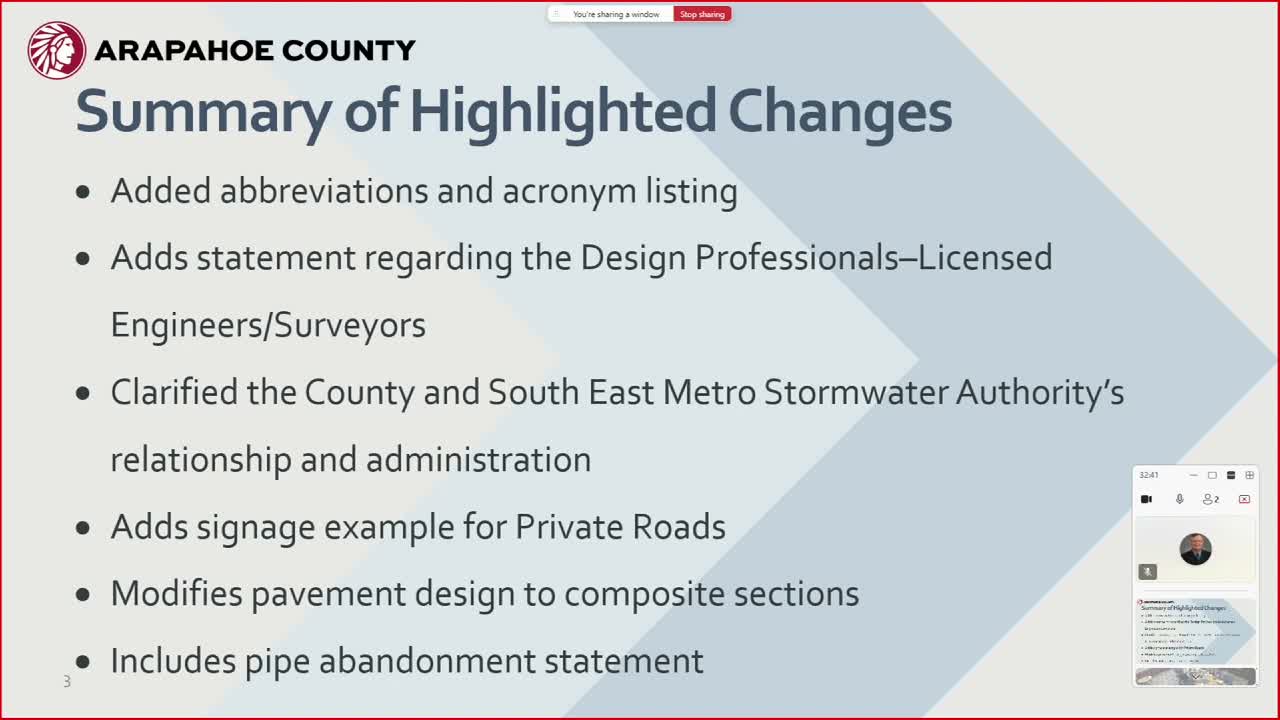
Public Works proposed edits to the Infrastructure Design and Construction Standards that would replace a 2-year age-based pavement moratorium with an asset-condition trigger (OCI/PCI 90+), require larger restoration patches, and apply double utility-trench impact fees on high-condition segments; commissioners asked for clarified PCI/OCI language and discussion about development impacts.
Arapahoe County Public Works and Development presented proposed revisions to the county92s Infrastructure Design and Construction Standards (IDCS) and secured the board92s informal support to send the edits to public hearing.
Staff said changes are intended to improve clarity and fiscal sustainability in how the county manages new construction, utility cuts and roadway restoration. "We92re moving it from an age-based moratorium criteria to an asset management based, which is condition," a Public Works presenter said, explaining that an overall condition index (OCI) or pavement condition index (PCI) of 90 or higher would identify segments where cutting the pavement imposes a disproportionately large future maintenance cost.
Under the proposed revisions, roadway segments meeting the condition threshold would generally incur double utility trench impact fees in addition to standard street-cut permitting fees, and applicants would be required to make larger restoration patches (for example curb-to-curb where appropriate) rather than narrow trench patches. Staff said the change would protect long-life pavement investments and allow the county to recover more of the cost of early rework.
Commissioners raised procedural and equity questions. Several asked staff to clarify whether PCI (segment-level measurement) or OCI (network-weighted average) would determine fees and how mixed-condition corridors would be treated. Road & Bridge staff explained OCI is a weighted average for a network while PCI is the segment-specific metric; they recommended applying the policy at the segment (PCI) level to avoid inconsistent fee application across a single corridor.
Commissioner Campbell flagged potential unintended consequences for development, noting that projects already planned but not yet permitted could face higher costs or delays if caught by a new moratorium threshold. Staff said emergencies and critical utility work would still be allowed and that the county operates quarterly coordination meetings with utilities to plan work around future pavement rehabilitation.
The board signaled informal support for the revisions by thumbs-up and asked staff to return with clarified language on PCI/OCI and specific implementation guidance before a public hearing.