Get Full Government Meeting Transcripts, Videos, & Alerts Forever!
Get email alerts on the Water Infrastructure topic
No spam. Unsubscribe anytime.
Wellington advances $7.3 million cellular AMI meter replacement; contractors recommended
Summary
Village staff told council the utility recommends replacing roughly 18,000 meters with a cellular AMI system, asking authorizations for material, installation, program-management and contingency contracts totaling about $7.3 million plus a $400,000 contingency. Funding is through State Revolving Loan funds with repayment beginning in 2028.
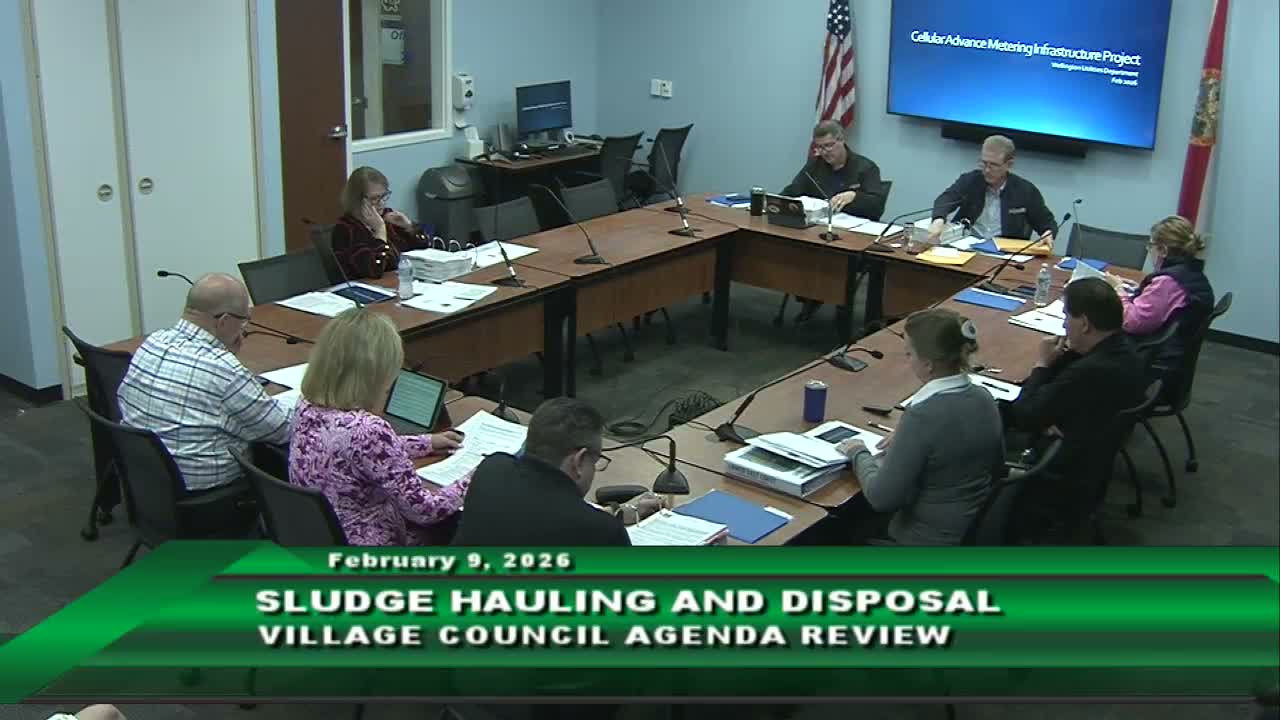
Wellington staff asked the village council during an agenda-review meeting on Feb. 9 to authorize contract awards and task orders to implement a systemwide, cellular Advanced Metering Infrastructure (AMI) replacement for the water utility.
The utility plans to replace roughly 18,000 aging meters and move from the existing drive-by AMR system to an AMI platform that transmits reads over the cellular network several times per day. Speaker 4, presenting the item, said the change will provide near-real-time customer and system data, help detect leaks, and support conservation.
The selection committee recommended Badger Meter to supply meters and integration services (cost cited at about $5,100,000) and RTS Water Solutions for meter installation (about $1,784,000). Staff also requested approximately $163,000 for field installation oversight (Kesha Vars and Associates), program-management services from eSource, $98,000 for SRF consulting (Holtz Consulting) and an owner-controlled contingency of $400,000 to address unforeseen construction or integration issues. Speaker 4 said these numbers include materials, installation, integration and initial system setup; ongoing platform fees for some vendors will continue after commissioning.
On schedule, staff said the meter installer’s contract time is 330 days once meters are delivered; current lead-time estimates make it plausible that the installation program will take about a year to 18 months to complete. Speaker 4 estimated meter lead times have shortened versus earlier projections.
Funding and rate implications: staff explained the project is financed with State Revolving Loan (SRF) dollars; the village will submit reimbursements as work is completed and begin SRF repayments in 2028. Speaker 8 said the repayment amount was included in a five-year rate study and will be incorporated into water/wastewater budgets; some repayment will be drawn from utility reserves as planned. Staff emphasized that the utility is an enterprise fund (paid by users) and is not supported by ad valorem tax dollars.
Council members asked about schedule, vendor selection and whether customers will see higher bills. Staff said the rate study accounts for repayment and that some reserve balances will help smooth payments. The council did not take a final vote during the agenda review; staff sought authorization to place the awards on the upcoming council agenda for formal action.
The council will consider formal contract awards at a subsequent meeting; implementation timing and any ongoing platform fees were described as part of staff’s presentation and will be reflected in the final contract documents.