Get Full Government Meeting Transcripts, Videos, & Alerts Forever!
Get email alerts on the State Legislation topic
No spam. Unsubscribe anytime.
General Assembly update: Stafford priorities remain in play as committees set budgets
Summary
Staff reported that Stafford's priorities — including a 1% sales tax referendum for school construction and several proposals addressing disabled veterans and education funding — remain active in the General Assembly; staff also warned about unfunded mandates such as collective bargaining and higher minimum wages.
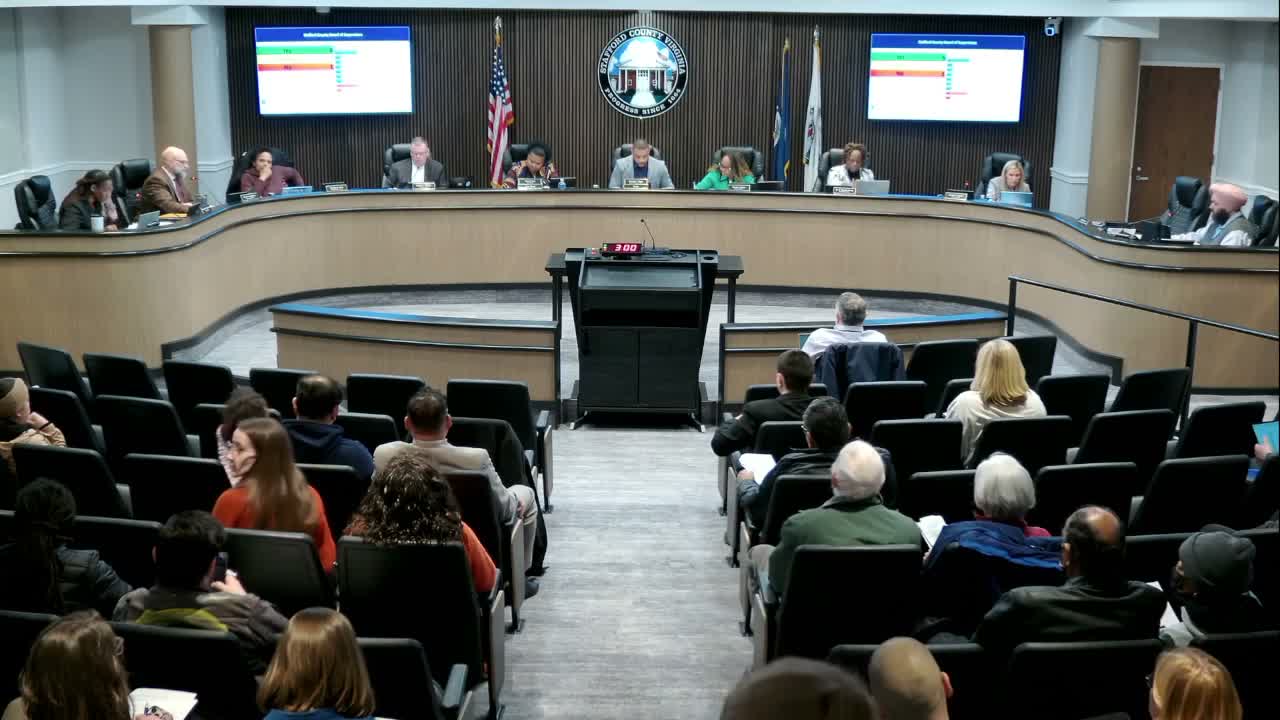
Anthony Twigo, Stafford's Intergovernmental Affairs Manager, briefed the Board on the General Assembly session and budget outlook, saying committees must report budgets by Feb. 22 and that calendar constraints make the governor's formal budget available in early March. Twigo said the House and the governor project roughly $1.2 billion of new spending across the biennium and that unfunded mandates are emerging as a major theme.
Stafford priorities: Twigo reported that the board's request for authority to hold a referendum on an additional 1% sales and use tax for school construction advanced in the House (patron: Del. Samuel Rasoul) and has counterparts in the Senate (SB 66) with differing technical approaches that staff expect to reconcile. He also described three approaches being pursued to address disabled‑veteran property tax issues and a $26 million one‑time reimbursement amendment championed by Delegate Franklin that would target Stafford County.
Unfunded mandates and local impact: Twigo highlighted policy proposals with likely local funding impacts, including teacher‑salary mandates tied to national averages, breakfast program expansions, elimination of school meal debt, collective bargaining for public employees, and a proposed $15 minimum wage by 2028. Twigo and board members discussed how Stafford can advocate — via letters or delegation meetings — and whether to pursue coordinated regional advocacy with other localities and VACO.
Timing and next steps: Twigo emphasized crossover and committee deadlines and said staff will support board communications with legislators. Several supervisors asked staff to prepare financial impact summaries for specific bills (for example, the LCI bill and the $26 million amendment) prior to upcoming lobbying trips and meetings.
Context: Board members expressed interest in supporting the debt-service version of the 1% referendum and asked staff to press the county delegation on reconciliation talks. Twigo noted that multiple local and regional lobbying channels (VACO, coalition groups) are already engaged.