Get Full Government Meeting Transcripts, Videos, & Alerts Forever!
Get email alerts on the Land Use Data Centers topic
No spam. Unsubscribe anytime.
Spotsylvania supervisors direct staff to pursue zoning change making data centers a special-use review
Summary
After months of debate, the Spotsylvania County Board of Supervisors voted to send a red-line draft ordinance to the planning commission that would remove data centers as a permitted use in I‑1 and I‑2 districts and subject them to a special-use permit with nonbinding design guidelines.
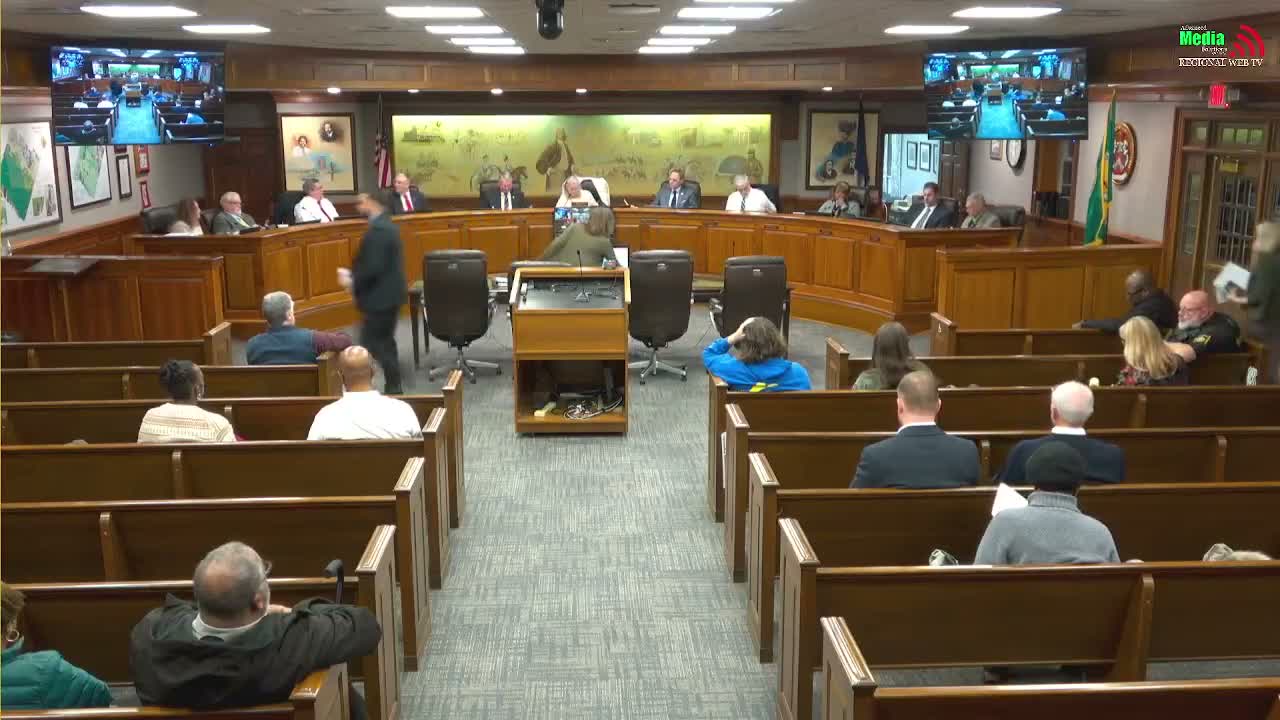
The Spotsylvania County Board of Supervisors on Jan. 13 voted to forward a proposed zoning amendment to the planning commission that would remove data centers from by‑right status in the county's I‑1 and I‑2 industrial districts and require special‑use (SUP) review instead.
County planning staff, led by Kimberly, presented a red‑line draft that strikes the code's current development standards while recommending that staff compile those expectations into a guidance checklist for applicants. "What the proposed draft would accomplish is it would remove data centers as a permitted use in the I‑one and I‑two districts," Kimberly told the board, and it would "add data center as a special use in the I1 and I2 districts." She said the checklist would encourage, but not legally require, practices such as use of Tier‑4 generators and thorough viewshed analyses.
The board's discussion focused on two competing priorities: community protections and predictable standards for developers. Supervisor Chris Yakubowski emphasized the public role in the SUP process, saying, "The public has an absolute right when they have property that is close by that is going to be developed in such a way that might impact them, to have a voice in that process." Supervisor Mullins repeatedly urged preserving concrete starting points so developers know expectations and citizens see negotiated outcomes; he described a recent applicant's changes as evidence the standards can work.
Several supervisors pressed staff and the applicant on technical points including building heights (a 75‑foot cap was noted for the site discussed), viewshed analyses, topography, and distances from residences. Kimberly recommended that guidelines include qualifying language making any numeric baseline adjustable "given the location of your property, topography, existing vegetation," so the guidance would be a baseline rather than an immutable setback.
After discussion, the board voted to move the red‑line ordinance forward to the planning commission for public hearing, with a request for a timely return to the board. The motion was placed by Supervisor Lane and seconded from the floor; the board recorded a majority in favor and one recorded abstention. The planning commission was asked to hold a public hearing in early February so the board could consider a report and its own public hearing later in January/February.
What happens next: the planning commission will advertise and hold a public hearing on the proposed code amendment; the board will receive the commission's recommendation and hold its own public hearing before taking final action. The vote to advance the amendment does not by itself change county code.
Notes on the record: staff reported six pending rezoning applications related to data centers; the draft allows applicants to seek a special‑use approval concurrently with a zoning map amendment rather than requiring two separate applications. The board emphasized that the guidance/checklist could be incorporated as conditions on any SUP.
The board's deliberations underscored the tension in land‑use policy between fixed numerical standards and case‑by‑case public review. Affected residents and developer representatives will have further opportunities to comment during the planning commission and subsequent board hearings.