Get email alerts on the Public Transit topic
No spam. Unsubscribe anytime.
MET Transit outlines ridership, electrification study and asks for 4% operating boost
Summary
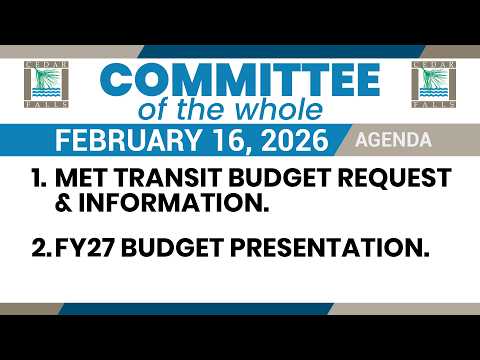
MET Transit general manager David Stearch briefed the Committee of the Whole on fixed‑route and paratransit ridership, a recent transit study and fleet electrification options; MET requested a 4% operating increase, which staff included in the FY27 budget as presented.
David Stearch, general manager of MET Transit, told the City of Cedar Falls Committee of the Whole on Monday that MET operates both fixed‑route buses and paratransit services across Waterloo, Cedar Falls and Evansdale and carries roughly 190,000 fixed‑route passengers per year. "We operate the public transportation services for the Waterloo‑Cedar Falls area in the fixed route system and... the door‑to‑door paratransit for elderly and ADA passengers," Stearch said.
Stearch gave a routes and ridership breakdown: Route 9, the Cedar Falls loop, logged just under 14,000 riders in the last year; the shared Waterloo–Cedar Falls routes 6 and 7 carried roughly 5,000 and 37,000 riders respectively. He said paratransit runs about 11 weekday vehicles with an average weekday passenger load between about 170 and 220.
The presentation summarized a year‑and‑a‑half transit study that prompted route restructuring in Waterloo in 2024 and a fleet transition plan that examined zero‑emission buses, compressed natural gas and hydrogen fuel cells. Stearch said facility power upgrades would be required for electric buses and that hydrogen remains costly and difficult to refuel locally. "We looked at 0 emission buses... or a hybrid electric down the road or a full electric," he said.
Stearch also described rider‑facing improvements under consideration: improved stop signage with QR codes linked to a real‑time GPS tracking app, broader route information in the mobile app and modernized fare options such as tap‑to‑pay or reloadable cards that would require better on‑vehicle internet connectivity.
On cost pressures, Stearch cited rising vehicle prices: "When I first started at MET 6 years ago, a bus was $470,000. Now it's $200,000 more..." He warned that vehicle replacement and insurance costs are significant budget drivers and said MET has faced hiring and retention challenges for drivers but is approaching a more stable roster.
Stearch said MET is exploring micro‑transit — demand‑responsive or first/last‑mile services — but stressed that launching such services would require additional funding and partners. Councilors praised MET’s paratransit for its role moving patients to medical appointments and flagged potential interest in restoring a UNI campus route that had been paused after COVID and was previously funded by student government.
The Committee did not take separate action on MET’s presentation; staff noted MET requested a 4% operating increase and that request is included in the FY27 budget materials presented later in the meeting.
Next steps: MET will continue outreach on micro‑transit options and staff will incorporate MET’s 4% request into the subsequent budget hearings and public notice process.
AI generated
The text on this page is AI generated. Summaries, highlights, analysis, and video transcripts are all produced from the original source material.
AI can make mistakes, so if you spot one, and we will fix it for everyone.
Note: the source content is unaltered by us. Any content source we link to, be it a video, an audio recording, or a document, is presented exactly as its publisher released it. That publisher is usually a government body, sometimes an individual official or another organisation.