Get Full Government Meeting Transcripts, Videos, & Alerts Forever!
Get email alerts on the Redevelopment topic
No spam. Unsubscribe anytime.
Ogden Redevelopment Authority accepts 2024–25 annual report after presentation on TIF, dashboard and project pipeline
Summary
The Ogden Redevelopment Authority voted to accept its fiscal year 2024–25 annual report after a presentation by Economic Development Director Eric Gibson on the RDA's mission, tax increment financing tools, a new public dashboard and upcoming project areas including Union Station, WonderBlock and a $20 million Malachite housing permit.
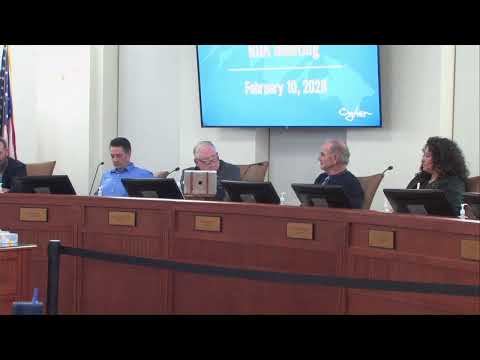
Ogden's Redevelopment Authority voted to accept its fiscal year 2024–25 annual report on Feb. 10 after staff laid out the agency's mission, financing tools and a live data dashboard intended to make RDA activity more transparent.
Economic Development Director Eric Gibson presented the report and read the agency's updated mission, saying the RDA 'exists to improve the lives of Ogden residents by strengthening the city's tax base and reducing long-term tax pressure on citizens' and by 'strategically reinvesting in underutilized properties' to support redevelopment, housing and public amenities. He outlined seven focus areas, including housing, historic preservation, transportation and access to services, and described tax increment financing (TIF) as the RDA's primary tool to fill financing gaps for projects that would not otherwise be feasible.
Why it matters: staff said a new public dashboard will replace the static annual report and provide near-real-time county tax data so council members and residents can see current RDA project values, collected increment and the status of active project areas. That transparency matters for oversight of multi-million-dollar projects and for public understanding of how tax increment is used to fund infrastructure, remediation and site improvements.
Key facts and projects: Gibson said two project areas that closed in 2024 are now returning $215,000 a year to Ogden's general fund and cited Defense Depot Ogden as generating more than $1,000,000 annually for the city. He identified several proposed or pipeline project areas: an airport CRA expansion, a 5 Points zone, a Union Station HTRZ (transit-oriented zone), Capitol Square, the 24th State interchange area and East Washington. Gibson also noted a building permit issued Jan. 28 for the Malachite housing project in the 2600 block of Adams Avenue, which he said is a roughly $20,000,000 development for that CRA.
On TIF and subsidies: members of the public questioned whether TIF amounts to a developer subsidy. Resident Thor Dorosh asked, "fundamentally, any money being given to a developer, I feel, is a subsidy"; staff and board members pushed back with clarifying distinctions. As one slide read and staff reiterated, TIF is not a new tax or a diversion of pre-existing taxes and 'is not a subsidy for a project that could move forward without public support.' Gibson explained that TIF captures new value created after a baseline is set and that many projects require gap funding for remediation or infrastructure to be feasible.
Dashboard, data and timing: Gibson described an automated ETL process to pull county tax data and populate a publicly accessible dashboard (to be posted to city pages). He said the interface can be made live immediately once staff decide who will administer the link and that current target timing for a formal update cycle is by June.
Public comment and community concerns: during the public-comment period, residents expressed a mix of policy and civic concerns. Frankie Ortega said the community is 'witnessing an increase in chaos, division, and lawlessness' and urged unity and return to faith-based values. Theresa Bramwell and other residents described neighborhood decline on 25th and Monroe and voiced concern about large developers and the loss of long-term local ownership in the Capitol Square footprint. Angel Castillo urged care in deal-making and offered outside technical contacts for economic-development best practices.
Board action and next steps: Board member Ritchie moved to accept the annual report; Vice Chair Graff seconded the motion and the board approved it by voice vote. Staff said they will continue to refine RDA policies and mission documents and will follow up with more detail on specific pipeline projects and environmental cleanup timelines (for example, the Capitol Square site where monitoring by the Department of Environmental Quality is ongoing).
Votes at a glance: - Approval of Nov. 18, 2025 special meeting minutes: motion by Board member Myers, seconded by Vice Chair Graff; voice vote; outcome: approved. - Acceptance of fiscal year 2024–25 RDA annual report: motion by Board member Ritchie, seconded by Vice Chair Graff; voice vote; outcome: approved. - Motion to adjourn: voice vote; outcome: approved.
What's next: staff will publish the RDA dashboard once administrators are assigned to the public link, continue work on proposed project-area designations (including an HTRZ around Union Station), finalize revised RDA mission and policy documents, and return with project-specific agreements and financial analyses as projects move from concept to agreement.