Get Full Government Meeting Transcripts, Videos, & Alerts Forever!
Get email alerts on the Higher Education Workforce Integration topic
No spam. Unsubscribe anytime.
Missouri commissioner outlines push to link higher education and workforce to meet 60% attainment goal
Summary
Missouri Commissioner Bennett G. Boggs outlined plans to integrate higher education and workforce development—highlighting 23 job centers, a P20W longitudinal data system, rapid-response job fairs, apprenticeship growth and reentry education—as part of a strategy to raise postsecondary attainment and regional employment.
Bennett G. Boggs, Missouri’s commissioner of higher education and workforce development, told an audience at Washington University in St. Louis that Missouri is pursuing an integrated model of higher education and workforce services to raise postsecondary attainment and expand regional employment opportunities. "By the year 2030, 72% of all new jobs are going to require something past high school," Boggs said, citing research he follows from Georgetown University’s Center on Education and the Workforce.
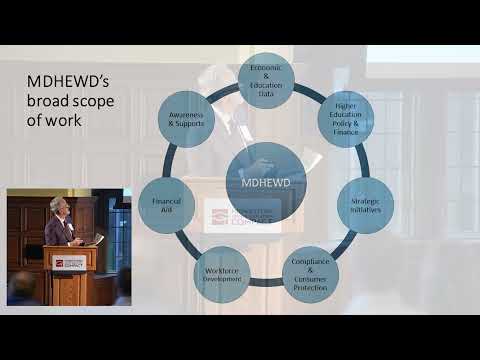
Boggs described the department as the product of an executive order from Governor Mike Parson in 2019 and said it combines three components—traditional higher-education functions, an office of workforce development and the Missouri Economic Research and Information Center (MERIC)—to coordinate policy, budgeting, student aid and labor-market research. He said Missouri currently sits a little above 50% postsecondary attainment and that the state’s goal is 60%, with particular attention on raising outcomes for African American, Hispanic and rural students.
To support those goals, Boggs listed a set of operational initiatives: 23 regional job centers that served about 70,000 Missourians last year; co‑staffed prison education programs; a P20W longitudinal data system to link preschool through postsecondary records (with masked identities) for policy analysis; and an adult learner network focused on reskilling and reintegrating people with some college but no degree.
Boggs highlighted workforce partnerships and apprenticeships as a key lever. "We had 42,000 new registered apprenticeships," he said, noting that Missouri ranks near the top nationally behind larger states and that employers are increasingly willing to help pay tuition or training costs. He also described the state's use of American Rescue Plan Act funds to seed campus-based assessments and matched industry partnerships, saying roughly $110,000,000 has been allocated so far with an additional $54,000,000 approved to expand programming.
On targeted grant programs, Boggs pointed to the Fast Track incentive grant for nontraditional adult students and said the program showed about a 70% success rate in placing students into careers—many into health-care fields—with a large share of participants identifying as Black women. He framed these efforts as part of a broader push to create soft handoffs from GED and adult-education providers into community colleges and credential programs.
During a question-and-answer period, attendees pressed on details. Katie Stewart asked whether state scholarship programs apply to part-time students or cover non‑tuition costs, and whether recipients must remain in Missouri after graduation. A department staff member answered that programs vary, that the A+ Scholarship functions as last-dollar tuition-and-fee aid, most programs historically required full-time enrollment, and that most do not require post‑graduation residency; Fast Track had previously included a loan-forgiveness condition that the legislature removed.
An attendee asked how the department serves people without a high-school diploma; Boggs said job centers connect individuals to GED classes, adult-high-school programs and local supports, and emphasized locating services where learners are comfortable—often at community colleges rather than K–12 campuses. On rural retention, Boggs discussed county-level grant models and county-led partnerships among local government, business and postsecondary institutions as a means to create local career pathways.
Boggs said the state is also prioritizing data and research: MERIC produces regional job and skills reports that can help local partners identify shortages and target programs. He closed by urging more local and regional collaboration among community colleges, regional universities and employers to meet workforce needs.
The presentation ended with thanks to Boggs’ staff and the event hosts; Boggs invited follow-up conversations about implementing the strategies he described.