Get Full Government Meeting Transcripts, Videos, & Alerts Forever!
Get email alerts on the Oer Research Pilot topic
No spam. Unsubscribe anytime.
Pilot results: presenters say no-cost/low-cost course participants showed higher completion in a limited study; national study underway
Summary
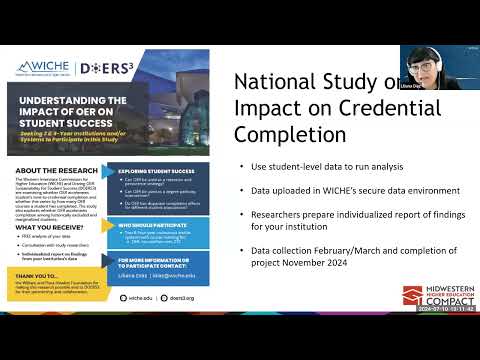
WICHE and MEC presenters described a pilot indicating students in courses designated no-cost/low-cost were twice as likely to complete credentials; they cautioned the result is preliminary, because many institutions combined OER and low-cost designations, and said a national study with five institutions is underway with results expected by November 2024.
Presenters on the Midwestern Higher Education Compact webinar described preliminary research and the limitations that currently constrain attributing student outcomes to open educational resources alone. Liliana Diaz Salutikin, senior policy analyst at WICHE, said the pilot produced "promising results" and reported that "students that participated in no cost, low cost credits were 2 times more likely to graduate or complete their credential compared to students who did not participate in a no cost, low cost credit." She and other presenters cautioned the finding is limited by how institutions label courses.
Methodological caveat: several institutions in the pilot rolled OER into a broader "no cost/low cost" designation (many Western states use a $20–$40 threshold for low cost), which prevents isolating the independent effect of OER. As Diaz Salutikin put it: the study is comparing students registered in courses with OER, ZTC or no-cost/low-cost designations against students who did not participate in such courses; the current analysis focuses on outcomes rather than access and thus does not address whether improved access explains outcome differences.
Publication status and next steps: Diaz Salutikin said the pilot team submitted the paper for journal publication (resubmitted) and expected publication in the coming months; a larger national study is underway with five participating institutions using WICHE’s secure data environment and aggregated analysis, with results expected by November 2024.
Audience questions during the webinar raised two implementation concerns: academic freedom and bookstore/vendor incentives. An attendee asked whether course-marking mandates could undermine faculty academic freedom; Gina Johnson said the roadmap "did not dig into that particular topic in any depth in this report" and pointed listeners to linked resources for more detail. On bookstores and vendors, presenters acknowledged pushback can occur; Johnson recommended early engagement with campus stores and noted some vendors respond to low-cost cutoffs by adjusting prices (an example cited was vendors pricing materials at $39.99 when a $40 cutoff is used).
What to watch: presenters urged institutions to separate course-designation categories where possible, pilot data collection methods and await the national study results for more definitive evidence on the relationship between course-marking, OER adoption and student outcomes.