Get Full Government Meeting Transcripts, Videos, & Alerts Forever!
Get email alerts on the Dual Enrollment Policy topic
No spam. Unsubscribe anytime.
Indiana’s model for dual and concurrent enrollment centers on guaranteed transfer, advising and state funding
Summary
Presenters from MEC’s webinar outlined Indiana’s pillar-based approach to dual enrollment: statutory transfer guarantees (including a 30-credit Indiana College Core), advising requirements, funding incentives and new tools such as MyCollege4 to help students pick transferable courses.
Indiana’s approach to strengthening dual and concurrent enrollment centers on aligning state policy, financial incentives and advising so college credits earned in high school reliably transfer and apply to students’ chosen programs, speakers said in a Midwestern Higher Education Compact webinar.
Jennifer Zinn, a consultant who works on dual-enrollment policy, and Terry Lambert, director of curriculum innovation initiatives and transfer pathways at Ball State University, described a multi‑part “blueprint” Indiana uses to reduce duplication, improve equity and help students complete credentials sooner.
The model pairs statutory and policy tools with infrastructure and dollars. Lambert described a legislatively mandated transfer framework that includes a statewide transfer library and the Indiana College Core, “the total core consists of 30 semester hours of credit and when completed, transfers as a block and then counts as satisfying the core equivalent at receiving institutions,” she said. Zinn said states can require in statute that dual‑enrollment coursework be recognized for transfer on the same basis as courses taken by regular matriculated students.
Why it matters: students and families often cannot tell which courses will apply toward a degree. Zinn noted the downstream cost for students when courses do not apply: “my my students, my child went to college, took English 101 as a high school student, now has to repeat English 101,” she said, adding that repeat coursework can disproportionately harm low‑income and first‑generation students.
Key pillars and policy levers
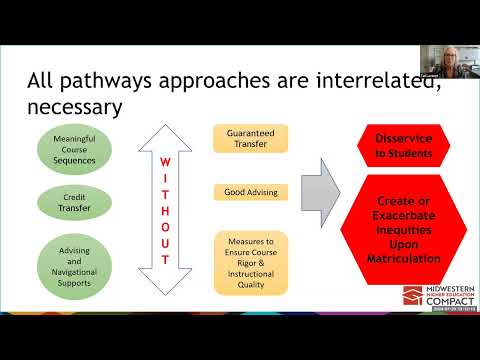
Lambert and Zinn laid out what they called six pillars that, together, support intentional pathways: clear policy and statutes, infrastructure for cross‑sector coordination, prioritized transferable course lists, funding and fiscal incentives, technology tools and data. Lambert credited leadership at the Indiana Commission for Higher Education for building those structures and named Dr. Ken Sauer for long‑running work in the area.
Funding and incentives were a recurring point. Lambert said the Indiana legislature provides line‑item allocations and other appropriations that subsidize reduced tuition, waive costs for eligible students, and support teacher professional development for dual‑credit delivery. "Indiana's legislature has been so supportive and generously funded these dual credit programs for years through a line item allocation," she said.
Advising, transfer applicability and technology
Both presenters emphasized that transfer is not just about credits moving from one transcript to another but whether those credits apply to a student’s major or program of study. Zinn urged states to communicate ‘‘meaningful course sequences’’ by defining which courses apply to general education or CTE program requirements and by collecting state‑level data on whether students take courses that apply.
Lambert highlighted two technology tools: transferindiana.net, the Commission’s long‑running transfer database, and MyCollege4, a newer navigation tool developed to help students, families and counselors make course choices that align with intended pathways. She credited Jessica Barrett at the Indiana Commission for leading the MyCollege4 effort.
FAFSA and completion metrics
Speakers discussed tying FAFSA completion to college‑going initiatives. Zinn noted some states require FAFSA completion for graduation but cautioned that the link between FAFSA filing and long‑term degree persistence is not yet fully understood: policymakers should combine FAFSA requirements with effective advising so underrepresented students gain intended benefits.
Outcomes, challenges and next steps
Lambert and Zinn pointed to evidence that dual‑credit participation can improve college readiness and persistence. Lambert said research shows institutions typically "gain students that are so much better prepared and are ready to move forward and are not don't need, you know, remediation. They're they're persisting, and they're completing their degrees." They also acknowledged persistent challenges including capacity constraints, complexity of transcripts, equity and implementation fidelity; both speakers urged ongoing evaluation and clear communication to avoid “unfulfilled promises” to students.
Q&A and follow up
During a closing Q&A, attendees asked who leads reforms and who should inform families. Speakers said the Indiana Commission for Higher Education drives much of the policy and coordinates with the Department of Education, postsecondary institutions and community partners, but that communication is a shared responsibility. Jonathan Nichols, MEC stakeholder engagement lead and session moderator, closed by reminding attendees of a July 31 webinar focused on instructional quality and inviting participants to take a post‑webinar survey.
What remains unresolved: presenters said proposed changes to Indiana’s graduation requirements were still under discussion and that it was too early to assess the full effect on dual‑credit outcomes. They recommended continued data collection, targeted advising, and coordination between K–12 and postsecondary systems as next steps.