Get Full Government Meeting Transcripts, Videos, & Alerts Forever!
Get email alerts on the Course Marking Roadmap topic
No spam. Unsubscribe anytime.
Midwestern Higher Education Compact releases course-marking roadmap to help institutions identify open and affordable classes
Summary
The Midwestern Higher Education Compact released a Course Marking Roadmap in a webinar, offering a five-step guide—define goals, form a committee, set terms, document processes, and implement—to help institutions mark OER, no-cost and low-cost courses so students and researchers can track savings and outcomes.
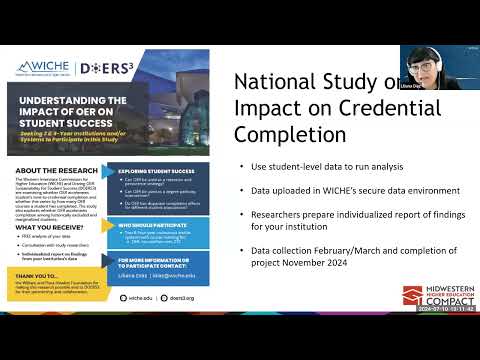
The Midwestern Higher Education Compact (MEC) released a Course Marking Roadmap on a webinar presented by Jenny Parks, vice president for policy and research at MEC, Gina Johnson, principal and co-founder of Data Empowered Consulting, and Liliana Diaz Salutikin, senior policy analyst at the Western Interstate Commission for Higher Education (WICHE). The roadmap, produced under the National Consortium for Open Educational Resources (NCOER) with Hewlett Foundation support, aims to help institutions and systems mark courses so students know whether course materials are open, low cost or no cost and so researchers can reliably measure cost savings and impacts.
Why it matters: accurate course marking is a prerequisite for measuring student savings and for analyzing whether open and affordable materials affect student outcomes. "It gives students agency," Johnson said. "When students can see when they're registering what types of materials each of their courses are using, it gives them agency to make some selections." The report’s authors argue that consistent, well-documented course identifiers allow institutions to both inform students at registration and to use back-end data for institutional research.
What the roadmap recommends: the report is organized around five steps: (1) define goals and purpose; (2) formalize a committee or working group; (3) identify and develop clear terms and definitions (OER, no cost, low cost, ZTC); (4) develop and document validation and data processes; and (5) implement, communicate and evaluate. Johnson emphasized that the work is iterative and that institutions should plan pilots, involve IT and bookstore partners, and test student-facing tools before a full launch.
Practical guidance and examples: the roadmap includes examples and links to existing resources (including "Marking Open and Affordable Courses"), and cites institution examples such as the University of Kansas (communication icons and defined terminology) and the University of Alaska Southeast (faculty-facing websites) as models for implementation. The presenters advised building committees that can include IT, institutional research, faculty champions and student representatives and urged institutions to document where data live and how they will be used.
Limitations and next steps: presenters noted course marking can look different across institutions and systems; aligning terminology across institutions is encouraged but may require local adaptation. All webinar materials and the report are available on the MEC website, and attendees were told they would receive a follow-up email with links and a request for feedback.
The webinar tied the roadmap to earlier MEC work and a recent landscape survey that informed the recommendations; materials and slides will remain accessible on the MEC site.