Get Full Government Meeting Transcripts, Videos, & Alerts Forever!
Get email alerts on the Dual Enrollment Policy topic
No spam. Unsubscribe anytime.
Webinar: Midwestern Higher Education Compact hosts dual-enrollment forum; Minnesota P-20 and Complete College America outline equity-focused strategies
Summary
Speakers from Complete College America and Minnesota's P-20 Partnership described aligning dual/concurrent enrollment with college completion strategies, keeping student costs covered, expanding co-requisite supports, and using statewide convening to remove funding and policy barriers.
Complete College America and Minnesota's P-20 Partnership used a Midwestern Higher Education Compact webinar to argue that dual and concurrent enrollment should be reframed as a state-level strategy for college completion and equity, not merely an access program for high-achieving students.
Brandon Protus, assistant vice president for Alliance Engagement at Complete College America, said CCEA's goal is "to dramatically increase college completion rates and close institutional performance gaps," and urged a systems approach that aligns dual enrollment with colleges' guided pathways, advising, and supports.
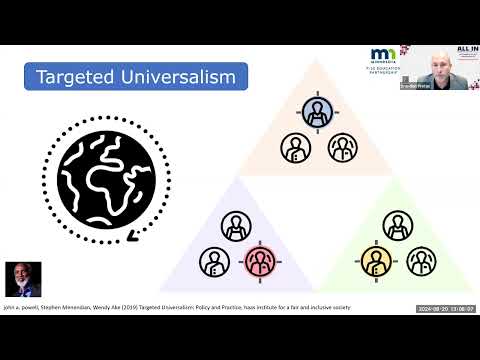
"If we want to achieve equity," Protus said, "we need to put [marginalized] students in the middle," and described three stages of concurrent-enrollment practice: expanding access, aligning coursework with college pathways, and centering equity in who benefits. He recommended multiple measures for placement (including high school GPA), co-requisite supports so students can enroll in college-level gateway courses with appropriate support, proactive college advising tailored to dual-enrollment students, and use of meta-majors and semester-by-semester academic maps to keep students on track.
Josiah S. Lattont, executive director of the Minnesota P-20 Education Partnership, described Minnesota's long-standing dual enrollment system and the P-20's role as a statewide intermediary. Lattont said Minnesota's dual-enrollment policy dates to 1985 and that the P-20 council was codified in state statute; he noted the partnership includes 25 member organizations and operates at the policy and collaborative level rather than delivering services directly.
"We collaborate across sectors to increase equitable education access and supports," Lattont said, summarizing the P-20 mission. He described Minnesota's two program types: PSEO (postsecondary enrollment options) taught by college faculty and concurrent enrollment taught by credentialed high-school teachers. Lattont said, "In Minnesota, student tuition fees and textbook costs are completely covered for students without a cap," while also noting that the state funding model creates trade-offs for high schools and colleges because state aid is adjusted when a student enrolls in postsecondary courses.
Both presenters emphasized that keeping dual enrollment cost-free for students is a core principle and that policy changes should be student-centered. Lattont outlined P-20 priorities including filling state data and research gaps on who participates and succeeds, strengthening strategic collaboration across higher education and K-12, and expanding holistic supports (transportation, food, housing) for dual-enrollment students.
In the question-and-answer session, Protus said co-requisite adoption typically occurs at the college level and cited outcomes data: "we see threefold gains or more, in throughput rates," meaning more students complete gateway courses when supported through co-requisite models. Both presenters recommended structured approaches to convening stakeholders and capturing student voice—1 surveys, focus groups, advisory boards and regionally connected local convenings—and cautioned against tokenizing single student panels.
The presenters closed by urging states to decide which barriers they can address immediately and which require longer-term work, and to consider intermediaries (like P-20 bodies or advisory boards) to sustain collaboration across education sectors. The webinar host said follow-up materials and recordings would be posted on the Midwestern Higher Education Compact website.