Get Full Government Meeting Transcripts, Videos, & Alerts Forever!
Get email alerts on the Dual Enrollment Outcomes topic
No spam. Unsubscribe anytime.
Analysis: Dual‑enrollment students more likely to enroll and complete college, but access and outcomes vary by state and subgroup
Summary
A CCRC analysis presented at a Midwestern Higher Education Compact webinar shows about 81% of dual‑enrollment students enrolled in college within one year and 42% completed a credential within four years; researchers cautioned results are descriptive, access is uneven across states, and Black and Hispanic students remain underrepresented.
Virtual — Researchers from the Community College Research Center at Columbia University presented new national and state‑level findings on the postsecondary outcomes of high‑school students who took college courses before graduation, reporting higher immediate college enrollment and four‑year completion rates for dual‑enrollment students but large variation in access and results across states.
Tatiana Velasco, senior research associate at the Community College Research Center, said the study follows students who first took college coursework in 2015 and tracks their outcomes up to four years after expected high‑school completion. "About 81 percent of these dual enrollment students were enrolled at a postsecondary institution within one year from high school completion," Velasco said, and she reported that 42 percent completed a credential within four years (approximately 25 percent a bachelor's degree, 10 percent an associate degree and 2 percent a certificate).
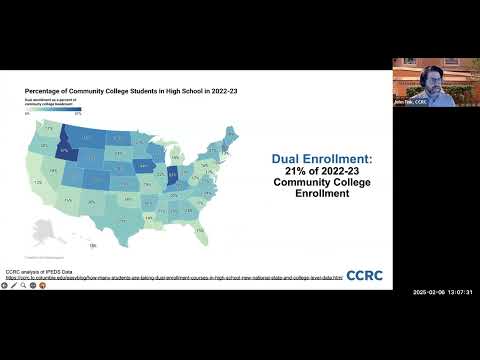
John Fink, senior research associate and program lead at the Community College Research Center, highlighted the scale of the programs: "It's nearly 2,500,000 dual enrollments in the 2022–23" academic year, he said, and noted dual enrollment represents roughly a fifth of community college enrollment nationally.
The researchers emphasized that the findings are descriptive rather than causal. Velasco said outcomes vary widely by state and by how dual enrollment is implemented, financed and defined: "Because of the wide differences in how dual enrollment is implemented ... it's not fair to speak about rankings across the states of states doing better than others," she said. The report and dashboard are offered as points of reference for states and institutions.
The analysis also found subgroup patterns that both encourage and caution policymakers. When compared descriptively with young non‑dual‑enrollment peers, dual‑enrollment students showed higher degree completion rates in most states; in 41 states the association favored dual enrollees, and in 16 states the gap exceeded 10 percentage points in four‑year completion. Velasco said gains were particularly notable for underrepresented groups: "these gaps in bachelor completion rates between dual enrollees and non dual enrollees increase quite a lot by 8 percentage points in the case of low income students, by 11 percentage points in the case of Black students," though she added that Black and Hispanic students often remain underrepresented in dual‑enrollment participation in many states.
Panelists discussed sector differences and measurement. Students who took dual‑enrollment courses at four‑year institutions generally showed higher four‑year bachelor completion rates than students who took courses at community colleges, but the presenters warned that selection effects likely explain part of that gap. On measurement, Velasco said the team used National Student Clearinghouse data to validate identification approaches and that an age‑based proxy used historically in IPEDS (students under 18) is reasonably reliable overall but can vary by state.
The researchers demonstrated a public data dashboard that allows users to filter metrics by state, subgroup (for example, low income), and sector and to see the counts underlying each calculation. They urged practitioners to use Clearinghouse data to examine local trajectories and to align dual‑enrollment offerings with advising and degree pathways.
During a question‑and‑answer session, the panel confirmed the analysis includes many two‑year and technical institutions and said future work will compare dual enrollment with AP/IB and CTE course taking and examine longer‑term labor market outcomes in state case studies (for example, planned Texas analyses). The presenters reiterated limitations: the data show enrollment (attempted coursework) but do not reliably indicate whether students earned credit or how many courses they took.
Jenny Parks, vice president of policy and research at the Midwestern Higher Education Compact, closed the webinar and said MEC will post resources and the chat transcript and will host a dual‑enrollment state policy workshop this summer and a forthcoming MEC report on state dual‑enrollment data availability.
The CCRC report and dashboard described in the webinar are available through CCRC and the National Student Clearinghouse Research Center; MEC will circulate links to attendees and post materials on its website.