
Committee reviews H.549 draft to give DOC role in gathering ID documents and expand zero‑fee credentials for incarcerated and detained people
Get AI-powered insights, summaries, and transcripts
Subscribe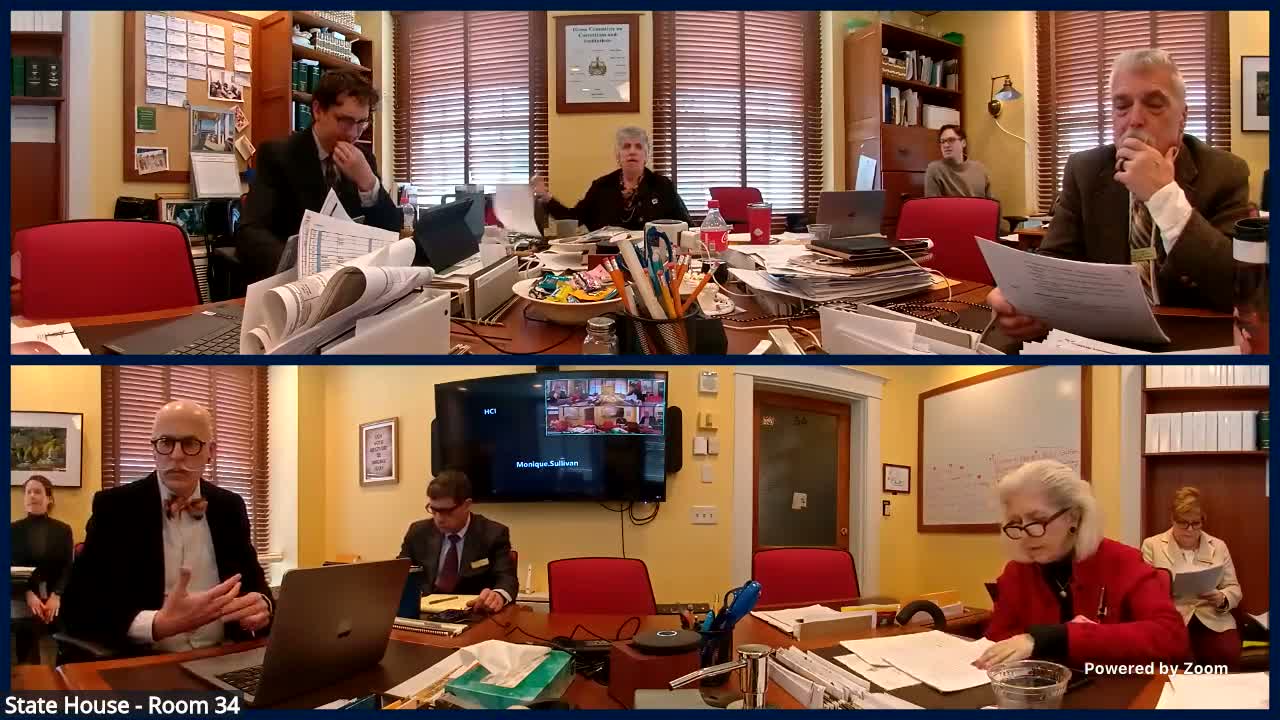
Summary
The House Corrections & Institutions Committee on Feb. 17 reviewed draft H.549 (1.2), which would require the Department of Corrections to collect documentation and coordinate with the Department of Motor Vehicles so people sentenced or detained six months or more can obtain non‑driver IDs, replacement driver licenses (if expired ≤3 years) and replacement learner permits (if expired ≤2 years); DMV said basic credentials would be issued at no cost and the bill proposes staggered effective dates to allow implementation.
The House Corrections & Institutions Committee met Feb. 17 to review H.549 (draft 1.2), a bill that would formalize Department of Corrections (DOC) coordination with the Department of Motor Vehicles (DMV) so people who are sentenced or detained for six months or more can obtain state identification and driving credentials ahead of release.
Hillary Cheddar Ames of the Office of Legislative Council presented the consolidated draft, saying it folds previously discussed miscellaneous motor vehicle language into three sections covering non‑driver identification cards, replacement operator's licenses and replacement learner's permits. The draft adds detainees held six months or more to the population already eligible as sentenced individuals and aligns statutory terminology to refer to “correctional facility.”
Why it matters: Committee members said having identification and driving credentials ready at release reduces barriers to housing, banking and employment. DMV operations staff described how the process works for sentenced people now — DOC gathers required documentation in advance and DMV issues credentials so the individual has them at release — and outlined the operational changes needed to extend that service to detainees, whose release timing can be unpredictable.
Key provisions and logistics: The draft distinguishes non‑Real ID non‑driver identification (requiring Social Security number and proof of residency) from Real ID credentials (requiring residency plus birth certificate or passport). Nancy Prescott, director of operations at the DMV, said, "If the individual has expired for more than 3 years, they would then have to retest at their expense." Documentation would be collected by DOC once a person reaches six months of detention or sentence and held with the individual's belongings for release processing.
For replacement operator's licenses, the draft makes anyone eligible who was sentenced to six months or more and whose license expired not more than three years prior; replacement learner's permits would be available if the permit expired not more than two years prior. DMV staff indicated the agency currently absorbs the $3.30 per‑credential cost for sentenced individuals and the draft would extend a $0 fee for the plain (non‑enhanced) credential to eligible people under the bill.
Implementation timing: The draft as presented proposes staggered effective dates: sections on operator's licenses and learner's permits to take effect July 1, 2026, and the non‑driver identification section to take effect Jan. 1, 2027, to allow DMV time to build system changes to process detainee applications and zero‑fee handling. Committee members discussed whether the detained track of sections 2 and 3 should share the later effective date and asked counsel to rework statutory structure if necessary so implementation timing is clear.
Concerns and tradeoffs: Members queried how credentials will be delivered when release is unpredictable, whether law enforcement evidence holds can block DOC from collecting items, and whether newly released people will be able to get to DMV offices to finalize credentials. A committee member observed that the proposal creates a benefit for people who are incarcerated; proponents framed the change as removing barriers to successful reentry.
Next steps: The committee asked legislative counsel to draft amendments to (a) add detainees to the operator's license and learner's permit language mirroring the non‑driver ID wording, (b) specify that the plain credential be provided at no cost for eligible people, and (c) consider a cross‑reference in Title 28 so DOC‑focused staff can find the DMV‑issued credential requirements. Counsel said she would prepare amendment language and present the draft to the Senate Transportation Committee as scheduled the following day.
The committee recessed after scheduling further drafting and follow‑up with DMV and DOC staff.