Lifetime Citizen Portal Access — AI Briefings, Alerts & Unlimited Follows
Researcher outlines Bayesian‑network method to combine tool‑mark and paint evidence
Loading...
Summary
Dr. Patrick Budzini of Sam Houston University presented at an NIJ/RTI conference a demonstration of Bayesian networks to combine tool‑mark and paint‑transfer evidence, showing illustrative examples of how partial and full matches shift probabilistic support and calling for more empirical studies to populate model parameters.
Dr. Patrick Budzini, associate professor of forensic science at Sam Houston University, presented a methods demonstration showing how Bayesian networks can combine tool‑mark and paint‑transfer evidence to assess whether a particular tool was used in an incident. Speaking at a session hosted by the National Institute of Justice (NIJ) and RTI International, he described the approach as a way to move beyond separate, silos of reporting for different evidence types.
Budzini said the method models relationships among variables — such as manufacturing features, acquired tool defects, and paint spectra — and permits updating a prior probability when observations are made. “We keep 50 50 because the exercise that I want to be to do here with you today is to see how those would change anytime we do a particular observation,” he said, stressing that the 0.5 prior in his talk was illustrative, not a case‑level assertion.
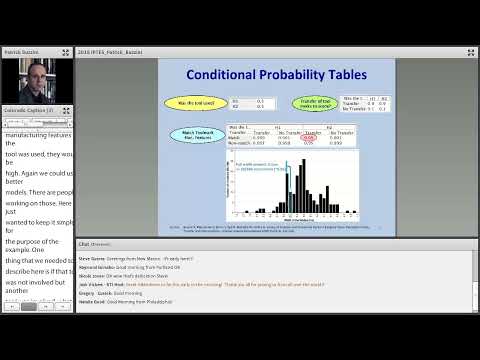
Using example conditional‑probability tables and compact experimental data, Budzini showed how different observations alter posterior odds: a partial correspondence of manufacturing features moved an illustrative prior from about 50% to roughly 55%, while a strong match of both manufacturing and acquired features could raise modeled support close to 99%. Conversely, nonmatching paint observations in his examples reduced support for the hypothesis that the tool was used.
The presentation described the empirical inputs as limited and in some cases dated: Budzini referenced surveys and a dataset of “more than 200 crowbars” used to estimate width distributions and rare feature rates, and he acknowledged that many parameter choices were simplifications made for the demonstration. He summarized experimental work that categorized paint transfer quantities as none, few or large and used infrared profiles to compare paint samples.
On cross‑transfer — paint moving between tool and scene in both directions — he said modeled examples and experiments did not always show the large evidential contribution some practitioners expect. “Data does not suggest that necessary,” Budzini said, arguing the effect depends on observed quantities and the quality of matches.
He emphasized limits and next steps: the numbers he used were for pedagogical illustration, not drawn from adjudicated cases, and he urged broader, rigorous studies to estimate conditional probabilities and comparison‑score distributions in real‑world instrument and tool populations. He closed by saying the challenge of combining evidence is “a scientific problem” and invited further questions and follow‑up by email.
The presentation framed Bayesian networks as a tool to make explicit assumptions and to quantify how different kinds of evidence jointly affect an activity‑level question such as whether a tool was used to force a door. Budzini and his co‑author, Nick Petraco Jr., presented the approach as a step toward integrating multiple evidence types while noting the method’s dependence on larger empirical studies to ensure its inputs are robust.