
Cadre Forensics presenter says virtual microscopy reproduced examiner conclusions in 2016 feasibility study
Get AI-powered insights, summaries, and transcripts
Subscribe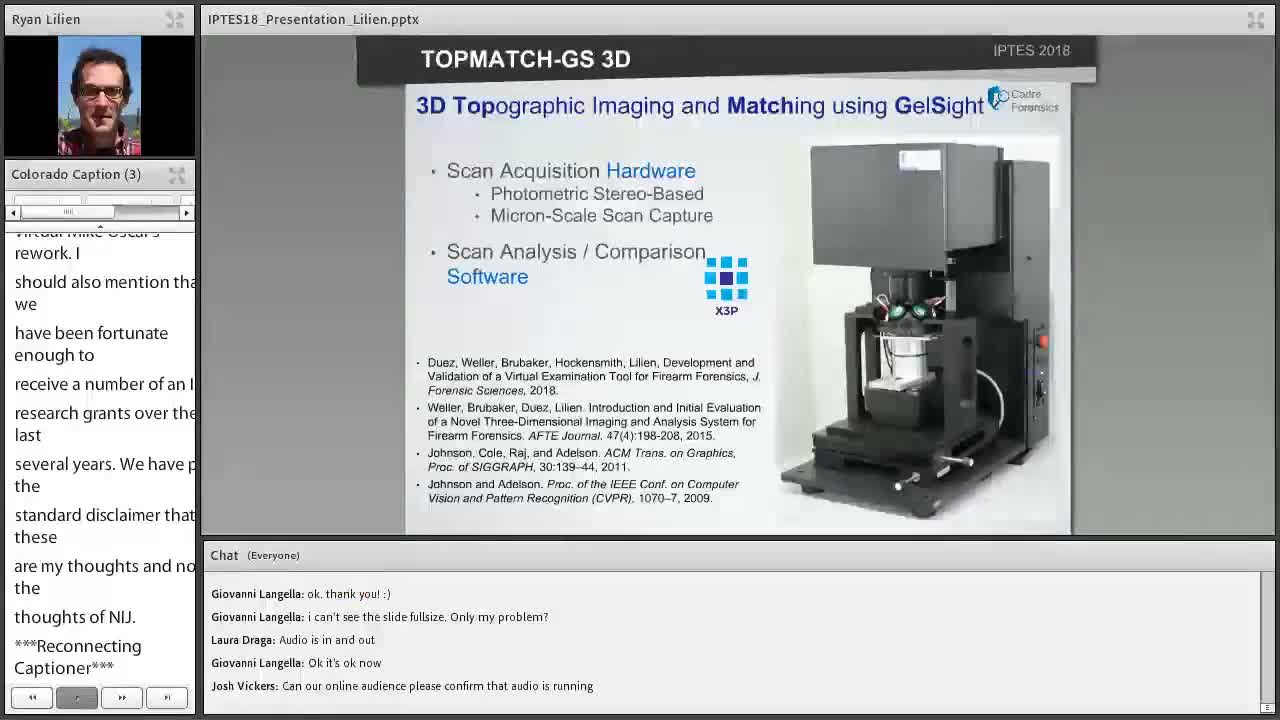
Summary
A Cadre Forensics researcher described a 2016 feasibility study showing virtual microscopy for 3D cartridge-case comparisons produced no false positives among 46 examiners and enabled consistent annotations across labs; presenter outlined hardware, software, and plans to build large shared scan datasets.
An unidentified researcher from Cadre Forensics told a technical session that virtual microscopy — the visual examination of a digital 3D microscopic representation of evidence — produced robust results in a 2016 feasibility study and could expand remote review, training and proficiency testing in firearm forensics.
The researcher said the work centered on Cadre’s TopMatch GS 3D system, which uses GelSight photometric-stereo scanning to capture micron-scale surface topography and companion software to visualize, annotate and compare scans. "We don't have any false positives," the presenter said of their scoring function after "over a 150,000 comparisons," adding that "if they're well marked, we get a 100% recall" and that recall for more realistic, minimally marked cases was about "80% depending on the test set." The presenter described the GelSight method as a reversible silicone casting that conforms to a cartridge-case surface, permits nondestructive imaging and can be reused.
Why it matters: 3D scans produce measurements in traceable units (microns) and can be shared remotely without moving physical evidence, potentially reducing handling risk and enabling standardized training and blind verification across agencies. The presenter emphasized interoperability — work with NIST on an x3p surface-topography file format and anticipated OSAC guidance on scan acquisition and lab implementation — as a prerequisite for broad adoption.
Study design and results: The feasibility test used two CADRE CTS-style test sets (each with seven cartridge cases: three knowns and four unknowns) and was completed in 2016. Cadre distributed standardized hardware (Dell laptops with high-resolution monitors) and its virtual-microscopy software to participating labs to control display variables. Fifteen U.S. crime labs participated, yielding 46 trained examiners and 10 trainees. Participants annotated regions of similarity and difference on paired scans; aggregated annotation "heat maps" showed consistent examiner focus on aperture-shear regions when calling matches and highlighted breach-face areas useful for elimination.
The presenter reported that trained examiners correctly identified matches in the controlled test sets and that the study produced no false-positive identifications; some participants recorded "inconclusive" rather than "elimination" on nonmatches because of local lab policies restricting elimination on individual marks (the presenter cited the FBI as an example of such a policy). The presenter framed the study as a feasibility exercise, not an assessment of individual error rates.
Tools and throughput: The version-3 scanner was described as having greater automation and a tray that holds up to 15 cartridge cases for batch scanning. The researcher noted the FBI Firearms and Toolmark Unit had conducted internal validation and was using the system in casework, and that the RCMP in Ottawa is an active collaborator.
Next steps and data collection: Moving toward a statistically grounded scoring function will require very large, representative datasets to build likelihood distributions. The presenter said Cadre is collaborating with the FBI FTU (speaker estimated on the order of 10,000 test fires, noting uncertainty), the RCMP (donated roughly 20,000 cartridge cases), and volunteering state labs to scan retired test fires. Cadre plans to contribute scans to NIST’s ballistic toolmark database; the presenter said a target of "15,000 cartridge case in 2018" was the collection goal.
Limitations and adoption considerations: The presenter warned that virtual microscopy is an indirect examination (examining a digital representation rather than photons directly from the object) and that some surfaces — for example certain chamber marks — may not be captured unless specifically scanned. He also noted practical trade-offs: 3D scanning can be slower and produces larger files, and lab adoption requires interoperable formats, validated software, and updated SOPs.
The session closed with acknowledgements of NIJ funding and collaborating organizations; the presenter invited interested labs to participate in follow-up studies and a live virtual proficiency test to be offered through CTS.