
NIJ director highlights non-DNA evidence, new imaging tools and research funding at forensic symposium
Get AI-powered insights, summaries, and transcripts
Sign Up Free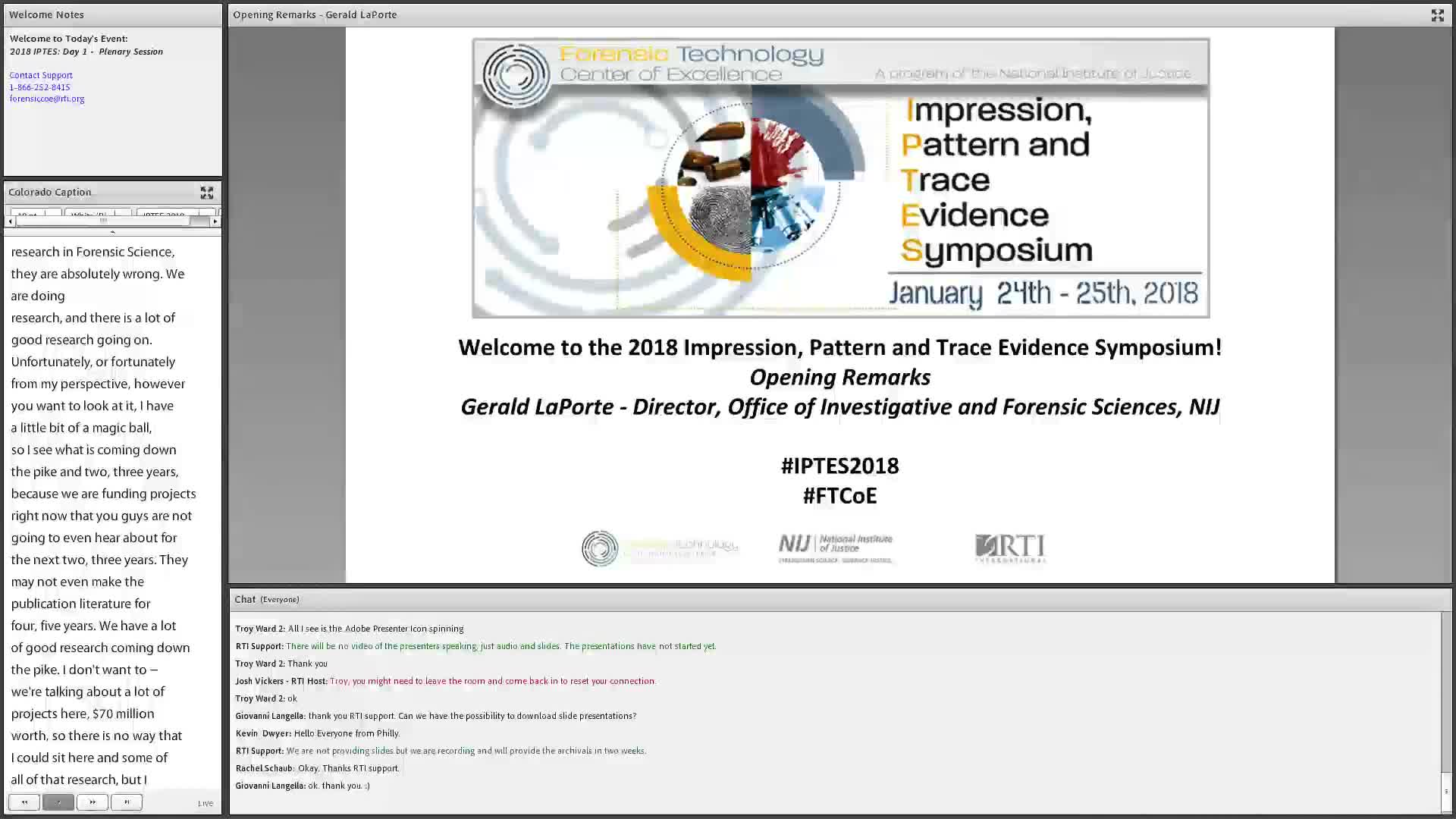
Summary
NIJ director Jerry LaPorte told attendees the agency has invested heavily in forensic research and stressed the value of non-DNA evidence, highlighting CADRE’s Top Match 3-D imaging system and West Virginia University studies on examiner decision-making.
Jerry LaPorte, director of the Office of Investigative and Forensic Sciences at the National Institute of Justice, used opening remarks at the Impression, Pattern and Trace Evidence Symposium to emphasize the agency’s investments in forensic research and the practical importance of non‑DNA evidence.
LaPorte told the audience that NIJ has invested “over $200,000,000 in forensic science research and development” since 2009 and cited a cumulative running total of about $248,000,000 dating to 2002. He said that more than one‑third of NIJ‑funded projects in recent years — roughly $70,000,000 — have gone directly to impression, pattern and trace evidence disciplines.
LaPorte highlighted specific projects funded or supported by NIJ. He described a system developed by CADRE Research Laboratories called Top Match, a three‑dimensional surface topography imaging and analysis tool for cartridge casings that was developed in collaboration with an Oakland Police Department firearms expert and researchers at NIST. “Top Match … was developed to provide fast three‑dimensional scans of cartridges that are significantly more detailed than some of the earlier systems,” he said.
He also pointed to research at West Virginia University seeking to understand expert decision making in footwear examinations and to quantify variability in examiner conclusions. LaPorte said the work aims to identify factors that affect footwear comparisons and could translate across other impression and pattern disciplines.
Arguing for a broad forensic toolbox, LaPorte cited a recent NIJ article and summarized its central point: in roughly half of sexual‑assault cases no DNA is recovered, meaning other types of forensic evidence can be decisive. “DNA is great … but even in [sexual] assault cases, in half of [those] cases there is no DNA,” he said, noting that impression, trace and other non‑DNA evidence have linked multiple scenes in investigations where DNA was absent.
LaPorte closed by previewing symposium topics — statistical frameworks, communications of findings, deep learning and discussions of error rates — and by stressing the value of collaboration between researchers and practitioners to move tools from the lab to operational use.
LaPorte’s remarks were followed by an introduction of Ted Hunt, senior adviser to the deputy attorney general on forensic science at the Department of Justice, who was presented as the symposium’s next speaker.