Get Full Government Meeting Transcripts, Videos, & Alerts Forever!
Get email alerts on the Forensic Hair Analysis topic
No spam. Unsubscribe anytime.
Penn State researcher urges caution using hair microstructure to assign ancestry
Summary
Sandra Koch presented research showing measurable hair-trait differences across populations but substantial overlap that limits definitive ancestry assignments; she urged more descriptive reporting and investment in reference collections tied to genetic ancestry.
At a Trace Evidence breakout session this morning, Sandra Koch, a PhD candidate in anthropology at Penn State University, presented findings from microscopy-based studies of human hair and urged forensic practitioners to avoid broad racial categorizations when reporting ancestry from hair.
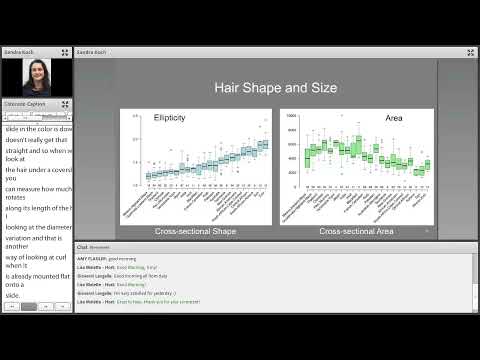
Koch told attendees she is "really interested in understanding the structure in human hair and how it varies among different population groups and . . . how do we quantify those traits for forensic purposes?" She described a set of measurable traits—cross-sectional shape, hair area, cuticle thickness, pigment granule size and distribution, and curl—that can be quantified using light and transmission electron microscopy.
Koch reported patterns across groups: some populations showed narrower ranges of ellipticity (shape) while hair area varied more, and there were measurable mean differences in cuticle thickness and pigment granule sizes across samples selected for high proportions of genetic ancestry. "These typological models really do fail because most biological traits are continuous variables," she said, arguing that older racial categories do not reliably map to hair form.
Her results showed general trends—larger pigment granules tended to appear in samples from people with African ancestry, intermediate sizes in East Asian samples and smaller sizes in European samples—but she emphasized substantial overlap between groups and intra-hair variability. Koch also described a practical measure of curl based on apparent diameter variation when hairs are mounted on slides and noted higher counts among samples with African ancestry and similar patterns in some New Guinea samples from the historic Trotter collection held at the Smithsonian National Museum of Natural History.
Koch summarized an interlaboratory review and proficiency-test observations about examiner reporting. "There's a good third of laboratories that are still using the outdated racial terms," she said, and added that some labs now combine race and ancestry while others avoid reporting ancestry out of concern about being wrong.
As a remedy, Koch proposed changes to reporting practices: replacing terse statements such as "microscopically similar" with concise trait descriptions (color, pigmentation patterning, shape) and contextualizing those traits as "suggestive of" particular ancestry backgrounds while explicitly noting limitations. She urged building reference collections linked to known genetic ancestry and said that effort "is going to take money" and further research.
Koch acknowledged funding support from the National Science Foundation, a National Institute of Justice (NIJ) grant, the Asti Research Award and Penn State University and said her views are her own. She closed by inviting questions from online and in-person attendees.
The presentation emphasized methodological detail and professional practice: Koch recommended clearer, trait-based reporting and investment in genetically documented reference material to improve the scientific basis for ancestry-related statements in forensic hair reports.