
NIST researcher describes ‘‘congruent matching’’ method, reports near‑zero error rates in ballistics tests
Get AI-powered insights, summaries, and transcripts
Subscribe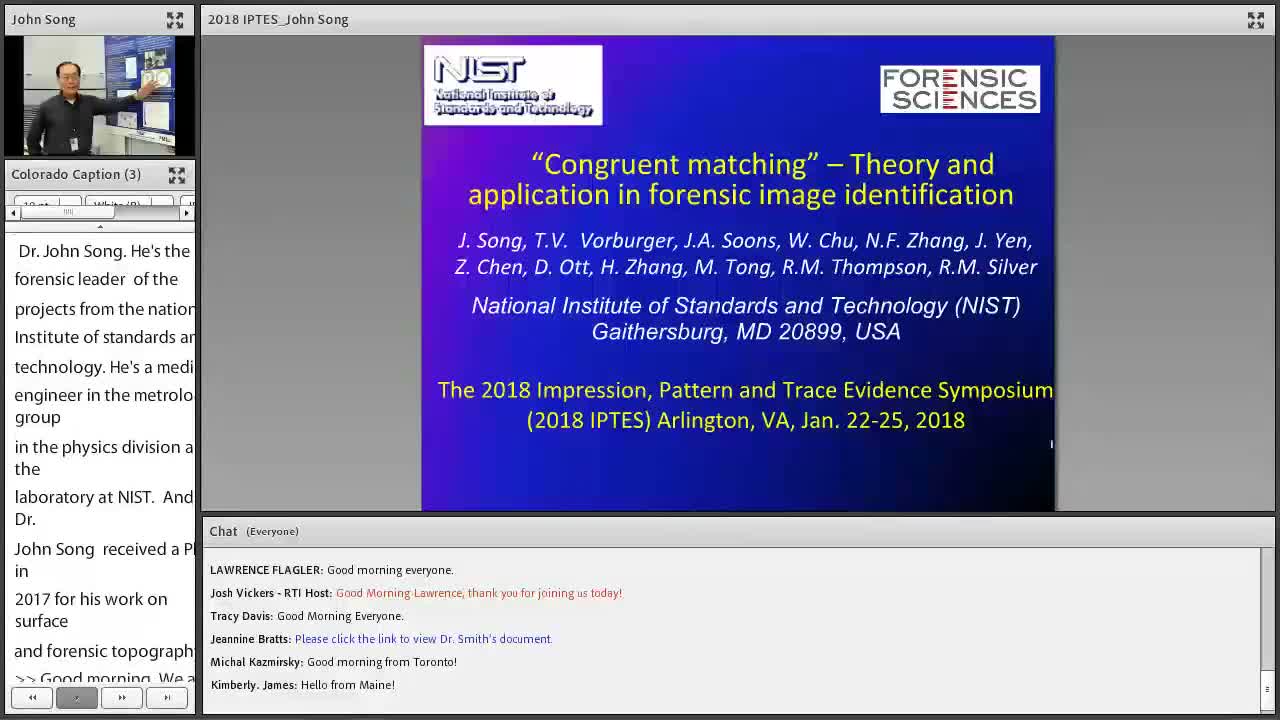
Summary
Dr. Song of NIST presented a method called congruent matching for forensic image correlation and reported validation experiments (including 95 cartridge cases and 4,465 image pairs) he says yield cumulative false positive and false negative error rates of less than 1 in 1,000,000. He described workflows for cartridge-case, firing-pin and bullet‑profile comparisons and said the approach could support federal ballistic identification efforts.
Dr. Song, project leader of the Forensic Topography and Surface Metrology Project at the National Institute of Standards and Technology, presented a statistical, cell‑based approach to forensic image correlation he described as "congruent matching" and summarized validation tests he said show extremely low error rates.
In a technical presentation, Dr. Song said the method discretizes a ballistic image into many small "cells," then applies multiple identification parameters (including cross‑correlation maxima and spatial congruency of cell distributions) so that aggregated cell matches form a statistical basis for identification rather than a single subjective judgment. "We developed congruent matching for accurate ballistics identification and error rate report," he said.
Why it matters: The National Research Council (2009) and the President’s Council of Advisors on Science and Technology (PCAST, 2016) both criticized traditional firearms‑forensics practice for relying on assumptions of uniqueness and examiner judgment without a statistical foundation. Dr. Song framed congruent matching as a response to those critiques, aiming to produce objective, reportable error rates.
Validation and tests: Dr. Song described a validation study he said used 95 cartridge cases fired from 10 consecutively manufactured pistol slides, producing 4,465 image pairs. He reported that "the cumulative false positive and cumulative false negative error rate is smaller than 1 over 1000000," attributing that figure to the aggregate cell‑matching distributions observed in the tests. He also presented score ranges for matching versus nonmatching pairs (transcript contains several numeric ranges described during the talk) and said most nonmatching pairs produced zero congruent matching cells.
Methods for curved and subclass features: For firing‑pin and other curved surfaces, Dr. Song described slicing 3‑D topography images into circular cross sections, transforming them to linear profiles via polar coordinates, subtracting mean profiles to emphasize high‑frequency, individual features, and then correlating those profiles with metrics such as CCFmax. He also described a feature‑extraction pipeline that highlights peaks and valleys (using a central‑truncation filter) and produces a colorized similarity map to help examiners visualize matches (pink for similar peaks, blue for similar valleys, yellow for dissimilar areas, gray for low‑importance regions).
Bullet profile segmentation: Dr. Song outlined a segmentation approach for bullet land/groove profiles that uses parameters including twist angle and land index, and he reported test results from a dataset of bullets fired from consecutively manufactured firearms that, he said, show separable score distributions for known matching and nonmatching pairs.
Limitations and transcript caveats: Several numeric ranges and some transcribed phrases in the talk are unclear in the recording (for example, a funding source he named is transcribed as "Fluminest special program office," and an apparent reference to a standards body is transcribed as "AUSAC"). The presentation language attributes the methods and reported results to Dr. Song and his NIST team; the transcript contains no independent external validation or agency adoption at the time of the talk.
Implications: Dr. Song suggested the approach could help U.S. manufacturers develop next‑generation automated ballistic identification systems and said it could "support ATF and FBI for ballistic identifications," framing the work as a research contribution rather than a policy decision or immediate operational change for federal agencies.
What’s next: Dr. Song closed by noting further work remains on subclass features and broader validation; Tyler Warburg was mentioned as scheduled to introduce a related report later in the program but does not speak in the provided transcript. The presentation ended without any formal vote or policy action.