
Panelists say jurors can understand probabilistic evidence with training; trace evidence needs databases and education
Get AI-powered insights, summaries, and transcripts
Sign Up Free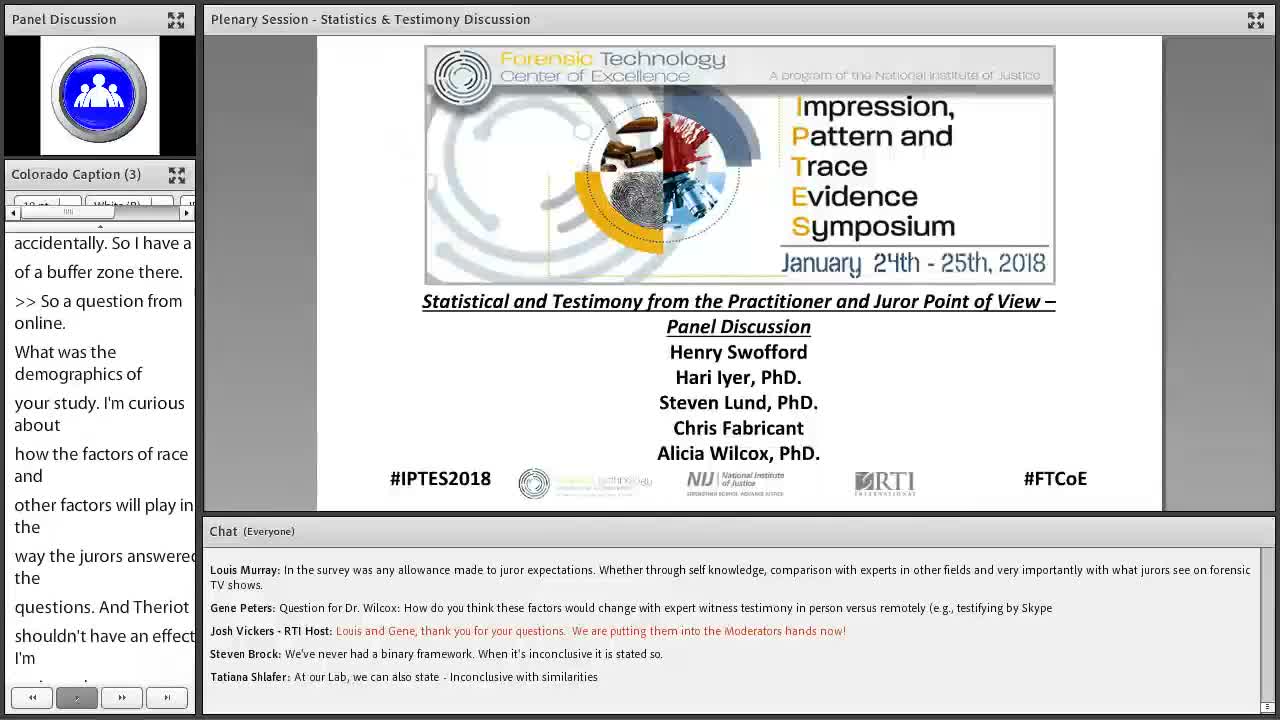
Summary
Panelists and attendees debated whether juries can accept probabilistic forensic testimony. Researchers recommended validated methods, demonstratives, practitioner education, and stronger trace evidence databases to improve juror perceptions.
Researchers and lab practitioners at the panel focused on juror comprehension, workforce qualifications, and evidence types that need more empirical support.
Alicia, who conducted a juror survey, confirmed she collected demographic data including race, education, political beliefs and CSI exposure but had only analyzed education and last science course so far; she said more analysis is needed to determine whether race or age affected juror responses. She and other panelists stressed that jurors can follow probabilistic testimony if experts take the time to explain the inference and use demonstratives. "Jurors never understood any kind of numbers... I simply try to communicate the weight of evidence in the simplest way possible," said Nora Rudin, who has testified with probabilistic approaches.
Trace evidence drew separate attention. Jessica, a trace evidence examiner with the Pennsylvania State Police, said jurors view trace conclusions as less credible than fingerprints and asked whether advanced degrees or training would improve juror perception. Alicia and others responded that expanded, high-quality trace databases and stronger empirical resources would make trace conclusions more robust and more persuasive to jurors; they also supported advanced education and certifications for laboratory staff.
Panelists highlighted the research need to compare model outputs: multiple models producing the same inference bolster confidence, while widespread divergence requires further study in research settings rather than courtroom resolution. The panel repeatedly emphasized that foundational validation should precede courtroom use, and that education for investigators, prosecutors, defense counsel, and jurors is essential to communicate probabilistic findings accurately.
The discussion ended with a call for continued community engagement, research on model convergence, and additional training programs to prepare nontechnical audiences to interpret quantitative forensic evidence.