Get Full Government Meeting Transcripts, Videos, & Alerts Forever!
Get email alerts on the Local History topic
No spam. Unsubscribe anytime.
Historian Lisa Burton traces New Rochelle's Black history and warns about redlining and displacement
Summary
Lisa Burton delivered a historical presentation at New Rochelle's Feb. 5, 2026 Black History Month event, citing 1698 census entries, the 1930s codification of redlining, and highway construction that she said removed '300 homes' from predominantly Black neighborhoods.
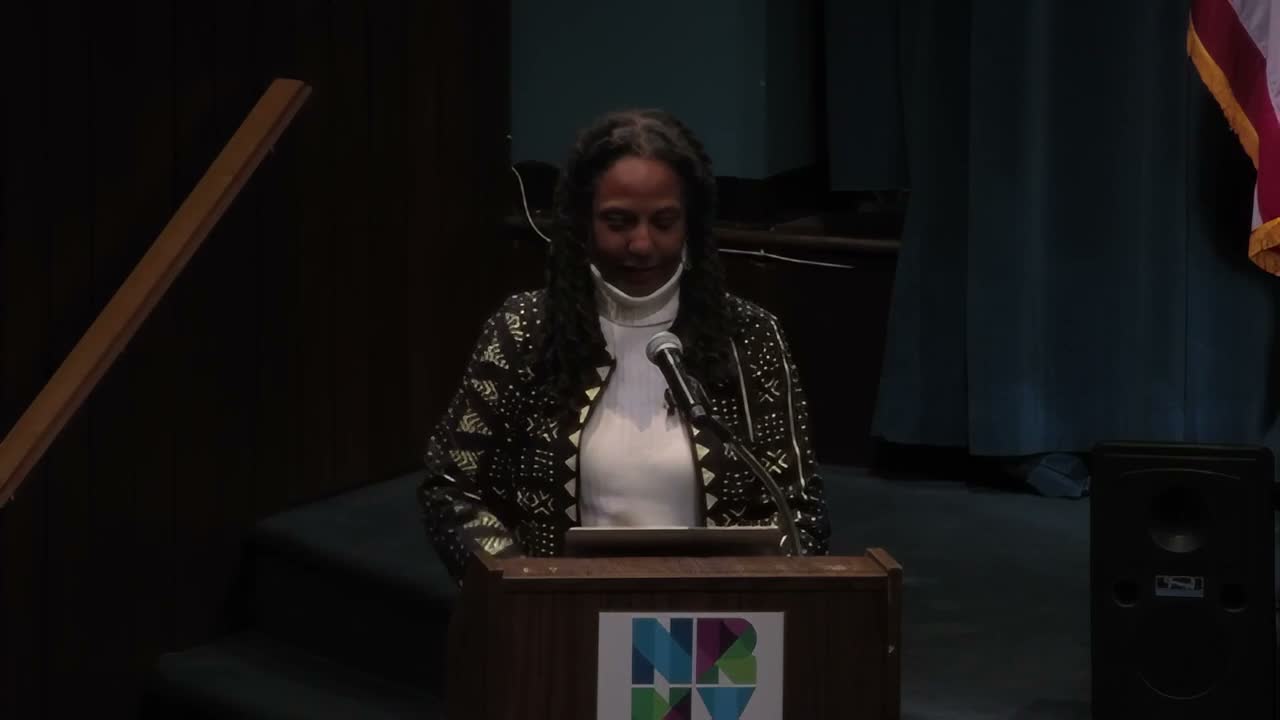
Lisa Burton, a member of the African American Advisory Committee, gave a wide-ranging historical presentation at New Rochelle's Black History Month celebration on Feb. 5, 2026, that linked early Black settlement to twentieth-century housing discrimination and urban-renewal displacement.
Burton opened with a quotation from Zora Neale Hurston and traced local history from a 1698 census listing enslaved people through the 20th century. She described civic formations such as the Booker T. Washington Club and a 1905 cooperative business league, and she noted visits and speaking engagements in New Rochelle by figures including Ella Fitzgerald and Paul Robeson.
Burton emphasized structural barriers in housing and planning. "In the 1930s, the federal government codified prejudice," she said, describing redlining maps and recommending the online project 'Undesign the Redline' as a resource. She also said highway and urban-renewal projects removed homes in Black neighborhoods—"300 homes were destroyed when they built the rotary," she stated—and urged attendees to study local maps to see overlaps between redlined areas, highways and contemporary health burdens.
Why it matters: Burton framed current inequalities as rooted in decades of policy and planning decisions. Her remarks were part historical recital and part civic call to action; she concluded by urging the community to "link arms and move forward" and to convert recognition into organized change.
What was said and how it was sourced: Burton read names from an early census and cited local sources (Schomburg Library photo collections, Linda Taryn Reed's Lincoln Conservatory work) and public exhibitions; numeric claims and some dates were presented by Burton and are recorded in the event transcript but were not accompanied by on-site documents. The transcript records her characterization of New Deal-era redlining and the displacement caused by highway projects as assertions in her presentation.
Closing: Burton concluded by urging collective will to restore civic gains and renew community power; the program moved on to proclamations and honoree remarks.