Get Full Government Meeting Transcripts, Videos, & Alerts Forever!
Get email alerts on the Local Government Finance topic
No spam. Unsubscribe anytime.
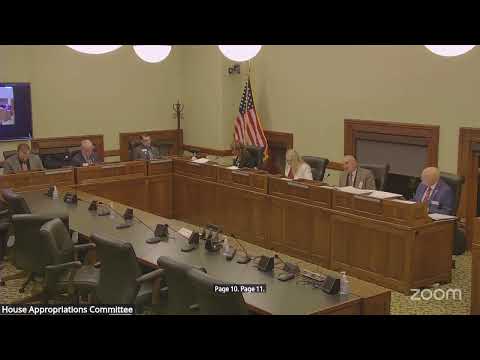
Panel backs bill to codify Madden distribution, ties local share to prior‑year sales tax
Summary
House Bill 107 would codify the Madden formula for local government distributions, move the funding source to 5.6% of the previous fiscal year’s statewide sales‑and‑use tax, change payment dates to Oct. and Mar. 15, and passed the Appropriations Committee on a 7–0 roll call.
Cheyenne — The House Appropriations Committee advanced House Bill 107, which would codify the state’s local‑government direct‑distribution model (the Madden formula) and change how the program is funded and timed.
Mister Quilty, presenting the bill, said the current framework—modernized in 2016—was designed to give more funding to municipalities and counties with lower tax bases or small populations. "The legislature appropriated $146,250,000 for the biennium or $73,125,000 per fiscal year from the general fund to the Office of State Lands and Investments," Quilty said, describing how OSLI distributes shares under the formula.
Under the proposed changes, the bill would move the source of local distributions from a legislatively determined appropriation to a fixed share: 5.6% of the previous fiscal year’s total statewide sales‑and‑use tax. The bill also codifies the formula into statute, shortens the data lag by using the immediately preceding fiscal year’s sales/use tax data, and changes payment dates for distributions from August and Jan. 15 to October and March 15.
Quilty walked the committee through the formula’s components: a flat distribution (a floor payment of $15,000 for communities with population 35 or fewer and $35,000 for those above 35), a proportional distribution (the Madden formula using normalized per‑capita sales/use tax and assessed valuations), and a 5% revenue‑challenge/hardship distribution for qualifying municipalities.
Public commenters representing counties and municipal organizations supported the change as a more sustainable, predictable funding stream. Commissioner Terry Wolf of Washoe County said direct distributions are "very critical" for basic services such as road and bridge work and emergency medical services, and pleaded for flexibility on the percentage. "We're hopeful that, I think it's currently at 5.6% — if that is able to be looked at to be increased there, that the … if it stays at that 5.6%, that's equivalent to $242,000 reduction on an annual basis for Washoe County," Wolf said, noting the county’s road budget was about $608,400.
Jeremiah (Mister Raymond) and association representatives urged care in drafting intent provisions; Raymond cited Niobrara County’s experience, saying recent intent language had restricted how a small county used funds to expand employee benefits and created a practical barrier for a low‑revenue county attempting to offer health coverage.
Ashley Hart Street, executive director of the Wyoming Association of Municipalities, voiced the association’s support and noted two municipalities (Lost Springs and Van Tassel) fall below the 35‑person threshold for the flat distribution.
Committee members generally signaled support while reserving final decisions about the percentage and floor mechanics for later floor debate. The committee approved House Bill 107 by roll call (seven "aye" votes) and advanced it to the next stage.