Get Full Government Meeting Transcripts, Videos, & Alerts Forever!
Get email alerts on the Higher Education First Ladies topic
No spam. Unsubscribe anytime.
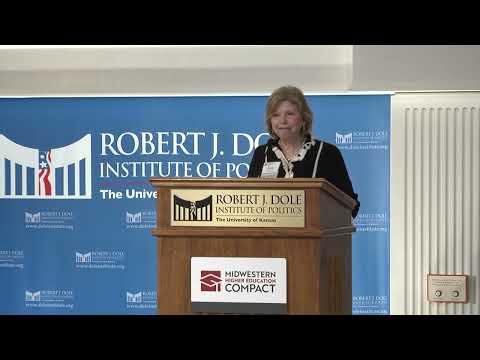
At Dole Institute, scholar outlines how first ladies use "soft power" to shape higher education
Summary
Dr. Diana Carlin argued at the Dole Institute that U.S. first ladies have influenced higher education through strategic speeches, philanthropy and program-making—from Caroline Harrison's push to admit women to Johns Hopkins medical school to Jill Biden's continued teaching while in the White House.
Dr. Diana Carlin, professor emerita of communication at Saint Louis University and retired professor of communication studies at the University of Kansas, told an audience at the Dole Institute of Politics in Lawrence that U.S. first ladies have long used "soft power" to shape higher education.
Carlin said the influence often works behind the scenes: "But this notion of soft power, that is what the first ladies have had since Martha Washington," she said, arguing that social hosting, conditions attached to fundraising and post-White House foundations have produced measurable change on campuses and in research priorities.
Carlin illustrated the point with historical and contemporary examples. She described Caroline Harrison's condition on raising money for Johns Hopkins medical school: Harrison agreed to fundraise only if the school began admitting women, a change Carlin said prompted other medical schools to follow. She credited Bess Truman with mobilizing Senate wives to stop a Congressional plan to demolish the White House, and cited Edith Roosevelt as the first first lady to hire staff.
Carlin also highlighted large post-White House philanthropic efforts and university partnerships. She said the Barbara Bush Foundation for Family Literacy "has given away over a $100,000,000," noting the foundation's grants to higher-education institutions and a competition that funded apps for adult learners. She described the Lady Bird Johnson Wildflower Center at the University of Texas at Austin as "an association" and a 234-acre research resource for environmental study and interdisciplinary work.
On health and recovery, Carlin said Betty Ford's openness about treatment led to institutional work on addiction and that the Hazelden Betty Ford Center collaborates with universities on research and clinical practice. She named NYU Grossman School of Medicine and the University of Minnesota as examples of university research tying into recovery and clinical programs.
Turning to more recent first ladies, Carlin said Laura Bush spotlighted higher-education research relevant to K-12 reforms and later backed university-led work on women's health. She summarized Michelle Obama's targeted choices of commencement venues and her competitive "First in the World" program, saying there were about 523 applicants and 12 awards in that competition, and described Michelle Obama's college signing-day and Reaching Higher efforts for first-generation students.
Carlin noted that the current first lady holds doctorates and continues to teach, linking that example to advocacy for community college and a White House Initiative on Women's Health that channels NIH-funded university research. She also emphasized cross-administration cooperation among first-lady staffs.
In closing, Carlin took audience questions and addressed the history of the first lady's office, saying, "up until 1978, the first lady did not have an office... it wasn't until that year also that Congress officially set up the office of the first lady," and adding that Rosalynn Carter was the first first lady with a formal office while Edith Roosevelt was the first to hire staff. She left the audience with examples of how speeches, fundraising conditions and foundation work have steered university priorities.
Carlin left time for audience questions and remained available after the lecture.