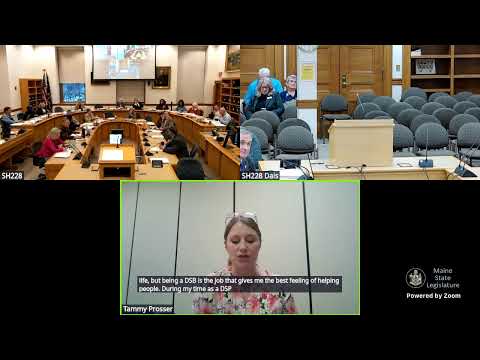
Advocates urge modest funding boost for Maine Developmental Services Oversight and Advisory Board
Loading...
Summary
Members of the Oversight and Advisory Board, parents and advocates told the Appropriations and HHS committees the board has been chronically underfunded and asked for a roughly $58,000 annual increase to hire staff and fulfill statutory oversight duties.
Cullen Ryan, chair of the Maine Developmental Services Oversight and Advisory Board, told the joint Appropriations and Health and Human Services hearing that the board has operated for 16 years with minimal staff and a static budget, and that the supplemental budget’s modest request would allow the board to hire staff to meet its statutory duties. "This will allow DHHS and the 6,000 people served to much more fully benefit from the assembly of talented volunteers," Ryan said in testimony.
The OAB is a 15‑member, statutorily created board charged with reviewing data, analyzing shortcomings and offering systemic recommendations to the Department of Health and Human Services and the legislature. Ryan and other witnesses cited recent statewide figures—the board’s last quarterly report listed 11,498 reportable events in three months and more than 2,300 people on the Section 21 waitlist—to argue that independent oversight is urgently needed.
Bonnie Jean Brooks, interim executive director for the board, described her part‑time pay and the organization’s lack of an office and permanent staff. She said the board’s contract and operating funds have not kept pace with inflation: testimony cited a compounded CPI increase of about 47% since the board’s contract date. Brooks told the committee that the supplemental request would fund a part‑time executive director at a competitive wage and a full‑time program manager.
Witnesses gave somewhat different budget figures for the board’s current baseline. At least two figures were quoted in testimony: "in the neighborhood of $127,000" and $137,682. Committee members noted the discrepancy and asked the department to confirm the exact baseline and how the requested increase would be allocated.
Anne Marie Mayberry and Kim Humphrey, both members or affiliates of OAB, urged the committees to support the funding and a technical language change (part g1) to allow unspent funds to carry forward year to year. Mayberry said the carryforward authority would provide critical cash‑flow flexibility for a board that currently cannot maintain an office or sustain multi‑month work efforts without ad hoc volunteer support.
Advocates framed the requested increase as small relative to the state’s investment in IDD services but large enough to make the OAB operationally effective: "This is a minuscule part of the supplemental budget, but it will much better allow the intention of the statute to be met," Ryan said. Committee members asked clarifying questions about the OAB’s review process, what constitutes a "reportable event," and whether the requested positions were annual or biennial allocations. Department and OAB witnesses said they would provide more detailed budget breakout and documentation at the work session.
Next steps: the hearing record will feed work‑session conversations. Several committee members requested written detail on the board’s current contract, a confirmation of the baseline budget number, and a line‑item explanation of how the supplemental funds would be used if approved.