
Committee rolls disaster-grant procurement bill after debate over procurement exemptions and audit safeguards
Get AI-powered insights, summaries, and transcripts
Subscribe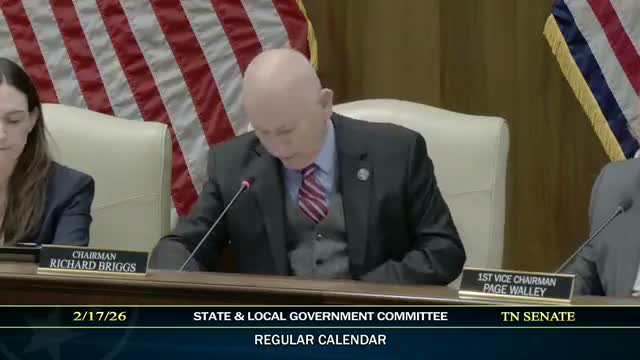
Summary
Senate Bill 17 78, intended to speed disaster grant distribution by exempting some procurement requirements, was rolled one week for further coordination with the Comptroller and TEMA after senators expressed concern the bill would remove statutory guardrails and increase fraud risk.
The State and Local Government Committee deferred action for one week on Senate Bill 17 78 after an extended debate over whether the measure's approach to exempting disaster grants from procurement requirements removes important statutory safeguards.
Senator Crowe, who carried the bill, told the committee the legislation is designed to accelerate disaster relief by allowing counties to avoid long procurement timelines and, in some cases, pledge collateral through the Comptroller's Office. He said the bill "streamlines the distribution of disaster grants by exempting them from the current requirements related to procurement" while placing an audit process through the Comptroller, according to his presentation.
Several senators, including Senator Yarbrough, urged caution. A recurring concern was that the bill "basically exempt[s] them from any statutory requirements" without specifying statutory replacement standards, leaving audits to evaluate compliance after the fact rather than prescribing enforceable procurement guardrails. One committee member, identifying a professional background in fraud training, told the committee that emergency funds without guardrails are "one of the greatest sources of fraud."
Austin Travis, legislative liaison for TEMA (referred to in testimony as "Tema"), explained the procurement rules are built for standard grant competitions and that in a disaster the state cannot reliably pre-specify the number of awards or maximum single-award amounts at the outset; he said the bill removes those pre-specifications while "leaving the audit requirements that all state contracts and state grants have." Comptroller Jason Mompower, who appeared with general counsel Rachel Buckley, said the Comptroller's investigative and audit authority is unchanged and emphasized the difficulty the state faced in past disasters, noting there were "49 steps" in the prior process that delayed relief.
Despite assurances, multiple senators asked whether the bill might waive conflict-of-interest or debarment provisions in procurement statutes, and whether the agency would need to promulgate rules or simply develop internal procedures. To allow the Comptroller, TEMA and government-operations counsel to clarify those issues, the committee moved to roll the bill for one week.
Next steps: Sponsors and staff were asked to coordinate with the Comptroller's Office and government-operations counsel and return with clearer statutory language or procedures before the bill is again considered.