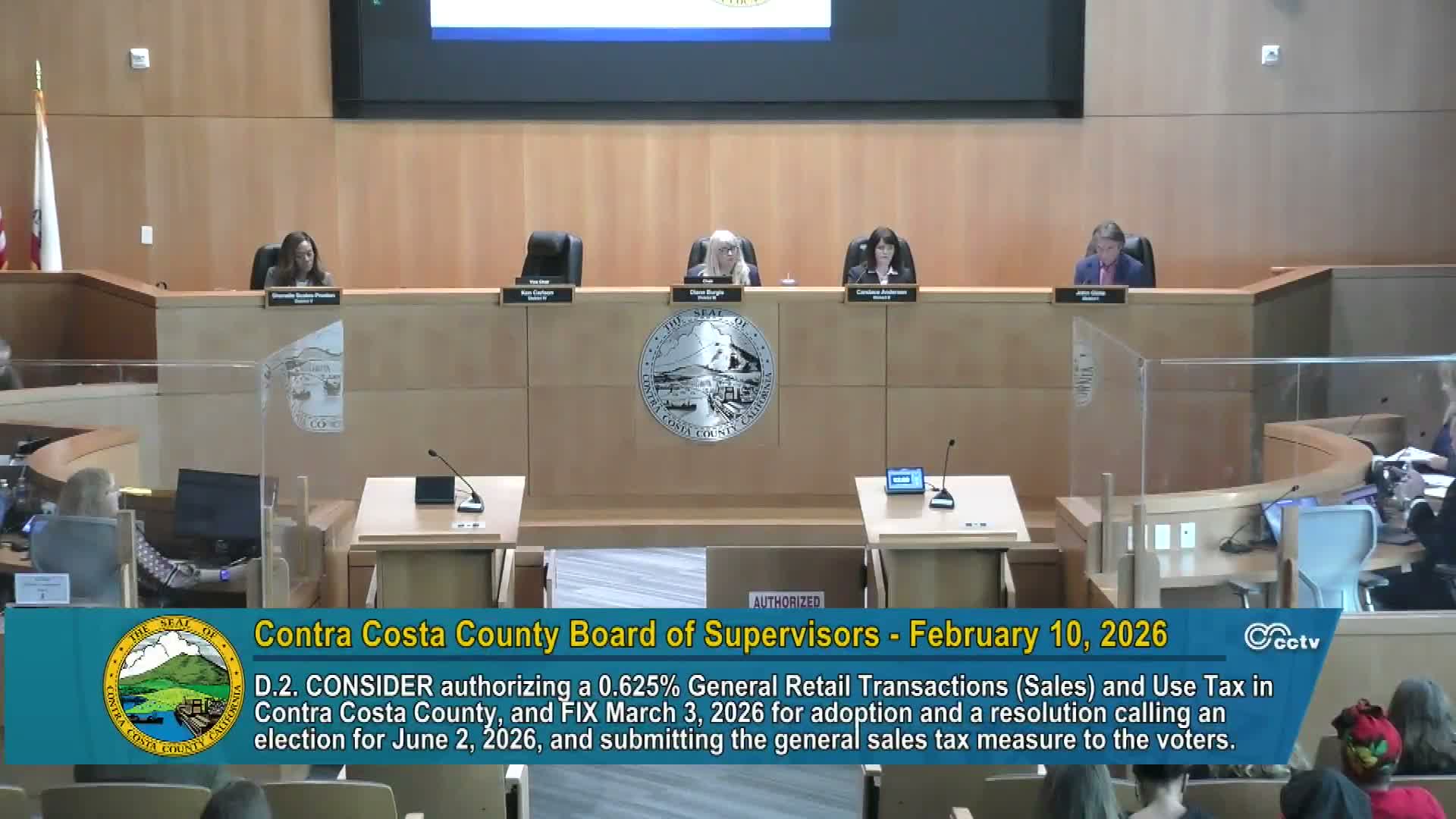
Contra Costa supervisors introduce 0.625% sales tax measure to offset federal cuts; place measure on June ballot
Loading...
Summary
The Contra Costa County Board of Supervisors voted unanimously Feb. 10 to introduce a proposed 0.625% (5/8‑cent) countywide sales tax for five years and set March 3 as the adoption date to allow placement on a June 2, 2026 ballot. County officials said the measure would help "bridge" revenue losses from federal HR1 changes but would not fully close projected healthcare funding gaps.
The Contra Costa County Board of Supervisors voted unanimously Feb. 10 to introduce an ordinance authorizing a 0.625% general retail transactions and use tax, and to set March 3 as the date to adopt the ordinance so it can be filed for the June 2, 2026 election.
County staff said the proposed five‑year measure is intended to help backfill projected reductions in federal funding under HR1 that county leaders said will significantly reduce healthcare and social‑service revenues. Emlen Strickland, presenting for county finance, described the proposal as a "bridge" to reduce harm to services while the county pursues federal and legislative remedies and internal fiscal adjustments.
"The way to look at this tax is really a bridge to try to help us get to a point where we're balancing the budget," county staff said during the presentation. Staff explained a state sales‑tax cap (9.25%) requires special legislation to enact a countywide rate because some cities already exceed that cap; the county is seeking authorization in the Legislature to levy the tax.
Supporters at the meeting included labor leaders and healthcare staff who described the measure as necessary to protect hospitals, eligibility workers and other front‑line services. "Please give voters the chance to help prevent the worst impacts of HR1 in this county," said Sean Stalbaum of IFPTE Local 21. Teamsters representative Matt Finnegan asked the board to "unanimously approve and submit this for the ballot."
Opponents called the tax regressive and urged the county to cut spending instead. Denise Kalm of Contra Costa Taxpayers said the increase would "hurt seniors and people on fixed incomes" and asked the board to reduce internal spending before raising taxes.
County staff and supervisors clarified the measure would not fully restore all projected losses. In response to a question, staff said the estimated healthcare impacts "accrete" to a very large shortfall by year three and described the sales tax as partial mitigation rather than a complete solution. Supervisors also noted that Measure X revenues are committed to other programs and cannot be reallocated to cover the HR1 shortfall.
The board discussion also covered schedule and implementation mechanics: March 3 is the last regular‑meeting date to adopt an ordinance for the June election timetable; the measure must be filed with the registrar of voters by March 6 to meet election‑code deadlines. Staff estimated the earliest county receipts from a new sales tax could arrive several months after the tax begins to be levied.
The motion to introduce the ordinance and set the March 3 adoption date was moved and seconded from the dais and passed unanimously.
Next steps: the board will adopt the ordinance (if the March 3 vote proceeds), file the measure for the June election, and continue state‑level advocacy for the special legislation needed to lift the sales‑tax cap in affected cities. If placed on the ballot, voters — not the board — will decide whether to approve the five‑year measure.