Council Hears Split Public Testimony on Draft Public‑Health Notice Requirement; Debate Centers on Version 3 vs. Version 4
Loading...
Summary
Dozens of residents, business and agency representatives testified on proposed land‑use code amendments to coordinate city permitting with DEQ, EPA and LRAPA. Advocates and LRAPA favor Version 3 (applicant attestation); many businesses prefer Version 4 (notification only). Council requested a memo on the JH Baxter regulatory failure and will take action March 9, 2026.
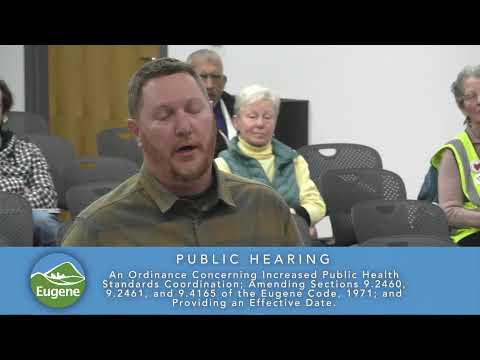
Eugene City Council heard extensive public testimony Feb. 17 on proposed land‑use code amendments intended to improve coordination between city permitting and environmental regulators for development in E2, I2 and I3 zones. The code changes would require the city to provide notice to the U.S. Environmental Protection Agency, Oregon Department of Environmental Quality (DEQ), and the Lane Regional Air Protection Agency (LRAPA) prior to issuing certain development permits; the debate focused on two versions of the proposal.
Proponents of Version 3 — which planning staff and LRAPA recommended — argued it closes a coordination gap by requiring applicants to complete an attestation listing whether their project requires air, land or water permits and to provide contacts for the three agencies. "When this applicant identifies and attests to the environmental permits their project requires, it gives LRAPA the ability to verify those requirements before the facility begins operating without necessary air quality controls," said Travis Knutson, executive director of LRAPA.
Community and environmental justice advocates urged the council to adopt Version 3 to ensure early identification of risks and equitable notice to affected neighborhoods. Eric Richardson of Beyond Toxics cited the Oregon environmental‑justice statute and asked the council to back the version that includes attestations and stronger early information for communities.
Business and economic‑development speakers backed Version 4, which directs city staff to send notice to regulators when an application is submitted but does not require applicant attestations. "Version 4 avoids creating unnecessary land use barriers that discourage investment or job creation," said Joe Liebersbach, a young professional testifying in support of Version 4. Rob Evans, who represents industrial employers, said the ordinance should not be redesigned around the illegal acts of a single operator and argued that regulatory enforcement remains the primary tool for protecting health.
Councilors asked staff detailed questions about scope and mechanics. Reid Verner, land‑use supervisor, said the proposed standard applies to "development permits," a code term that includes building permits, trade permits (electrical, plumbing), site‑development permits and 10‑infill permits, and that the attestation form would provide agency contact information for applicants.
Councilor Clark asked staff for a short memo—ideally within the council's two‑hour rule—describing how the regulatory system failed in the JH Baxter incident and why, so that the council can better understand enforcement gaps before making a final decision. Several councilors emphasized the need for clarity and enforceability and acknowledged limited time before the scheduled March 9 action.
Speakers who testified included planning commissioner Tiffany Edwards, Onward Eugene's Dana Siebert, community leaders from Bethel, industrial business owners, LRAPA's Travis Knutson, and residents representing both public health and business concerns. The Planning Commission recommended the version included in the packet (the record notes a 4–3 vote and an explanatory memo was provided to councilors), and staff reiterated that action on the code amendments is scheduled for March 9.
The council closed the public hearing and will accept written testimony until action is taken. Councilors and staff will continue to refine details about whether attestations will be required, what documentation applicants must provide, and how the city will coordinate with LRAPA, DEQ and EPA.