Get Full Government Meeting Transcripts, Videos, & Alerts Forever!
Get email alerts on the Conservation Policy topic
No spam. Unsubscribe anytime.
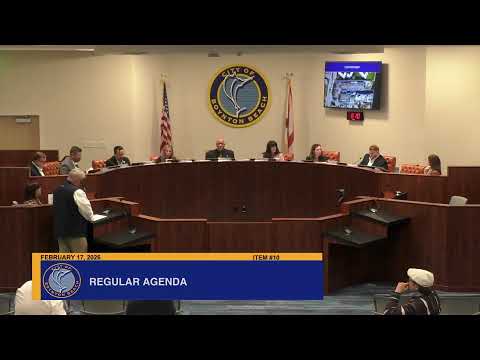
Boynton Beach commission approves first reading for conservation payment‑in‑lieu policy amid concerns
Summary
On first reading, commissioners moved to amend the comprehensive plan to allow payment‑in‑lieu for some conservation lands, 4–1. Staff said the change won’t lower the city’s overall 75% protection target; opponents warned it could weaken on‑site protections and raised mangrove mitigation concerns.
The Boynton Beach City Commission on Feb. 17 approved on first reading Ordinance 26‑005, a proposed amendment to the city’s comprehensive plan conservation element to permit a payment‑in‑lieu option for certain environmentally sensitive lands.
Planning & Zoning Director Kevin Fisher told commissioners the amendment would not change the underlying review criteria but would create a mechanism to fund acquisition or long‑term maintenance of conservation lands. “This could be a potential for that,” Fisher said, describing the payment program as a funding source the city currently lacks.
Several commissioners and members of the public warned about unintended consequences. Commissioner Cruz argued the proposal could weaken environmental protections by allowing developers to pay instead of preserving on‑site habitat: “This proposed amendment weakens the city's existing environmental protections by allowing developers to pay a fee instead of preserving native habitat on‑site,” Cruz said. Opponents repeatedly cited the current policy that requires a minimum of 25% on‑site preservation for the highest‑quality rated ecosystems.
Amanda Radigan, development director, clarified that the amendment would be limited in scope and that the city would retain a city‑wide target: “The requirement for conservation would still remain ... this option is only available if the city itself is still within its overall parameter of 75% sensitive property,” she said, noting state review would follow a commission decision.
Public commenters asked whether mangrove mitigation would be part of the program; staff said the city does not have delegated authority for mangrove mitigation, which would remain subject to other jurisdictions and permitting processes. The ordinance now will be transmitted to the state for review and return to the commission for a second reading; more detailed land‑development regulations and a fee schedule would be developed if the policy change is adopted.
The first‑reading vote passed 4–1, with Commissioner Cruz dissenting.