
VHCB outlines housing pipeline, conservation work and readiness to deploy capital if appropriated
Get AI-powered insights, summaries, and transcripts
Sign Up Free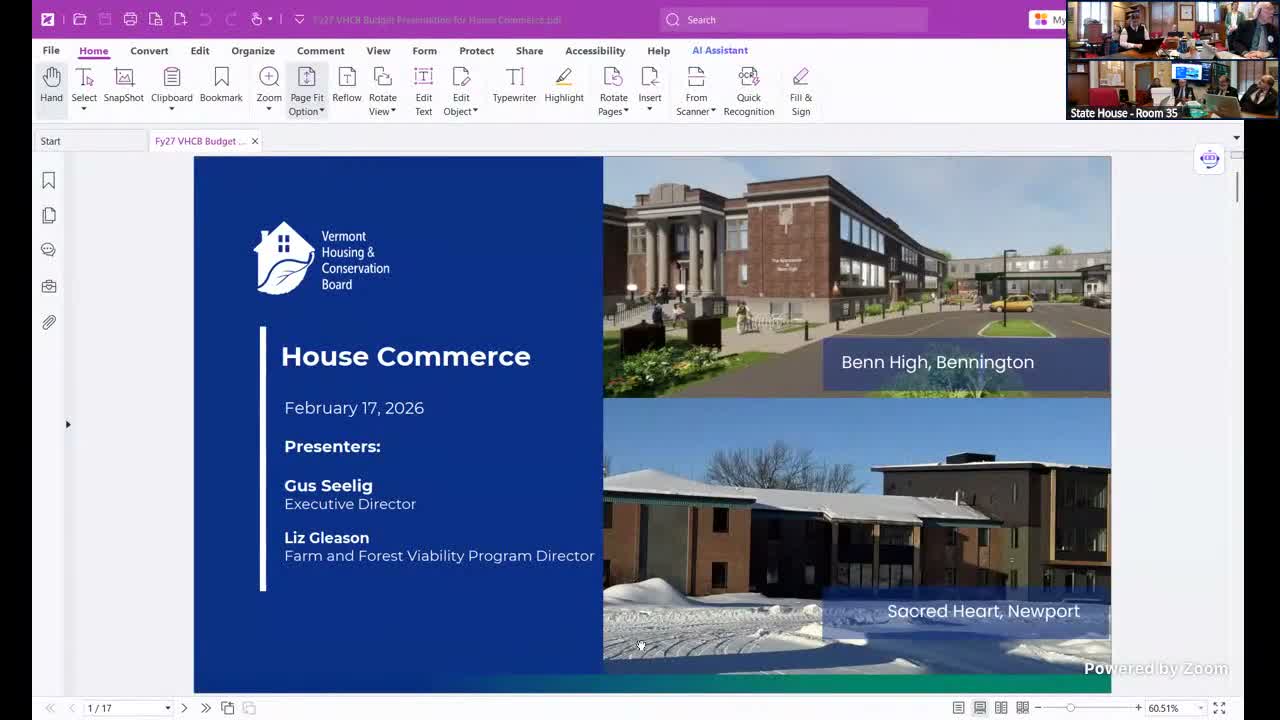
Summary
The Vermont Housing & Conservation Board briefed the committee on housing, conservation, and REDI grant-writing work; VHCB supports the governor's property transfer tax recommendation and highlighted projects converting vacant schools to apartments and investments that yield long-term permanent affordability.
Gus Selig, executive director of the Vermont Housing & Conservation Board, and Liz Gleason, director of the farm and forest viability program, presented an overview of VHCB’s work and budget priorities. Selig described recent projects — converting vacant school buildings to mixed housing, new rental and homeownership projects, and investments in shelter capacity and recovery residences — and noted VHCB’s statutory charge to ensure permanent affordability.
Budget context: Selig said VHCB supports the governor’s property transfer tax recommendation (roughly $37.6 million in testimony) and described how the agency leverages public dollars. He reported that average VHCB investment across a range of activities is about $80,000 per unit when averaged across project types, but that new construction or substantial rehab can cost far more. He also noted the board’s historically strong leverage: targeted investments can protect long‑term affordability and limit future subsidy needs.
Conservation and farm/forest programs: Gleason outlined farm and forest viability and the Rural Economic Development Initiative (REDI), which funds grant writers and technical assistance; she said REDI’s work (estimated state spending of roughly $1.2M since 2017) has helped communities secure about $35.5M in external grant funds. VHCB emphasized collaboration with regional partners and complementary roles with Working Lands and agency programs.
Why it matters: VHCB framed investments as a way to preserve permanent affordability, steward working lands and conservation values, and catalyze community economic activity. The committee did not take formal votes; members asked about statutory allocations from the property transfer tax and VHCB’s prior-year funding patterns.