
New Kent staff unveils draft Technology Overlay District to guide data‑center development
Get AI-powered insights, summaries, and transcripts
Subscribe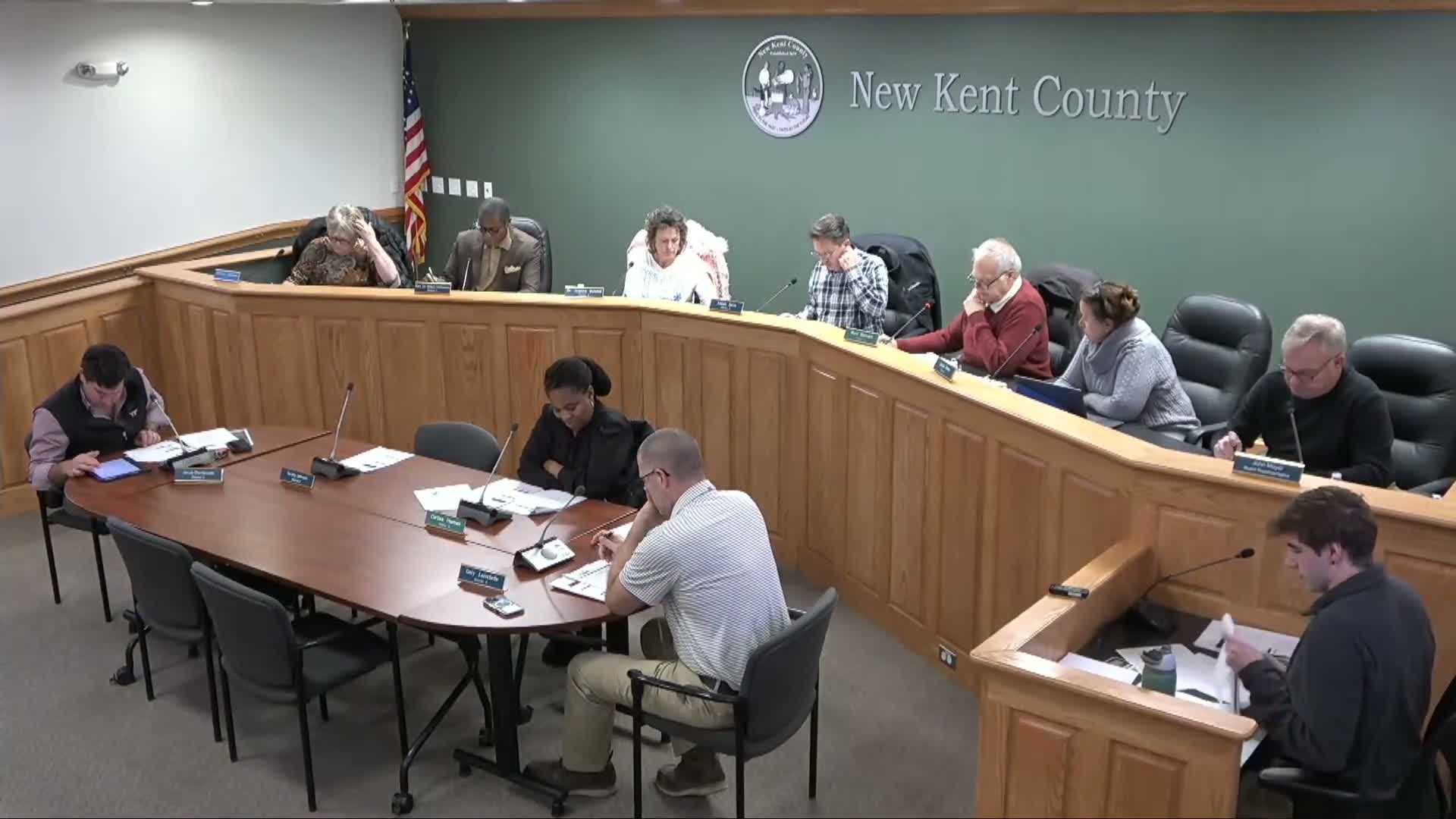
Summary
County staff presented a draft Technology Overlay District focused on data centers in the Route 33 corridor, proposing boundaries, design standards, noise and water rules, and an administrative permit process; commissioners raised questions about public input, water use, generator testing and buffer specificity.
New Kent County staff on Feb. 17 presented a draft Technology Overlay District (TOD) aimed at establishing standards and a boundary to guide potential data‑center development along the Route 33 corridor.
Josh Hiraghi, Director of Community Development, said the overlay is a proactive zoning tool designed so the county can “define the area that we want them” and set standards to mitigate noise, water usage, visual impacts and other concerns before formal applications arrive. The proposed district concentrates primarily along Route 33 and includes an estimated 1,800 gross acres (about 1.3% of county land) and roughly 1,260 net acres after unusable wetlands and RPAs are removed; usable acreage declines further once setbacks and buffers are applied.
Under the draft, data centers located inside the TOD would be subject to an administrative conditional‑use permit (CUP) and site‑plan review rather than separate project public hearings, provided the project meets the overlay standards. Hiraghi summarized key standards: setbacks and screening buffers ranging from 100 to 300 feet depending on adjacent zoning; a planting‑ratio and minimum stock size for buffer plantings; a building‑height limit of 75 feet to roof deck (85 feet including rooftop equipment); lighting restrictions; and signage limits. On noise, staff proposed operational maximums of 65 decibels daytime and 60 decibels at night measured at property lines, required noise impact assessments, and restricted regular generator testing to 9 a.m.–5 p.m. on weekdays while exempting genuine emergency operations.
Hiraghi also addressed cooling and water: the draft encourages closed‑loop or air‑cooled systems and states that “reclaimed water is our preferred water source” for evaporative cooling, and it requires a water‑use analysis to quantify peak and annual demand so the county can plan supply and wastewater capacity. Applicants must provide copies of state and federal permits (e.g., DEQ) for county records.
Several commissioners expressed reservations about the proposed administrative process because it would limit project‑level public hearings for future data‑center projects inside the TOD. One commissioner asked whether the public would lose the opportunity to comment on individual projects; staff responded that exceptions to the overlay and appeals of administrative decisions would still trigger public hearings, and that community outreach (including planned March meetings) will be used to solicit public input on the draft standards before adoption.
Economic development director Lindsey Hurt said the county’s research shows data centers typically employ relatively few workers on site — “50 to 100 people per building” — but those jobs are generally high paying and can diversify the county’s commercial tax base. Commissioners also probed grid and utility impacts, asking whether power lines and substations might need upgrades and how those costs would be allocated; staff noted that Dominion Energy and state regulators address rate and infrastructure issues and that redundancy (power and fiber) is a typical site requirement for data centers.
Hiraghi said the TOD text, map and presentation will be posted on the Planning Division web page and that staff intends community meetings in March 2026, a Planning Commission public hearing in May or June, and Board hearings for potential adoption in June–July 2026. Staff also offered to arrange site visits to existing data centers for commissioners prior to the hearings.
The presentation did not include any formal action by the commission; it served as the introduction of the draft overlay and the start of a public‑engagement process.