
Scott County hears detailed briefing on MNChoices delays, waiver changes and provider payment issues
Get AI-powered insights, summaries, and transcripts
Sign Up Free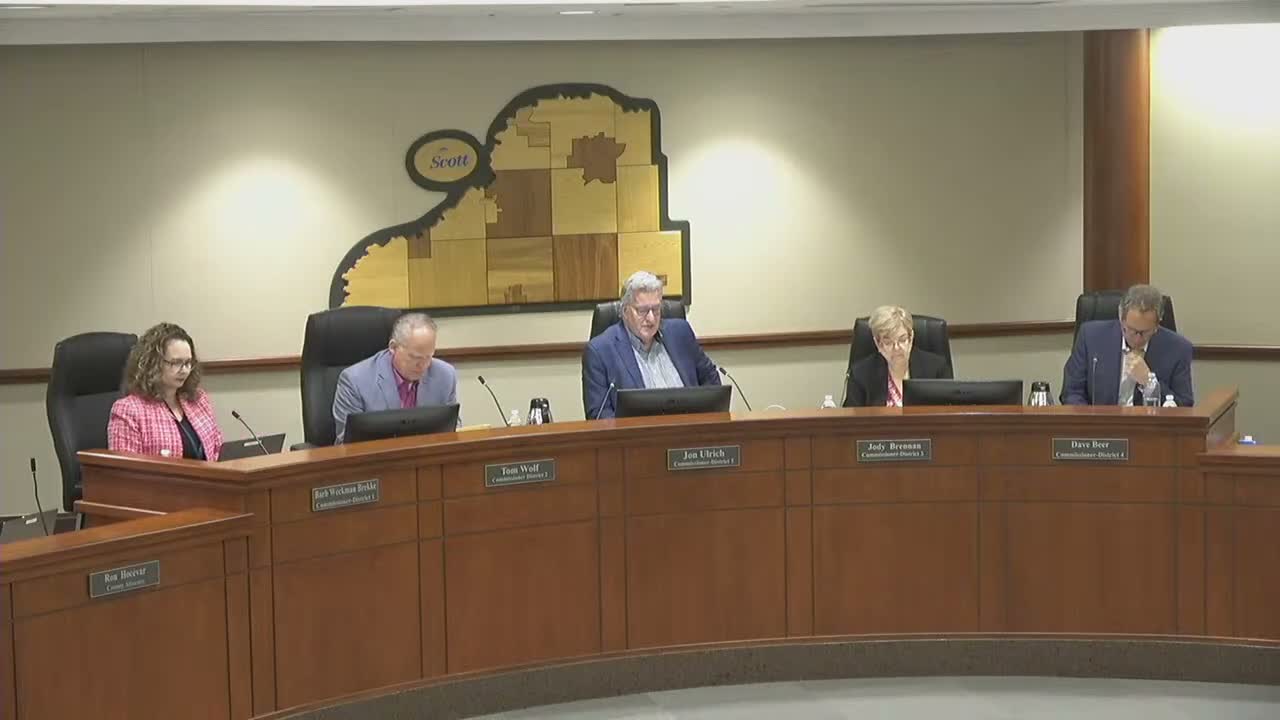
Summary
At its Feb. 17 meeting, the Scott County Board heard a presentation on Minnesota's long-term services and supports system (MNChoices), including assessment delays, DHS prepayment reviews that have paused some provider payments, and an ongoing 'waiver reimagine' process awaiting CMS decisions. Staff and contracted partners emphasized the operational strain and urged clearer state guidance.
At its Feb. 17 meeting, the Scott County Board of Commissioners received an information briefing on Minnesota's long-term services and supports system, focusing on MNChoices assessments, recent DHS payment-review practices and a large waiver amendment awaiting federal approval.
Katie Molica, Scott County quality-improvement lead, introduced a panel of county staff and contracted providers who explained how assessment timing, documentation and federal/state policy changes interact to delay services for some residents.
"Right now, it's an unsustainable system," said Britney Lane, Aging and Disability Services (paraphrase from panel remarks), summarizing presenters' view of the current operating environment as the county adapts to state and federal changes. Panelists said DHS implemented a prepayment review in October intended to improve program integrity; that review has caused some providers to experience delayed payments or to be asked not to provide services while enrollment or billing is reviewed.
Melissa Hurt, a Scott County case-management supervisor, said the county has been notified that five providers have been asked not to continue providing services, a situation that affects roughly 14'15 clients and has prompted county staff to coordinate with case managers and contracted partners to reduce disruption. "We are connecting with case managers, trying to get ahead of the game," Hurt said.
Staff and contractors described the MNChoices assessment process as two parts: an in-home assessment visit and follow-up office work to complete support plans and enroll clients in medical assistance when appropriate. Presenters said initial in-home assessments commonly take two to three hours (sometimes up to four hours), with additional time required to complete paperwork and ensure the plan is person-centered.
The board asked about statutory timelines. Presenters confirmed the 20-business-day target for completing MNChoices assessments originates with DHS statute, but said Scott County and many neighboring counties are not meeting that target; staff reported an approximate four-month waitlist for some assessments. For urgent situations there are expedited pathways: panelists cited average expedited-assessment timelines near 8'9 days for some prioritized criteria and 15 days for hospital discharges.
The group discussed federal changes affecting retroactive medical-assistance reimbursement. Panelists said nursing-home admissions that occur before assessments may receive retroactive MA only once eligibility and the MNChoices assessment are completed; federal policy changes have shortened prior retroactive periods (panelists described a reduction from three months to two months), which has increased pressure on providers and counties.
County staff also described increased reliance on contracted case-management agencies to handle volume. Contracted partners said they are expanding staff to meet Scott County demand but face planning challenges when assessment and consultation volumes fluctuate seasonally. Contractors and county leads emphasized quality checks (support-plan audits, timeline checks and file reviews) but noted turnover at some vendors is a limiting factor.
Panelists repeatedly asked for clearer, more consistent written guidance from DHS and for steps that would reduce duplication and reassessment burden. Several speakers supported moving to less frequent MNChoices reassessments for people with stable, long-term conditions (for example, changing annual reassessments to a longer interval for certain age ranges), while preserving case-manager contact and yearly support-plan updates.
County staff warned that a large '191-page waiver amendment from DHS requires CMS approval before counties know which portions will be implementable; until CMS and DHS publish final policy and forms, counties remain in a holding pattern.
No formal board action was taken on the presentation; commissioners thanked staff and panelists and asked to be kept apprised of legislative and CMS developments affecting assessment timelines, payment integrity processes and county budget exposure.