
Community action agencies ask Vermont House for $1.15M to expand micro‑business, tax and financial coaching services
Get AI-powered insights, summaries, and transcripts
Sign Up Free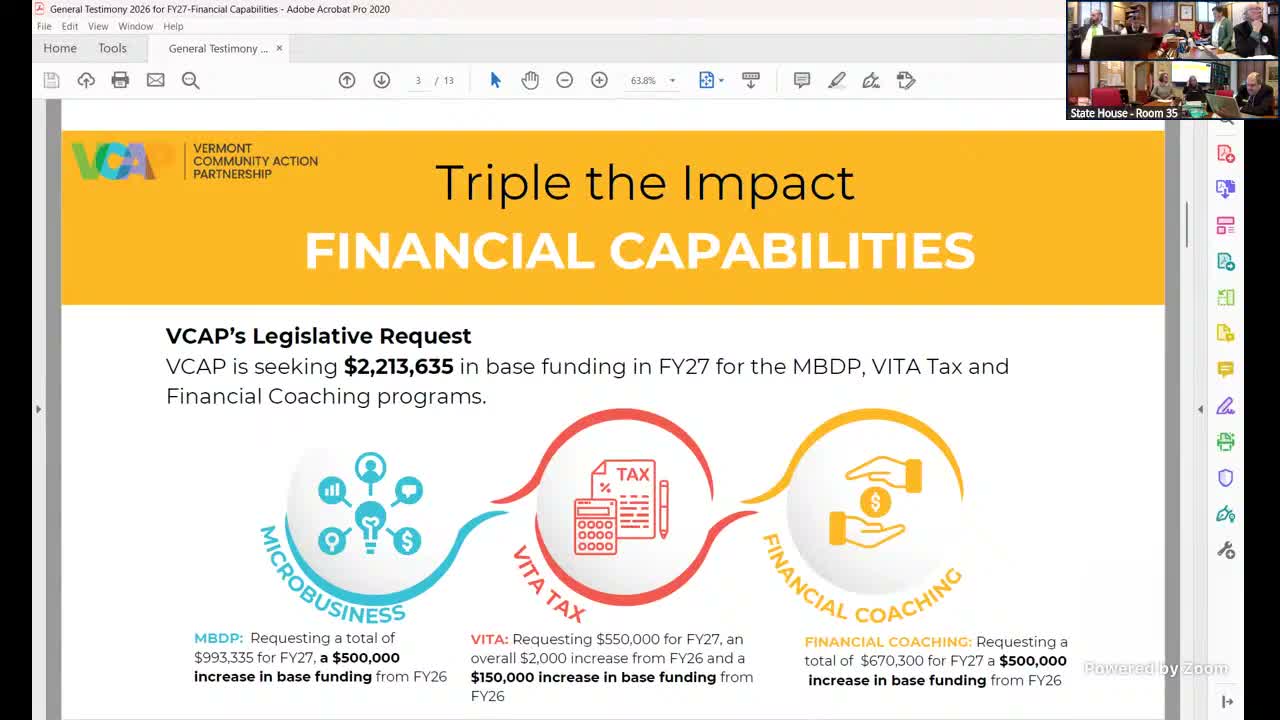
Summary
Capstone Community Action told the Vermont House Committee on Commerce & Economic Development on Feb. 17 that community action agencies are seeking $1.15 million in additional state funding to bolster micro‑business development, the VITA tax‑assistance program and statewide financial coaching; committee members asked for statewide intake and waitlist data before recommending appropriations.
Representatives from Capstone Community Action urged the Vermont House Committee on Commerce & Economic Development on Feb. 17, 2026, to increase state funding for programs that support micro‑businesses, tax filing assistance and financial coaching, saying the services help low‑income Vermonters move out of poverty and can lead to business starts and jobs.
"We are coming to the legislature this year to ask. We have a big ask for micro business, which is an increase of about $500,000 above the base," said Liz Scharf, director of community economic development and food security at Capstone Community Action. Scharf outlined a three‑part request that seeks an additional $500,000 for micro‑business development (above a current base of $493,000), a $150,000 increase for the Volunteer Income Tax Assistance (VITA) program (to $550,000) and $500,000 in base funding for financial coaching — a total additional request of about $1.15 million.
The presenters described measurable outcomes they say the funding would expand. Scharf told the committee that Capstone’s VITA work contributed to more than $5 million in tax refunds returned to the community in 2025 and roughly $2,400,000 in tax credits, and that the statewide VITA effort relies heavily on volunteers ("115 volunteers, averaging 70 hours per volunteer") and completed just over 5,000 returns last year. "We do, no charge tax prep and filing for people who make $69,000 or less," she added when explaining income eligibility for VITA.
Rosie Gray, a financial and business coach at Capstone, described the financial coaching and micro‑business programs as tightly linked: financial coaching often precedes business work, and coaching and classes ("Money Moves") provide budgeting, credit and bookkeeping help. Gray reported program metrics including about 664 clients accessing micro‑business coaching last year, 77 new business starts, 35 business expansions, roughly $524,000 in capital accessed by about 50 businesses, and 52 new full‑time jobs created.
Gray also described demand: after moving to an online intake process, she said Capstone recorded about 204–205 intakes in the past 11 months and estimated roughly 350–370 people reached out for micro‑business or financial coaching during recent periods. Scharf said other Community Action agencies show similar patterns when they have full‑time staff and noted that CDOEO currently has a roughly four‑week waitlist for micro‑business coaching.
Committee members pressed for statewide, comparable data before endorsing the funding request. "We like to look at data," one committee member said, asking the presenters to compile intake and waitlist numbers across all five community action agencies to show whether ramping staff from 0.3 FTE to 1.0 FTE per agency is warranted. Amy Scholberger offered to supply a one‑page statewide impact summary and pointed to a statistic that just over 22.5% of Vermonters face income volatility — a potential indicator of need for asset‑building services.
Presenters also outlined referral relationships with other providers: AARP handles many older filers, the Vermont Small Business Association offers services for certain small businesses, and United Way workplace programs sometimes provide supplemental counseling; community action agencies said they coordinate referrals to reduce duplication and preserve trust with vulnerable clients.
The committee did not take action on the request during the session. Presenters agreed to gather and submit the comparative intake, waitlist and staffing data the committee requested; the committee recessed for lunch and indicated it would consider the pending appropriation request when the additional numbers are available.