Get Full Government Meeting Transcripts, Videos, & Alerts Forever!
Get email alerts on the Chesapeake Bay Exceptions topic
No spam. Unsubscribe anytime.
Planning Commission reviews four Chesapeake Bay Act exception applications for shoreline properties
Summary
At an Aug. 25 Westmoreland County Planning Commission work session, staff presented four Chesapeake Bay Act exception requests for properties within resource protection areas; applicants proposed infiltration chambers, planting units and other mitigation, and staff said exceptions are required before permitting.
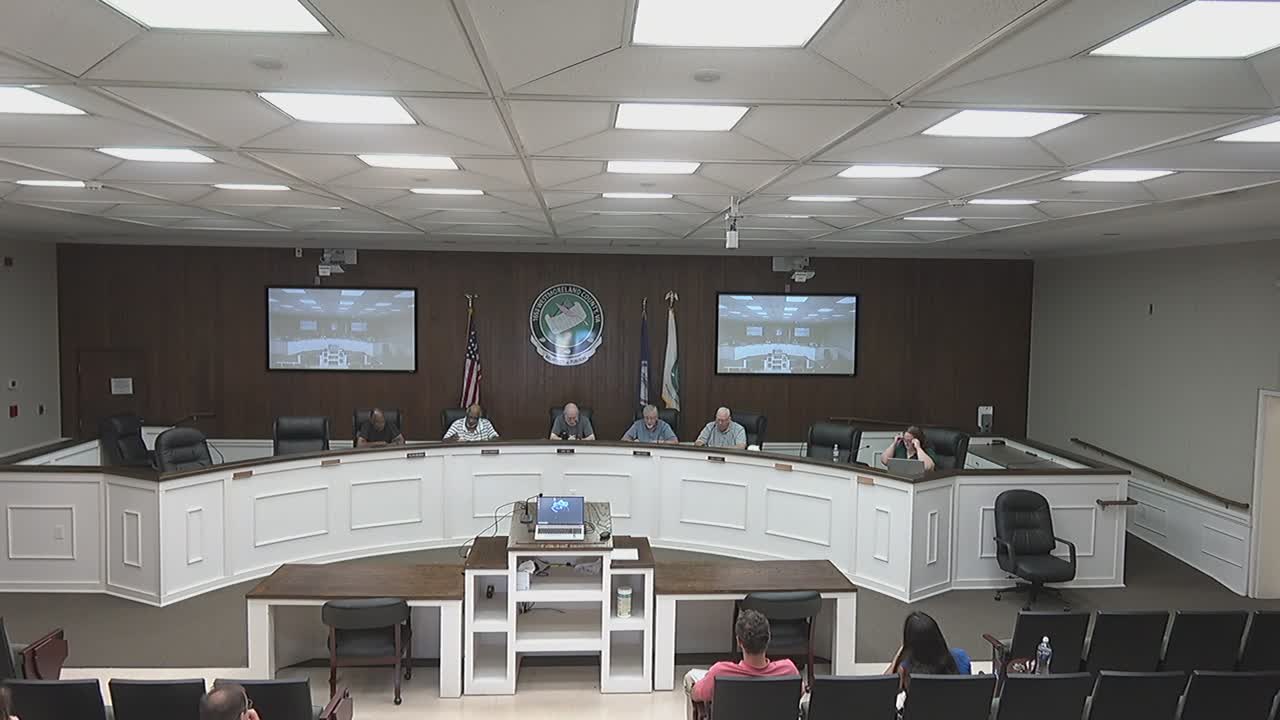
The Westmoreland County Planning Commission spent the bulk of its Aug. 25 work session reviewing four separate Chesapeake Bay Act exception requests for single-family and accessory construction on shoreline parcels, staff said.
Staff presenter Richard Stewart Jr. told commissioners that the applications are required because the entirety or a portion of each proposed project would fall inside the county's 100-foot resource protection area (RPA) and, in most cases, within the seaward 50-foot buffer. "The entirety of their proposed expansion will be within the 100 foot resource protection area," Stewart said when introducing case 2509-CBAE-07 for an expansion at 554 Ships Row, Montross. He added that the expansion would bring the deck about 10 feet closer to mean high water than the existing deck.
The applicants proposed several mitigation measures. An agent who identified himself in the meeting packet as Jeff Mentor and who answered commissioners' technical questions said the project includes infiltration chambers and planting beds under and around the deck. "We're treating more than...we're also proposing infiltration chambers," Mentor said. He told the commission the team is "treating more than way more than needs to be treated" and kept additional planting and stone measures to mitigate runoff and erosion.
Other projects presented included a replacement dwelling at 608 Narrows Beach Road (case 2509-CBA8-08), a new home off Fairway Lane (case 2509-CBAE-09) and a proposed 1,701-square-foot home on Shore Drive in Colonial Beach (case 2509-CBAE-10). Staff described the Narrows Beach parcel as a narrow peninsula with water on both sides; the replacement dwelling would increase impervious area by roughly 244 square feet, staff said. For the Fairway Lane property, staff noted the lot was subdivided in 1975 and adjusted in 1998, creating a post-1989 lot that requires an exception despite the proposed structure's modest footprint.
The Shore Drive application abuts a field-delineated marsh in Monroe Bay. Staff said applicants propose a level-2 bioretention filter with about 177 cubic feet of capacity and six planting units (33 individual plants listed), and that combined with existing on-site vegetation the plan would exceed required planting units. Commissioners asked staff to confirm that applicants had pulled proposed footprints as far forward as setbacks allow to reduce encroachment into the 50-foot buffer; staff agreed to require that adjustment before permitting if feasible.
No formal decisions or recorded votes on any of the exception requests appear in the transcript of the work session. Staff repeatedly emphasized that Chesapeake Bay Act exceptions must be approved prior to permitting and that some plan refinements (for example, moving a footprint forward to reduce buffer encroachment) would be requested during plan review. Several commissioners asked technical questions about roof capture, downspouts and drainfield configuration; staff and the applicants provided responses during the meeting.
Next steps: staff said cases would proceed through the normal review and permitting process; where applicants commit to design changes to reduce buffer impacts, staff indicated those adjustments should be made prior to permitting.