Get Full Government Meeting Transcripts, Videos, & Alerts Forever!
Get email alerts on the Tax Increment Financing topic
No spam. Unsubscribe anytime.
California webinar explains how tax‑increment districts can unlock housing and climate infrastructure
Summary
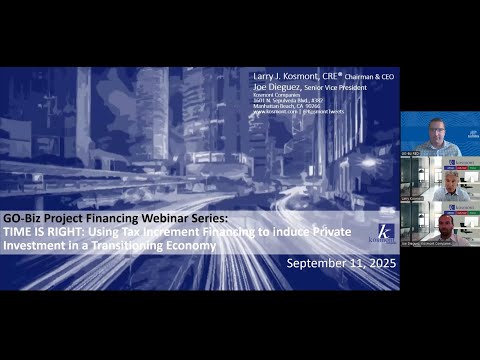
A GoBiz webinar led by Brian Coleman with presenters from Kosmot Companies explained how California cities and counties can use tax‑increment financing (TIF) — including EIFDs and Climate Resilience Districts — together with zoning and grants to attract private investment while addressing community trust and near‑term cash‑flow gaps.
Brian Coleman, project financing manager with the Governor’s Office of Business and Economic Development, hosted a webinar on using tax‑increment financing as a tool for local economic development and housing production.
Speakers Larry Kosmot and Joe Digas of Kosmot Companies urged jurisdictions to treat tax increment as one element in a broader value‑capture strategy that pairs zoning, grant funding and other public financing. "It's not just tax increment or TIF district," Kosmot said, framing TIF as part of a three‑part toolkit of tax increment, zoning as currency and other public money.
Why it matters: Presenters said TIF can unlock private investment for multifamily housing, industrial distribution and climate‑resilience projects at a moment when capital costs, material prices and market uncertainty have slowed many developments. Joe Digas noted that TIF does not create a new tax; instead, it earmarks a share of future assessed‑value growth. "You're not adding a new tax," Digas said. "You're saying a piece of my future tax that will come from this district." The presenters said that capacity to pair TIF with near‑term financing (community facilities districts, grants or private advances) is essential because TIF revenues typically arrive only after assessed‑value growth materializes.
Details: The webinar reviewed the statutory evolution and options available in California. Digas traced the history from Prop. 18 (1952) and the post‑redevelopment gap to SB 628 (2014), which reintroduced tax‑increment tools as Enhanced Infrastructure Financing Districts (EIFDs). Presenters highlighted newer options such as Climate Resilience Districts (CRDs) and a proposed disaster‑recovery district under SB 782, and flagged bills discussed during the presentation. They emphasized that districts require an infrastructure financing plan, public notice and hearings, and that the law provides a final majority‑protest process for landowners and residents within the district boundary.
Community concerns and oversight: An attendee raised concerns that redevelopment historically disenfranchised populations. The presenters acknowledged the history and said the new district forms include governance and transparency measures designed to address past harms, including requirements for public hearings, mailed notices (and increasingly translated notices), and representation on governing boards. Digas described a recent majority‑protest effort in which opponents argued the financing plan did not emphasize affordable housing enough; he said that demonstrates the importance of defensible fiscal analyses and explicit affordable‑housing commitments in the infrastructure financing plan.
Examples and scale: Presenters offered examples across city sizes — Placentia and Pittsburg for city EIFDs, Fresno for a larger urban EIFD, and Mount Shasta for a small city — showing the range of district sizes and priorities (streetscape, transit, housing, utilities). They described alternative financing formats — EIFD tax‑exempt bonds, community facilities districts (CFDs) that generate immediate special tax revenues, and private sector advances reimbursed by future increment — and urged jurisdictions to design deals to meet the "but‑for" test: investments should catalyze development that would not happen (or would be significantly delayed) but for the district.
Next steps and resources: Presenters urged jurisdictions to develop clear business plans, engage communities early, prepare fiscal‑impact analyses for partners (especially counties and special districts), and identify early public dollars to bridge cash‑flow timing. Coleman said slides and the recording will be posted to the GoBiz YouTube channel and noted future webinar sessions on state financing sources.
The webinar closed with contact information for the presenters and a reminder that the program materials and recording will be shared with registrants.