Get Full Government Meeting Transcripts, Videos, & Alerts Forever!
Get email alerts on the Capti topic
No spam. Unsubscribe anytime.
California releases draft Climate Action Plan for Transportation Infrastructure to align investment with climate, equity and resilience goals
Summary
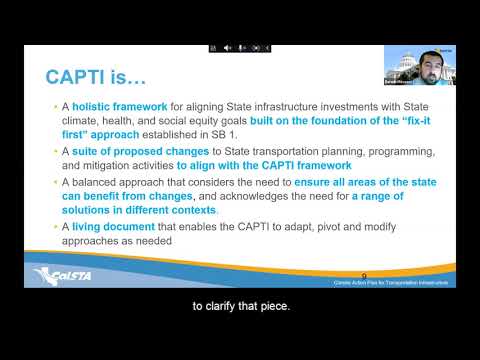
CalSTA released the draft Climate Action Plan for Transportation Infrastructure (CAPTI), a framework of seven strategies and roughly 30 actions to steer $5 billion in discretionary transportation spending toward lower emissions, resilience and equity; agencies will accept written comments through May 4 and aim to finalize the plan by July 15, 2021.
California officials on Wednesday released the Climate Action Plan for Transportation Infrastructure (CAPTI), a statewide framework that aims to align transportation programming and discretionary spending with the state’s climate, equity and resilience goals.
Secretary David Kim said the plan responds to the "climate crisis" and noted that "more than 50% of California's greenhouse gas emissions comes from the transportation sector," placing the transportation system at the center of the state's strategy to reduce emissions. Kim highlighted recent climate damage to Highway 1 as evidence of rising physical risks and said that vehicle technologies alone will not meet the state's targets; policies to encourage mode shift and reduce vehicle miles traveled (VMT) are also needed.
Darwin, the agency presenter for the draft, described CAPTI as a planning and programming framework developed over roughly 18 months by multiple state agencies. The plan identifies seven strategy areas and "approximately 30 actions" intended to improve how state transportation funds are pruned and used. Darwin said the executive order that directed the effort called for leveraging roughly $5,000,000,000 of discretionary transportation infrastructure spending and set a public‑comment period that closes May 4, with a target to adopt the plan by July 15, 2021.
State partners on the panel described how their agencies would support or implement CAPTI recommendations. Jeanne Ward Waller of Caltrans said the department is listed as a lead or supporting agency for nearly every action and flagged work that Caltrans will prioritize, including using the Interregional Transportation Improvement Program (ITIP) to expedite early project phases aligned with CAPTI goals, advancing an integrated travel project to support transit recovery, developing a transportation equity index and convening a roadway pricing working group.
Matthew Osgott of the California Transportation Commission (CTC) said CAPTI’s strategies map to the CTC’s climate, equity and active‑transportation priorities and noted near‑term opportunities to incorporate CAPTI recommendations into upcoming SB 1 program guideline updates and competitive program cycles. He also underscored technical assistance to broaden participation in funding programs.
Jennifer Gress of the California Air Resources Board (CARB) said CAPTI complements CARB work including mobile‑source regulation and the Sustainable Communities strategy, and pointed to a CARB report finding that GHG from VMT had not declined as hoped since SB 375. CARB and other agencies supported the proposal for annual joint meetings (CARB, CTC, HCD) to track CAPTI progress.
Josh Rosa of Housing and Community Development (HCD) framed CAPTI’s land‑use objectives as central to reducing VMT and affordability burdens, citing a statewide housing assessment that found nearly half of households pay more than 30% of income on housing and that transportation costs average above 20% of income in many counties. Egon Turpin (Strategic Growth Council/OPR) urged tailoring CAPTI implementation to regional conditions and emphasized a just‑transition approach that seeks high‑quality jobs alongside climate outcomes.
Panelists repeatedly stressed that CAPTI is intended to work within existing statutory program directions rather than to reallocate funds outside legal constraints. The plan lists recommended actions for agencies (CalSTA, Caltrans, CTC and others) and asks partners to identify programmatic approaches that produce more climate‑oriented outcomes while honoring existing statutes such as SB 1.
Officials said materials and a recording will be posted on the CalSTA website after ADA remediation; written public comments are invited through May 4 at the email address on the CAPTI page. The agencies plan follow‑up workshops and joint meetings to review implementation and monitoring steps.
The workshop closed with an announcement of a forthcoming FAQ document to address outstanding questions and additional opportunities for stakeholder engagement before the public comment period ends.